
Sign in
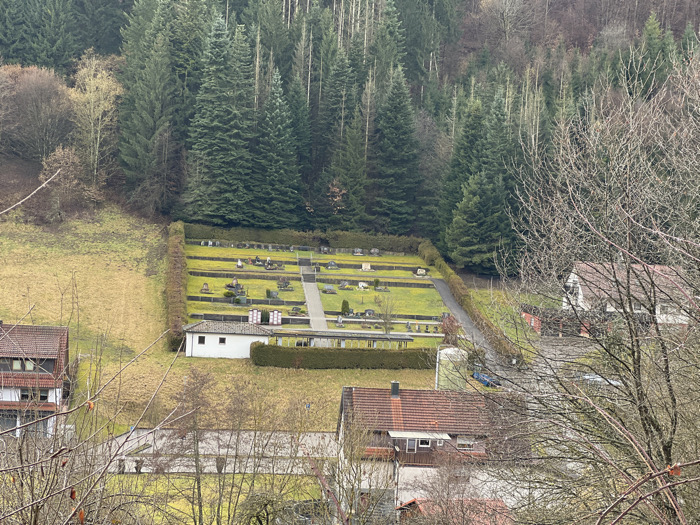
This image captures a panoramic view of a hillside landscape, focusing on a terraced cemetery nestled amidst natural and built environments. The scene appears to be set in a rural or semi-rural area, likely during late autumn or winter, given the sparse, bare branches of deciduous trees in the foreground and on parts of the hillsides, contrasting with the evergreen conifers. The lighting suggests an overcast day, providing soft, even illumination.

At the center of the image, the cemetery is meticulously arranged on multiple levels, following the natural slope of the hill. Each terrace is lined with neatly trimmed green hedges, separating sections of graves. A central paved pathway ascends through the cemetery, connecting the different levels. Numerous gravestones and memorials are visible, some standing upright, others laid flat, scattered across the manicured green grass plots. At the bottom edge of the cemetery, a small, white rectangular building with two prominent windows is visible, possibly a chapel or utility building. Adjacent to it on the right is another structure with a distinctive metal or translucent roof, suggesting a shelter or storage area.

Above and behind the cemetery, the hillside is densely covered with a forest of tall, dark green coniferous trees, dominating the upper background and extending towards the left. To the left of the cemetery, the hillside is a mix of drier, light brown and green grassy fields, dotted with some smaller, leafless trees and shrubs.

In the foreground and scattered across the lower parts of the hillside, several houses are visible. These houses typically feature pitched roofs with red or brownish tiles, and light-colored facades, characteristic of Central European architecture. One prominent house is seen in the lower left, with a red-tiled roof and visible windows. Another house is partially obscured by bare branches in the lower right, also with a red-tiled roof. Further down the hill, more roofs and parts of buildings are visible through the skeletal branches of foreground trees. A narrow, paved road or path can be seen winding uphill to the right of the cemetery.

The overall impression is one of tranquility and order, with the structured cemetery contrasting with the wilder natural landscape of the forest and the functional presence of scattered dwellings. No human activity is visible, making the scene appear still and contemplative.
Gvantsa

Feb 23, 2026

Wüstenrot, Germany

Stake attention in this memory

cemetery
forest
houses
hillside
trees

This image captures a panoramic view of a hillside landscape, focusing on a terraced cemetery nestled amidst natural and built environments. The scene appears to be set in a rural or semi-rural area, likely during late autumn or winter, given the sparse, bare branches of deciduous trees in the foreground and on parts of the hillsides, contrasting with the evergreen conifers. The lighting suggests an overcast day, providing soft, even illumination. At the center of the image, the cemetery is meticulously arranged on multiple levels, following the natural slope of the hill. Each terrace is lined with neatly trimmed green hedges, separating sections of graves. A central paved pathway ascends through the cemetery, connecting the different levels. Numerous gravestones and memorials are visible, some standing upright, others laid flat, scattered across the manicured green grass plots. At the bottom edge of the cemetery, a small, white rectangular building with two prominent windows is visible, possibly a chapel or utility building. Adjacent to it on the right is another structure with a distinctive metal or translucent roof, suggesting a shelter or storage area. Above and behind the cemetery, the hillside is densely covered with a forest of tall, dark green coniferous trees, dominating the upper background and extending towards the left. To the left of the cemetery, the hillside is a mix of drier, light brown and green grassy fields, dotted with some smaller, leafless trees and shrubs. In the foreground and scattered across the lower parts of the hillside, several houses are visible. These houses typically feature pitched roofs with red or brownish tiles, and light-colored facades, characteristic of Central European architecture. One prominent house is seen in the lower left, with a red-tiled roof and visible windows. Another house is partially obscured by bare branches in the lower right, also with a red-tiled roof. Further down the hill, more roofs and parts of buildings are visible through the skeletal branches of foreground trees. A narrow, paved road or path can be seen winding uphill to the right of the cemetery. The overall impression is one of tranquility and order, with the structured cemetery contrasting with the wilder natural landscape of the forest and the functional presence of scattered dwellings. No human activity is visible, making the scene appear still and contemplative.

transactions
revenues
stakers
Earliest
Latest
Highest stake

No transactions found

More from this user

More from Wüstenrot

Gvantsa

Feb 23, 2026

Wüstenrot, Germany

Licensed under Creative Commons Attribution 4.0 International License. You are free to share and adapt this content with proper attribution.