
Sign in
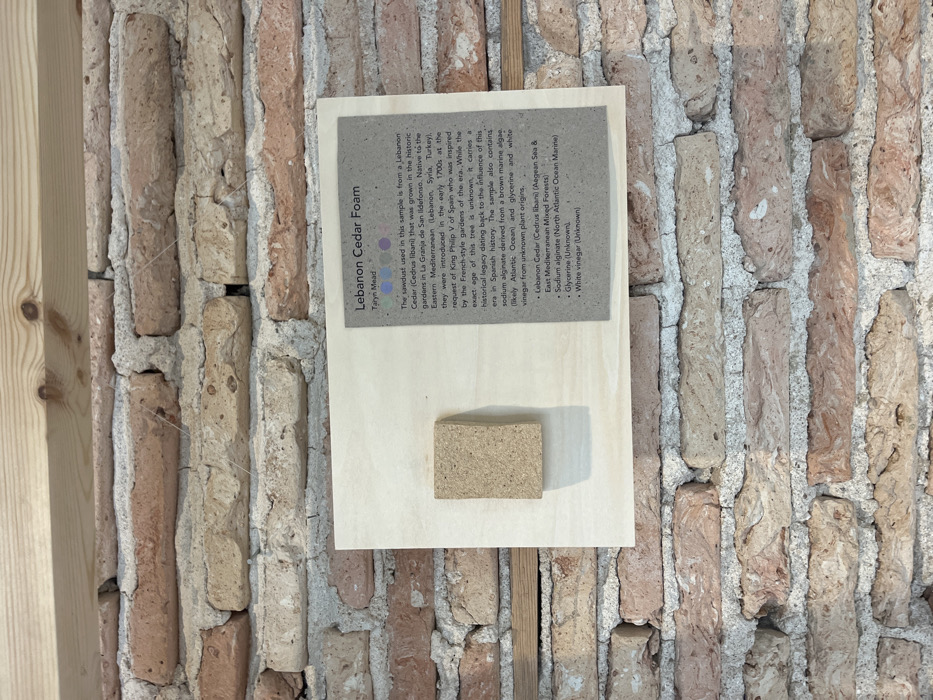
The image displays an exhibit featuring a sample of "Lebanon Cedar Foam" by Taryn Mead, likely located in Segovia, Spain. A small, rectangular, light brown, porous block, representing the foam, is presented on a light-colored wooden plank. Above the sample, a gray cardstock label provides detailed information.

The text on the label explains that the sawdust for the sample originates from a Lebanon Cedar (Cedrus libani) tree grown in the historic gardens of La Granja de San Ildefonso. These cedars, native to the Eastern Mediterranean, were introduced in Spain in the early 1700s at the request of King Philip V. The label highlights the tree's historical significance in Spanish history, though its exact age is unknown. The foam also contains sodium alginate from brown marine algae (likely Atlantic Ocean), and glycerine and white vinegar from unidentified plant sources. A bulleted list reiterates the components: Lebanon Cedar (Cedrus libani) from Aegean Sea & East Mediterranean Mixed Forests, Sodium alginate from North Atlantic Ocean Marine, and Glycerine and White vinegar of unknown origin.

The display is mounted on a rustic wall composed of irregular, light-colored bricks with thick, rough mortar joints. A vertical wooden beam is visible on the left side of the frame. The setting suggests an indoor environment, possibly a museum or historical building, with a focus on historical materials or natural resources.
FM-YafwI3

Feb 22, 2025, 2:33 PM

Segovia, Spain

Stake attention in this memory

The image displays an exhibit featuring a sample of "Lebanon Cedar Foam" by Taryn Mead, likely located in Segovia, Spain. A small, rectangular, light brown, porous block, representing the foam, is presented on a light-colored wooden plank. Above the sample, a gray cardstock label provides detailed information. The text on the label explains that the sawdust for the sample originates from a Lebanon Cedar (Cedrus libani) tree grown in the historic gardens of La Granja de San Ildefonso. These cedars, native to the Eastern Mediterranean, were introduced in Spain in the early 1700s at the request of King Philip V. The label highlights the tree's historical significance in Spanish history, though its exact age is unknown. The foam also contains sodium alginate from brown marine algae (likely Atlantic Ocean), and glycerine and white vinegar from unidentified plant sources. A bulleted list reiterates the components: Lebanon Cedar (Cedrus libani) from Aegean Sea & East Mediterranean Mixed Forests, Sodium alginate from North Atlantic Ocean Marine, and Glycerine and White vinegar of unknown origin. The display is mounted on a rustic wall composed of irregular, light-colored bricks with thick, rough mortar joints. A vertical wooden beam is visible on the left side of the frame. The setting suggests an indoor environment, possibly a museum or historical building, with a focus on historical materials or natural resources.

Loading AttnAds…

transactions
revenues
stakers
Earliest
Latest
Highest stake

No transactions found

More from this user

More from Segovia

FM-YafwI3

Feb 22, 2025, 2:33 PM

Segovia, Spain

Licensed under Creative Commons Attribution 4.0 International License. You are free to share and adapt this content with proper attribution.