
Sign in
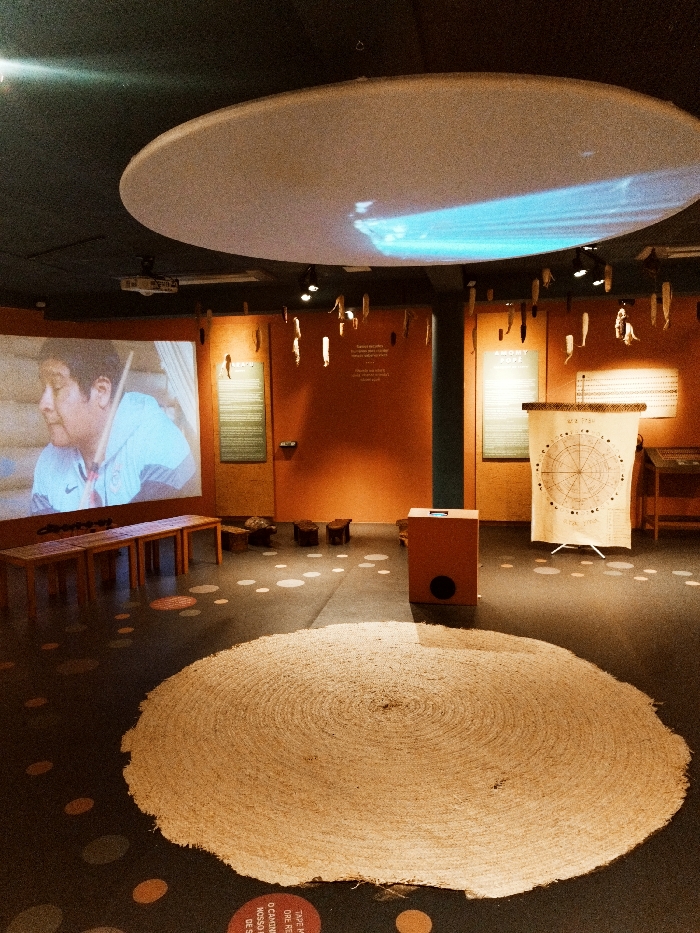
This image captures an interior view of an exhibition space within the Museu das Culturas Indígenas (Museum of Indigenous Cultures), located in São Paulo, Brazil. The environment is dimly lit, with specific areas illuminated to highlight exhibits.

The space features a dark ceiling, brown-orange walls, and a dark floor marked with light-colored circular patterns. A large, circular mat woven from natural fibers, approximately 2-3 meters in diameter, dominates the foreground floor.

On the left wall, a large projection screen displays a medium shot of an adult male. He possesses dark hair, a light complexion, and wears a light-colored (likely white or pale blue) short-sleeved shirt with a small, dark emblem on the left chest. He is observed looking to his left, with a neutral facial expression. Three elongated, simple wooden benches are positioned in a linear arrangement in front of this projection.

Along the mid-ground walls, multiple rectangular informational panels are mounted, one of which prominently displays the text "AMOMY POPE". From the ceiling in the central area, numerous small, dried, natural objects resembling corn cobs or similar organic materials hang at various heights. Several low, cylindrical wooden stools are arranged on the floor in the mid-center. A tall, light-brown, rectangular display stand or kiosk, featuring a circular opening near its base, is centrally located. To its right, a large white banner or scroll, depicting a complex circular diagram with radial lines and symbols, is presented on a freestanding mount.

Overhead, a large, flat, circular white disc is suspended from the dark ceiling. A projector, visible on the ceiling, casts a light-blue, abstract visual onto this disc. No individuals are present or actively interacting with the exhibits within the frame.
Mrv

Aug 28, 2025, 5:11 PM

São Paulo, Brazil

Stake attention in this memory

Cultural
Contemplative
Historical
Serene
Introspective

This image captures an interior view of an exhibition space within the Museu das Culturas Indígenas (Museum of Indigenous Cultures), located in São Paulo, Brazil. The environment is dimly lit, with specific areas illuminated to highlight exhibits. The space features a dark ceiling, brown-orange walls, and a dark floor marked with light-colored circular patterns. A large, circular mat woven from natural fibers, approximately 2-3 meters in diameter, dominates the foreground floor. On the left wall, a large projection screen displays a medium shot of an adult male. He possesses dark hair, a light complexion, and wears a light-colored (likely white or pale blue) short-sleeved shirt with a small, dark emblem on the left chest. He is observed looking to his left, with a neutral facial expression. Three elongated, simple wooden benches are positioned in a linear arrangement in front of this projection. Along the mid-ground walls, multiple rectangular informational panels are mounted, one of which prominently displays the text "AMOMY POPE". From the ceiling in the central area, numerous small, dried, natural objects resembling corn cobs or similar organic materials hang at various heights. Several low, cylindrical wooden stools are arranged on the floor in the mid-center. A tall, light-brown, rectangular display stand or kiosk, featuring a circular opening near its base, is centrally located. To its right, a large white banner or scroll, depicting a complex circular diagram with radial lines and symbols, is presented on a freestanding mount. Overhead, a large, flat, circular white disc is suspended from the dark ceiling. A projector, visible on the ceiling, casts a light-blue, abstract visual onto this disc. No individuals are present or actively interacting with the exhibits within the frame.

Loading AttnAds…

transactions
revenues
stakers
Earliest
Latest
Highest stake

No transactions found

More from this user

More from São Paulo

Mrv

Aug 28, 2025, 5:11 PM

São Paulo, Brazil

Licensed under Creative Commons Attribution 4.0 International License. You are free to share and adapt this content with proper attribution.