
Sign in
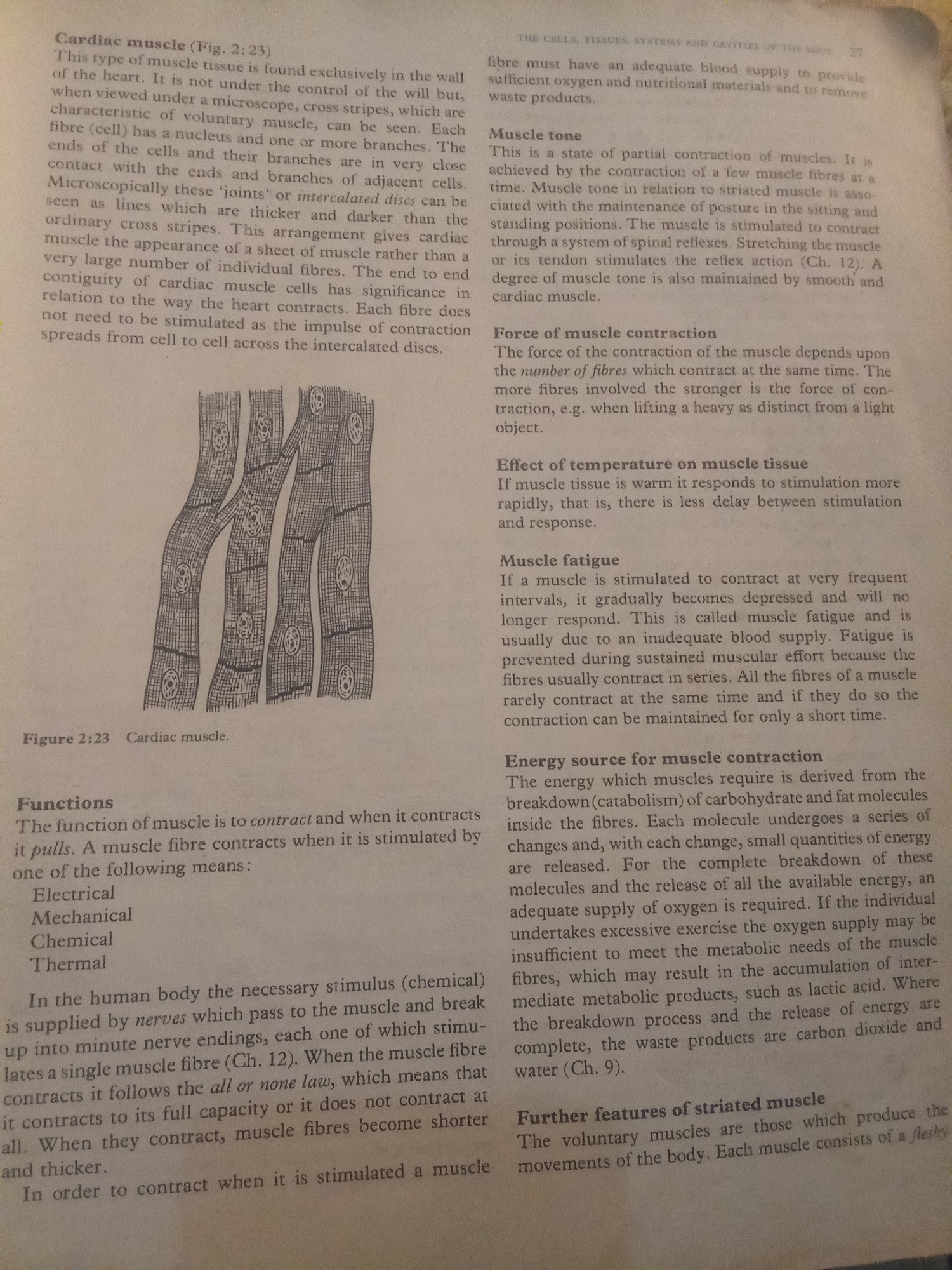
The image provided is a scanned page from a textbook, likely an anatomy or biology resource. The main subject matter is a detailed explanation of cardiac muscle, its structure, and function, accompanied by a diagram. The text on the left side of the page begins by defining cardiac muscle, mentioning its exclusive location in the heart wall. It highlights microscopic features such as cross stripes and intercalated discs, explaining how these contribute to the appearance of a muscle sheet. The text also touches upon the way cardiac muscle fibers are stimulated. Below this description is a black and white illustration labeled "Figure 2:23 Cardiac muscle," which depicts several elongated cells with internal striations and circular nuclei, arranged in a parallel fashion. Further down on the left, a section titled "Functions" lists the ways a muscle fiber contracts, including electrical, mechanical, chemical, and thermal stimulation. It specifies that in the human body, chemical stimuli from nerves initiate contraction, and that muscle fibers operate under an "all or none law," contracting to their full capacity or not at all, becoming shorter and thicker in the process. The right side of the page contains several distinct sections. The top right has a heading "THE CELLS, TISSUES, SYSTEMS AND CAVITIES OF THE BODY" followed by a page number "27". Below this, it discusses the fiber's need for an adequate blood supply. The next section defines "Muscle tone" as a state of partial muscle contraction, its role in posture, and how it can be maintained by different muscle types. "Force of muscle contraction" explains that it depends on the number of fibers contracting simultaneously. "Effect of temperature on muscle tissue" states that warm tissue responds more rapidly. "Muscle fatigue" describes the phenomenon of reduced response due to frequent stimulation, often linked to inadequate blood supply and how it's prevented in sustained effort. Finally, "Energy source for muscle contraction" details how energy is derived from the breakdown of carbohydrates and fats, the importance of oxygen, and the accumulation of metabolic products like lactic acid during strenuous activity. The page concludes with a heading "Further features of striated muscle" and a partial sentence about voluntary muscles. There are no people, objects, or a specific scene depicted beyond the textbook content. The setting is clearly an academic or educational environment due to the nature of the document. The visible text is extensive and provides a comprehensive overview of
FM-KpyEx1

Jun 30, 2026, 11:46 AM

Jalingo, Nigeria

Stake attention in this memory

Informative
Scientific
Educational
Detailed
Explanatory

The image provided is a scanned page from a textbook, likely an anatomy or biology resource. The main subject matter is a detailed explanation of cardiac muscle, its structure, and function, accompanied by a diagram. The text on the left side of the page begins by defining cardiac muscle, mentioning its exclusive location in the heart wall. It highlights microscopic features such as cross stripes and intercalated discs, explaining how these contribute to the appearance of a muscle sheet. The text also touches upon the way cardiac muscle fibers are stimulated. Below this description is a black and white illustration labeled "Figure 2:23 Cardiac muscle," which depicts several elongated cells with internal striations and circular nuclei, arranged in a parallel fashion. Further down on the left, a section titled "Functions" lists the ways a muscle fiber contracts, including electrical, mechanical, chemical, and thermal stimulation. It specifies that in the human body, chemical stimuli from nerves initiate contraction, and that muscle fibers operate under an "all or none law," contracting to their full capacity or not at all, becoming shorter and thicker in the process. The right side of the page contains several distinct sections. The top right has a heading "THE CELLS, TISSUES, SYSTEMS AND CAVITIES OF THE BODY" followed by a page number "27". Below this, it discusses the fiber's need for an adequate blood supply. The next section defines "Muscle tone" as a state of partial muscle contraction, its role in posture, and how it can be maintained by different muscle types. "Force of muscle contraction" explains that it depends on the number of fibers contracting simultaneously. "Effect of temperature on muscle tissue" states that warm tissue responds more rapidly. "Muscle fatigue" describes the phenomenon of reduced response due to frequent stimulation, often linked to inadequate blood supply and how it's prevented in sustained effort. Finally, "Energy source for muscle contraction" details how energy is derived from the breakdown of carbohydrates and fats, the importance of oxygen, and the accumulation of metabolic products like lactic acid during strenuous activity. The page concludes with a heading "Further features of striated muscle" and a partial sentence about voluntary muscles. There are no people, objects, or a specific scene depicted beyond the textbook content. The setting is clearly an academic or educational environment due to the nature of the document. The visible text is extensive and provides a comprehensive overview of

Loading AttnAds…

transactions
revenues
stakers
Earliest
Latest
Highest stake

No transactions found

More from this user

More from Jalingo

FM-KpyEx1

Jun 30, 2026, 11:46 AM

Jalingo, Nigeria

Licensed under Creative Commons Attribution 4.0 International License. You are free to share and adapt this content with proper attribution.