
Stake attention in this memory
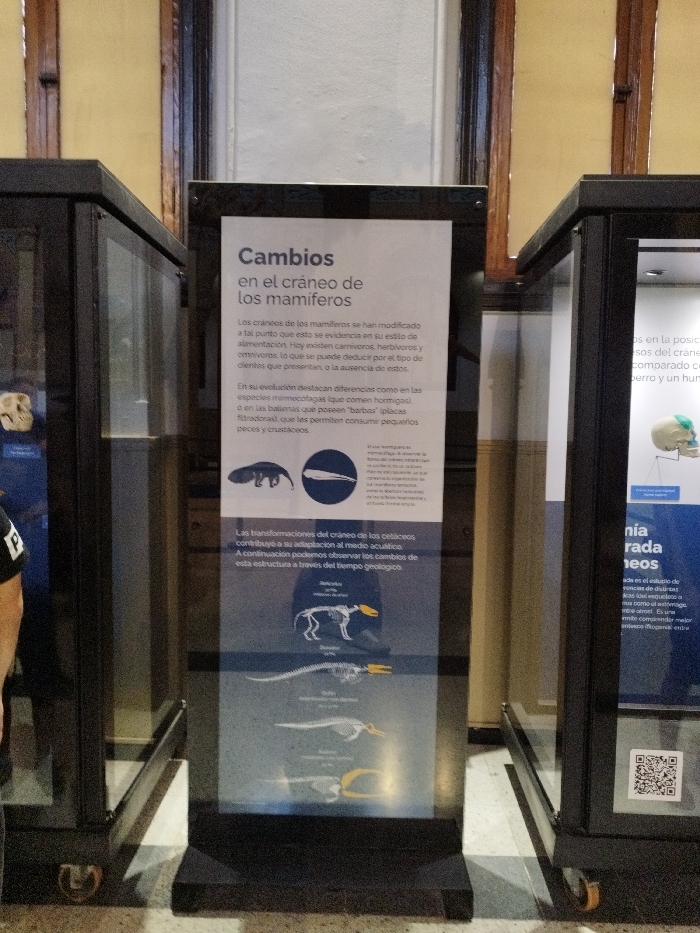
This image depicts an educational exhibit, likely within a museum in Santiago, Chile, focusing on the evolution of mammal skulls. A central, tall, rectangular display stand dominates the foreground, featuring text and illustrations. The main title on the stand reads "Cambios en el cráneo de los mamíferos" (Changes in mammal skulls). The accompanying Spanish text explains how mammal skulls have adapted to various feeding styles, such as those of carnivores, herbivores, and omnivores, with these adaptations reflected in their dentition or lack thereof. It further details specialized skulls found in myrmecophagous species (like anteaters) and baleen whales, which possess "barbas" (baleen plates) for filtering small prey. Below this, a section illustrates the evolutionary transformation of cetacean skulls for aquatic adaptation. Titled "Las transformaciones del cráneo de los cetáceos contribuyó a su adaptación al medio acuático" (The transformations of cetacean skulls contributed to their adaptation to the aquatic environment), it shows an evolutionary sequence of skeletons, including *Pakicetus*, *Ambulocetus*, *Dorudon*, and a modern whale, demonstrating their transition through geological time. To the left and right of the central display are other glass display cases with dark frames. A skull is visible within the left case. The right display case shows a skull with a green cap, and partially legible text mentioning "cráneo," "perro," and "humano," suggesting a comparison of cranial structures, possibly between a human and a dog. A QR code is also visible on the bottom right of this case. Part of a person's arm and shoulder, wearing a black shirt, is visible on the far left. The background features light-colored walls and dark wooden architectural details, indicating an indoor museum environment.
No transactions found