Stake attention in this memory
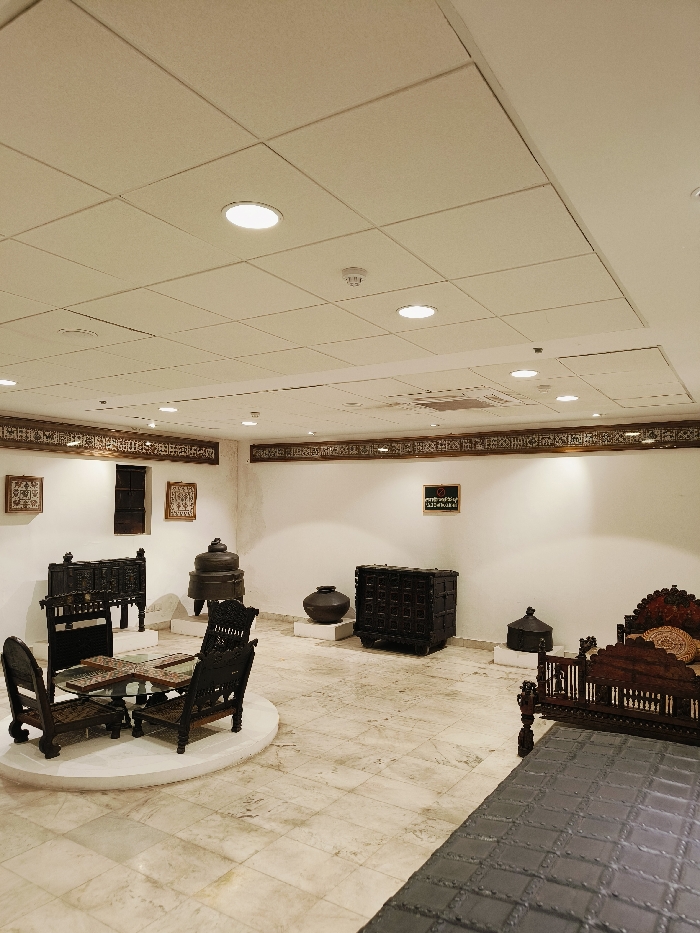
The image depicts an indoor room, likely a museum or exhibition space, showcasing traditional furniture and artifacts. The room has pristine white walls and a light-colored, possibly marble or tiled, floor with a subtle patterned texture. The ceiling is a grid of light-colored acoustic panels, featuring numerous circular recessed lights providing bright illumination. Several smoke detectors and air conditioning vents are also visible on the ceiling. Along the upper perimeter of the walls, a decorative wooden frieze or border with intricate carvings extends around the room. Various dark-wood furniture pieces and pottery are arranged throughout the space. In the foreground to the left, a set comprising a glass-topped table and four chairs, all made of dark, carved wood, rests on a raised circular platform. To the immediate right, the intricately carved wooden headboard and footboard of a bed are partially visible, with a dark, textured bedspread or cover. Other artifacts include a large, dark, tiered pot or vessel on a pedestal in the center-left, another simpler dark pot on a pedestal to its right, and several dark, ornate wooden chests or cabinets placed around the room. On the left wall, three framed pieces of art or textiles and a wooden panel are displayed. No people are present, suggesting a static display setup. A notable detail is a dark square sign on the right wall with a red circular 'no' symbol (a circle with a diagonal line through it) and white text below it. The text is in an Indian script, which reads "हाथ न लगायें" (Haath na lagayein), meaning "Do not touch." This sign reinforces the setting as a public exhibition where artifacts are to be observed without physical contact. The time of day is not discernible due to the artificial lighting.
No transactions found