
Sign in
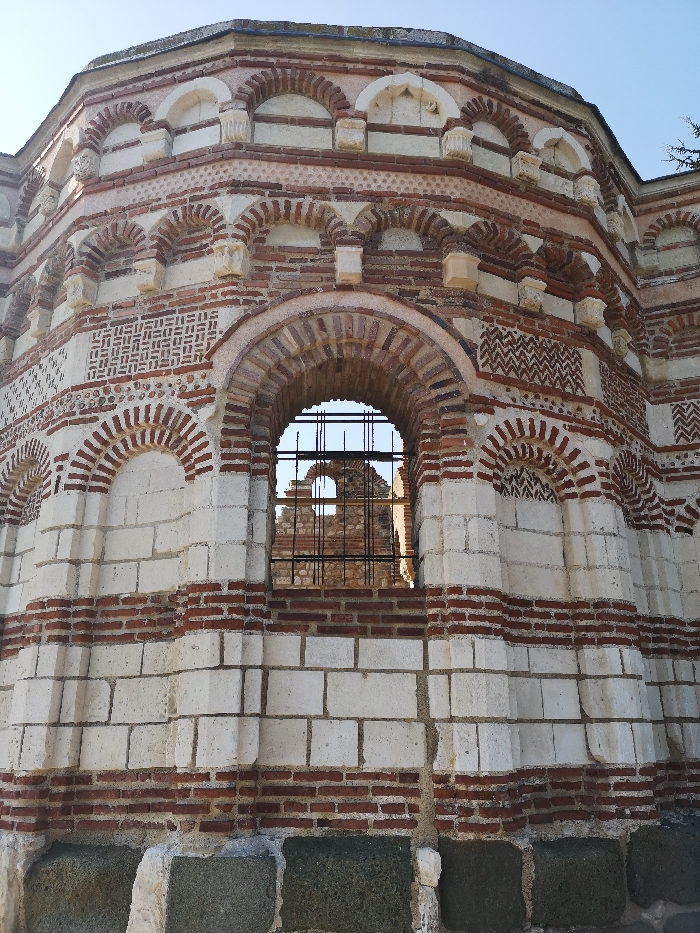
The image depicts the exterior facade of the Church of Christ Pantocrator in Nesebar, Bulgaria. The structure is an ancient, polygonal building characterized by its elaborate brick and stone construction.

The lower portion of the visible facade consists of large, light-colored, roughly cut stone blocks. Above this, the wall is built in an alternating pattern of courses of reddish-brown bricks and white stone blocks, a technique known as opus mixtum. The facade is highly decorative, featuring multiple tiers of architectural elements.

A prominent, large arched window, framed with multiple layers of brick, is centrally located. Dark metal bars form a grid across the window opening. Through this opening, remnants of an internal brick structure, possibly an apse or part of a dome, are visible, along with some lighter-colored structural elements or scaffolding.

Surrounding the window and across the upper sections of the facade are numerous decorative elements. These include tiers of small, blind brick arches, often paired, supported by slender stone pilasters or corbels. Intricate geometric patterns are integrated into the brickwork between the arches and stone courses. These patterns include chevron (herringbone), square meander-like designs, and small circular or dot patterns created by brick arrangements. Sculpted stone elements, resembling capitals or corbels, are visible above some of the blind arches in the upper registers.

The building's octagonal or polygonal form is evident as it tapers upwards towards a visible roofline against a clear blue sky. The masonry displays signs of age and weathering. No individuals or active subjects are present in the scene.
Alexandra. techno

Mar 16, 2026

Nesebar, Bulgaria

Stake attention in this memory

Ancient
Architectural
Historical
Somber
Dignified

The image depicts the exterior facade of the Church of Christ Pantocrator in Nesebar, Bulgaria. The structure is an ancient, polygonal building characterized by its elaborate brick and stone construction. The lower portion of the visible facade consists of large, light-colored, roughly cut stone blocks. Above this, the wall is built in an alternating pattern of courses of reddish-brown bricks and white stone blocks, a technique known as opus mixtum. The facade is highly decorative, featuring multiple tiers of architectural elements. A prominent, large arched window, framed with multiple layers of brick, is centrally located. Dark metal bars form a grid across the window opening. Through this opening, remnants of an internal brick structure, possibly an apse or part of a dome, are visible, along with some lighter-colored structural elements or scaffolding. Surrounding the window and across the upper sections of the facade are numerous decorative elements. These include tiers of small, blind brick arches, often paired, supported by slender stone pilasters or corbels. Intricate geometric patterns are integrated into the brickwork between the arches and stone courses. These patterns include chevron (herringbone), square meander-like designs, and small circular or dot patterns created by brick arrangements. Sculpted stone elements, resembling capitals or corbels, are visible above some of the blind arches in the upper registers. The building's octagonal or polygonal form is evident as it tapers upwards towards a visible roofline against a clear blue sky. The masonry displays signs of age and weathering. No individuals or active subjects are present in the scene.

transactions
revenues
stakers
Earliest
Latest
Highest stake

No transactions found

More from this user

More from Nesebar

Alexandra. techno

Mar 16, 2026

Nesebar, Bulgaria

Licensed under Creative Commons Attribution 4.0 International License. You are free to share and adapt this content with proper attribution.