Sign in
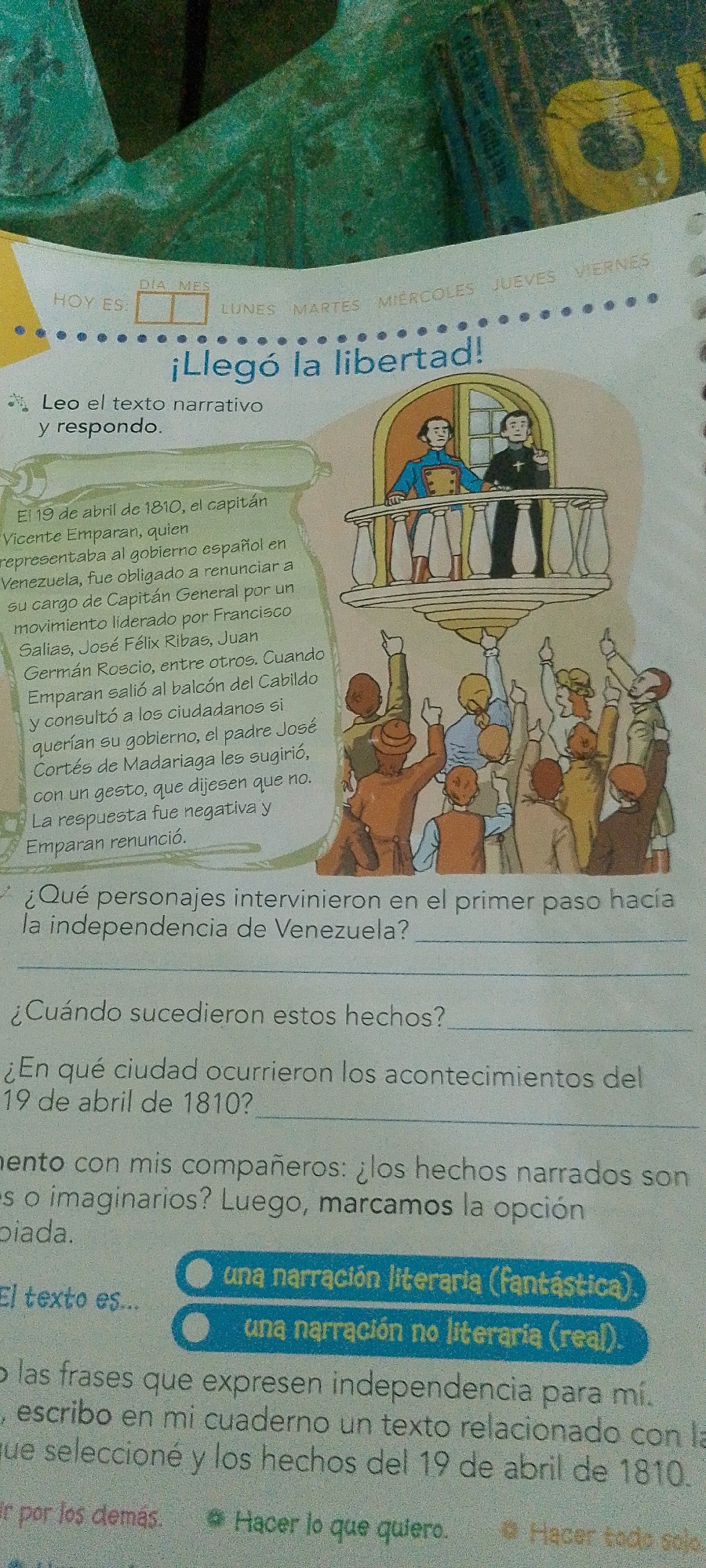
The image shows a page from a Spanish-language educational book. At the top, "HOY ES" (Today is) is followed by blank boxes for a date, and then the days of the week: LUNES (Monday), MARTES (Tuesday), MIÉRCOLES (Wednesday), JUEVES (Thursday), VIERNES (Friday). The prominent title is "¡Llegó la libertad!" (Liberty arrived!). Below this, an instruction reads "Leo el texto narrativo y respondo." (I read the narrative text and I answer.). The text describes historical events: "El 19 de abril de 1810, el capitán Vicente Emparan, quien representaba al gobierno español en Venezuela, fue obligado a renunciar a su cargo de Capitán General por un movimiento liderado por Francisco Salias, José Félix Ribas, Juan Germán Roscio, entre otros. Cuando Emparan salió al balcón del Cabildo y consultó a los ciudadanos si querían su gobierno, el padre José Cortés de Madariaga les sugirió, con un gesto, que dijesen que no. La respuesta fue negativa y Emparan renunció." (On April 19, 1810, Captain Vicente Emparan, who represented the Spanish government in Venezuela, was forced to resign his position as Captain General by a movement led by Francisco Salias, José Félix Ribas, Juan Germán Roscio, among others. When Emparan went out onto the balcony of the Cabildo and asked the citizens if they wanted his government, Father José Cortés de Madariaga suggested, with a gesture, that they say no. The response was negative and Emparan resigned.) Accompanying the text is an illustration depicting a man in a blue and red military uniform and a man in religious attire (black cassock and white collar) standing on a balcony. Below them, a crowd of people are looking up and pointing towards the balcony. The page also includes questions for the reader: 1. "¿Qué personajes intervinieron en el primer paso hacia la independencia de Venezuela?" (What characters intervened in the first step towards Venezuela's independence?) 2. "¿Cuándo sucedieron estos hechos?" (When did these events happen?) 3. "¿En qué ciudad ocurrieron los acontecimientos del 19 de abril de 1810?" (In which city did the events of April 19, 1810, occur?) Further down, there are options for classifying the text: "El texto es..." (The text is...) followed by two radio buttons: "una narración literaria (fantástica)" (a literary narrative (fantastic)) and "una narración no literaria (real)" (a non-literary narrative (real)). Finally, another instruction reads, "o las frases que expresen independencia para mí, escribo en mi cuaderno un texto relacionado con
cruzaleja

Jun 12, 2026, 12:41 AM

La Tagua, Venezuela

Moment

Stake attention in this memory

patriotic
revolutionary
triumphant
historical
hopeful

The image shows a page from a Spanish-language educational book. At the top, "HOY ES" (Today is) is followed by blank boxes for a date, and then the days of the week: LUNES (Monday), MARTES (Tuesday), MIÉRCOLES (Wednesday), JUEVES (Thursday), VIERNES (Friday). The prominent title is "¡Llegó la libertad!" (Liberty arrived!). Below this, an instruction reads "Leo el texto narrativo y respondo." (I read the narrative text and I answer.). The text describes historical events: "El 19 de abril de 1810, el capitán Vicente Emparan, quien representaba al gobierno español en Venezuela, fue obligado a renunciar a su cargo de Capitán General por un movimiento liderado por Francisco Salias, José Félix Ribas, Juan Germán Roscio, entre otros. Cuando Emparan salió al balcón del Cabildo y consultó a los ciudadanos si querían su gobierno, el padre José Cortés de Madariaga les sugirió, con un gesto, que dijesen que no. La respuesta fue negativa y Emparan renunció." (On April 19, 1810, Captain Vicente Emparan, who represented the Spanish government in Venezuela, was forced to resign his position as Captain General by a movement led by Francisco Salias, José Félix Ribas, Juan Germán Roscio, among others. When Emparan went out onto the balcony of the Cabildo and asked the citizens if they wanted his government, Father José Cortés de Madariaga suggested, with a gesture, that they say no. The response was negative and Emparan resigned.) Accompanying the text is an illustration depicting a man in a blue and red military uniform and a man in religious attire (black cassock and white collar) standing on a balcony. Below them, a crowd of people are looking up and pointing towards the balcony. The page also includes questions for the reader: 1. "¿Qué personajes intervinieron en el primer paso hacia la independencia de Venezuela?" (What characters intervened in the first step towards Venezuela's independence?) 2. "¿Cuándo sucedieron estos hechos?" (When did these events happen?) 3. "¿En qué ciudad ocurrieron los acontecimientos del 19 de abril de 1810?" (In which city did the events of April 19, 1810, occur?) Further down, there are options for classifying the text: "El texto es..." (The text is...) followed by two radio buttons: "una narración literaria (fantástica)" (a literary narrative (fantastic)) and "una narración no literaria (real)" (a non-literary narrative (real)). Finally, another instruction reads, "o las frases que expresen independencia para mí, escribo en mi cuaderno un texto relacionado con

Symbol

D4405

Volume

0

Creator

+$0.07

Revenue

+$0.00

TVL

$0.00

1D
1W
1M
All

Loading AttnAds…

transactions
revenues
stakers
Earliest
Latest
Highest stake

1

Mariale

Staked 1mo ago
Redeemed 28d ago

$2.78 USD

+$0.01 USD

Fee: $0.01 (0.5%)

+0.2%

2

Rev Bot 🤖💰

Injected revenue 1mo ago

Revenue bonus for the last stake.

+$0.05 USD

3

Jesús Ferrer

Staked 25d ago
Redeemed 23d ago

$2.78 USD

+$0.01 USD

Fee: $0.01 (0.5%)

+0.3%

4

Rev Bot 🤖💰

Injected revenue 25d ago

Revenue bonus for the last stake.

+$0.06 USD

More from this user

More from La Tagua

cruzaleja

Jun 12, 2026, 12:41 AM

La Tagua, Venezuela

Licensed under Creative Commons Attribution 4.0 International License. You are free to share and adapt this content with proper attribution.