
Stake attention in this memory
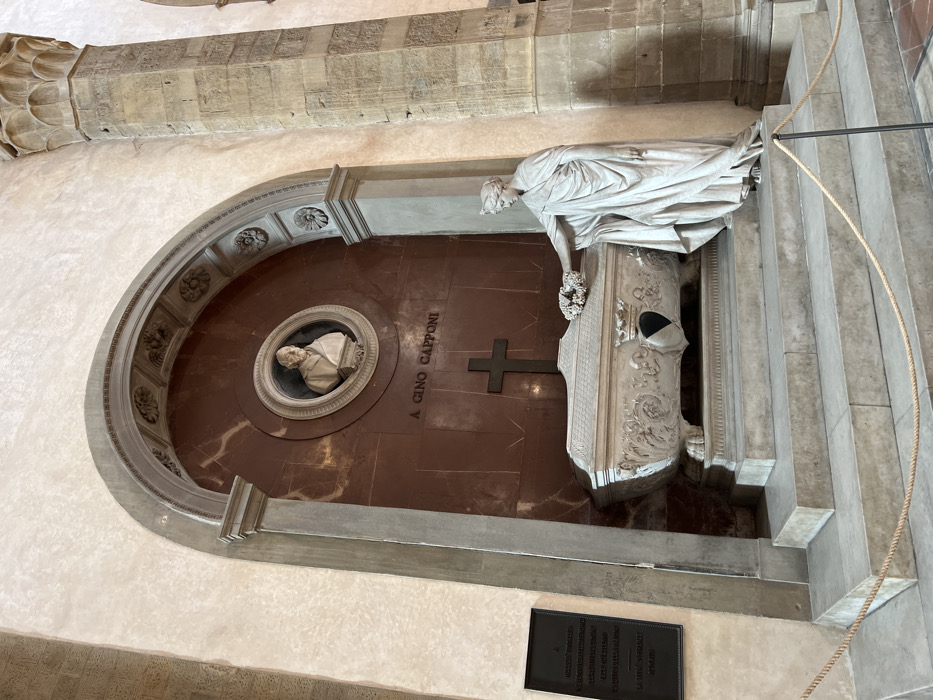
This image captures a solemn funerary monument within a grand architectural setting, likely a church or historical building in Florence, Italy. The scene centers on a large, intricately carved white marble tomb or sarcophagus. To the right of the tomb stands a life-sized marble statue of a robed male figure, possibly an allegorical representation or a mourner. He leans forward, his gaze directed downwards, and holds a delicate floral wreath or garland over the sarcophagus, suggesting an act of remembrance or tribute. The tomb itself is ornate, featuring detailed sculptural work and a shield-like emblem, possibly a coat of arms or a funerary helmet, resting on its surface. Behind the tomb, set into a recessed, arched niche of polished reddish-brown marble, is a large black cross. Above and to the left of the cross, a sculpted bust of a man in historical attire is encased within a circular, decorative frame, also recessed into the marble wall. Vertical text on the reddish-brown marble clearly spells out "A GINO CAPPONI," indicating the individual honored by the monument. The niche is framed by an elegant archway with carved rosettes. The surrounding walls are made of light-colored stone and plaster, with a textured finish, and robust architectural columns are visible on the left. A rope barrier is partially visible on the right, suggesting the monument is in a public, accessible space, but potentially sectioned off. At the bottom of the image, a dark rectangular plaque with white text further identifies the subject: "A GINO CAPPONI / ILLUSTRE CITTADINO, STORICO / E UOMO POLITICO INSIGNE / CUI DOVEVANO FIRENZE E L'ITALIA / TANTA PARTE DELL'EDIFIZIO / DELLA LORO LIBERTÀ E GRANDEZZA / LA CITTÀ PATRIA POSE / MDCCCXLVIII - MDCCCLXXVI". This inscription translates to a tribute to Gino Capponi, an illustrious citizen, historian, and distinguished politician, acknowledging his contribution to the freedom and greatness of Florence and Italy, erected by his homeland city, covering the period of 1848-1876. The overall impression is one of deep respect and historical significance.
No transactions found