Sign in
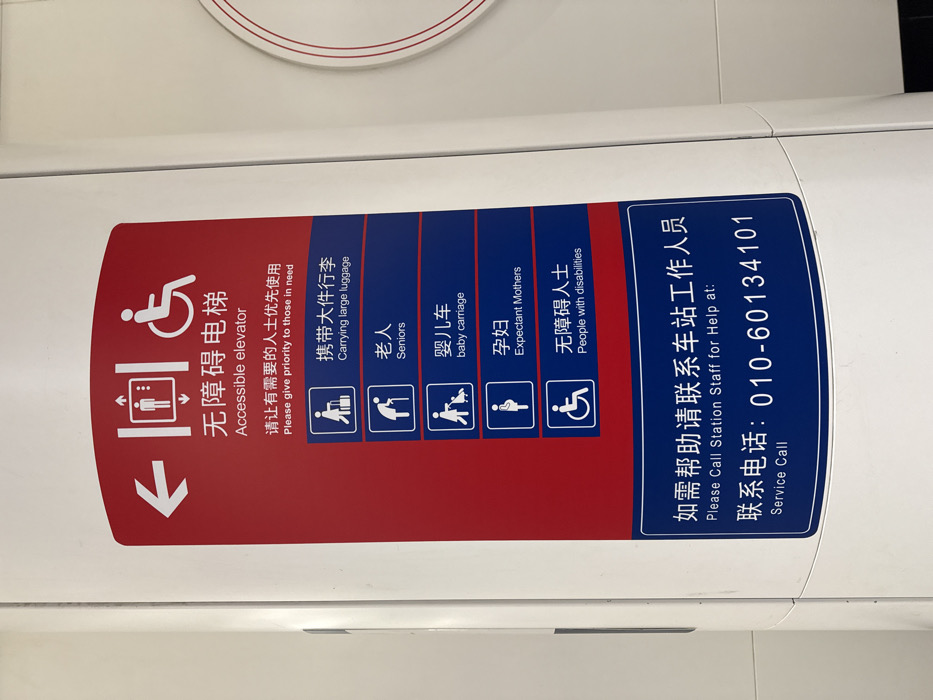
The image captures an informational sign, likely found in a public transportation setting such as a metro station or train car in Beijing, China. The sign is primarily red and dark blue with white text and pictograms, adhered to a clean, white wall or door.

The main subject of the sign is an "Accessible elevator" (无障碍电梯), indicated by a large red section on the left featuring an elevator icon with up and down arrows and a prominent disability symbol. Below this, an arrow points left, presumably indicating the direction of the elevator.

The sign emphasizes priority usage with the text: "Please give priority to those in need" (请让有需要的人士优先使用). It then lists five categories of individuals who should receive priority, each accompanied by a distinct icon and text in both Chinese and English:
1.  A person pushing a luggage cart: "Carrying large luggage" (携带大件行李)
2.  An elderly person with a cane: "Seniors" (老人)
3.  A person pushing a baby carriage: "baby carriage" (婴儿车)
4.  A pregnant woman: "Expectant Mothers" (孕妇)
5.  A person in a wheelchair: "People with disabilities" (无障碍人士)

The rightmost blue section provides contact information for assistance. It states: "Please Call Station Staff for Help at:" (如需帮助请联系车站工作人员) followed by "Service Call" (联系电话) and a phone number: "010-60134101". The "010" area code specifically identifies the location as Beijing. The sign's clear layout, bilingual text, and universally recognizable icons aim to ensure understanding for a diverse public, highlighting an emphasis on accessibility and passenger assistance.
Laurent

Feb 16, 2025, 1:06 PM

Beijing, China

Stake attention in this memory

The image captures an informational sign, likely found in a public transportation setting such as a metro station or train car in Beijing, China. The sign is primarily red and dark blue with white text and pictograms, adhered to a clean, white wall or door. The main subject of the sign is an "Accessible elevator" (无障碍电梯), indicated by a large red section on the left featuring an elevator icon with up and down arrows and a prominent disability symbol. Below this, an arrow points left, presumably indicating the direction of the elevator. The sign emphasizes priority usage with the text: "Please give priority to those in need" (请让有需要的人士优先使用). It then lists five categories of individuals who should receive priority, each accompanied by a distinct icon and text in both Chinese and English: 1. A person pushing a luggage cart: "Carrying large luggage" (携带大件行李) 2. An elderly person with a cane: "Seniors" (老人) 3. A person pushing a baby carriage: "baby carriage" (婴儿车) 4. A pregnant woman: "Expectant Mothers" (孕妇) 5. A person in a wheelchair: "People with disabilities" (无障碍人士) The rightmost blue section provides contact information for assistance. It states: "Please Call Station Staff for Help at:" (如需帮助请联系车站工作人员) followed by "Service Call" (联系电话) and a phone number: "010-60134101". The "010" area code specifically identifies the location as Beijing. The sign's clear layout, bilingual text, and universally recognizable icons aim to ensure understanding for a diverse public, highlighting an emphasis on accessibility and passenger assistance.

Loading AttnAds…

transactions
revenues
stakers
Earliest
Latest
Highest stake

No transactions found

More from this user

More from Beijing

Laurent

Feb 16, 2025, 1:06 PM

Beijing, China

Licensed under Creative Commons Attribution 4.0 International License. You are free to share and adapt this content with proper attribution.