
Stake attention in this memory
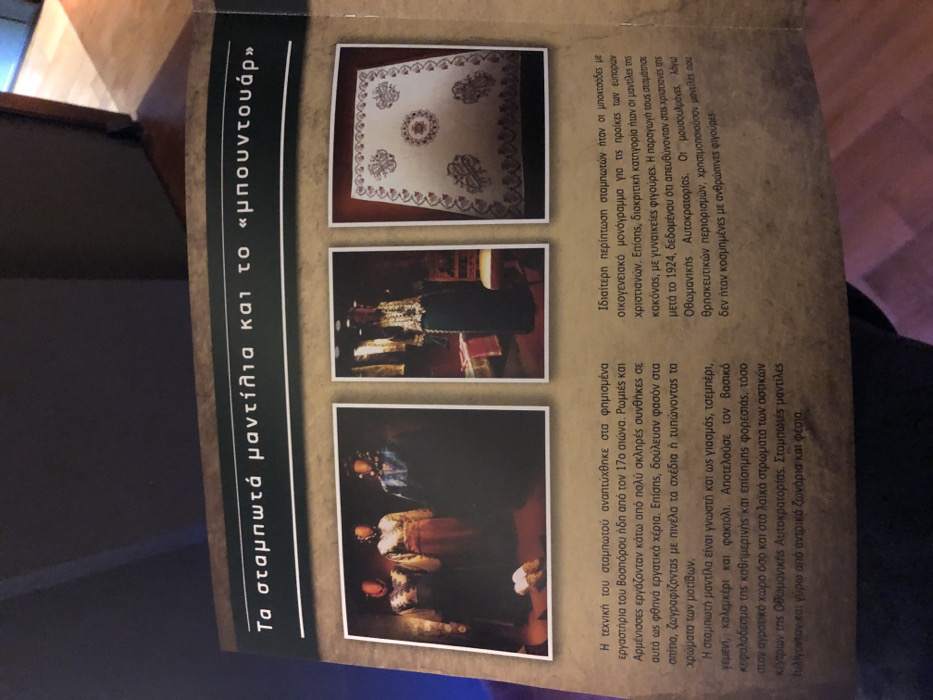
This media file displays a printed document, likely an informational brochure or museum exhibit text, resting on a surface in a dimly lit indoor environment. The document is vertically aligned, but its Greek text and embedded images are rotated 90 degrees counter-clockwise relative to the viewer. The visible text is titled "Τα σταμπωτά μαντίλια και το «μπουντουάρ»" (The Stamped Handkerchiefs and the "Boudoir"). It details the historical context of stamped handkerchiefs in the Ottoman Empire, originating from 17th-century Bosphorus workshops where Greek and Armenian women produced them. The text identifies various names for these handkerchiefs (yasma, tsembiri, yemani, etc.) and their use as head coverings for women and sashes for men. It also highlights specific types, such as "bakças" for Christian dowries and "kokona" handkerchiefs featuring female figures, noting that production ceased after 1924 due to their association with Christians, as Muslim women used unadorned versions. The document contains three embedded images: 1. **Top:** A light-colored, square textile, presumably a stamped handkerchief, adorned with intricate red and brown floral or geometric patterns. 2. **Middle:** A dark, framed image depicting a figure or mannequin dressed in elaborate, traditional Ottoman-era clothing. 3. **Bottom:** A dark, framed image showcasing three figures in historical attire, possibly in a staged scene or a museum display. The overall scene suggests documentation of cultural heritage information, potentially from a museum or exhibition in Nea Filadelfia, Greece. The ambient lighting is low, causing reflections on the document's surface.
Loading AttnAds…
No transactions found