
Stake attention in this memory
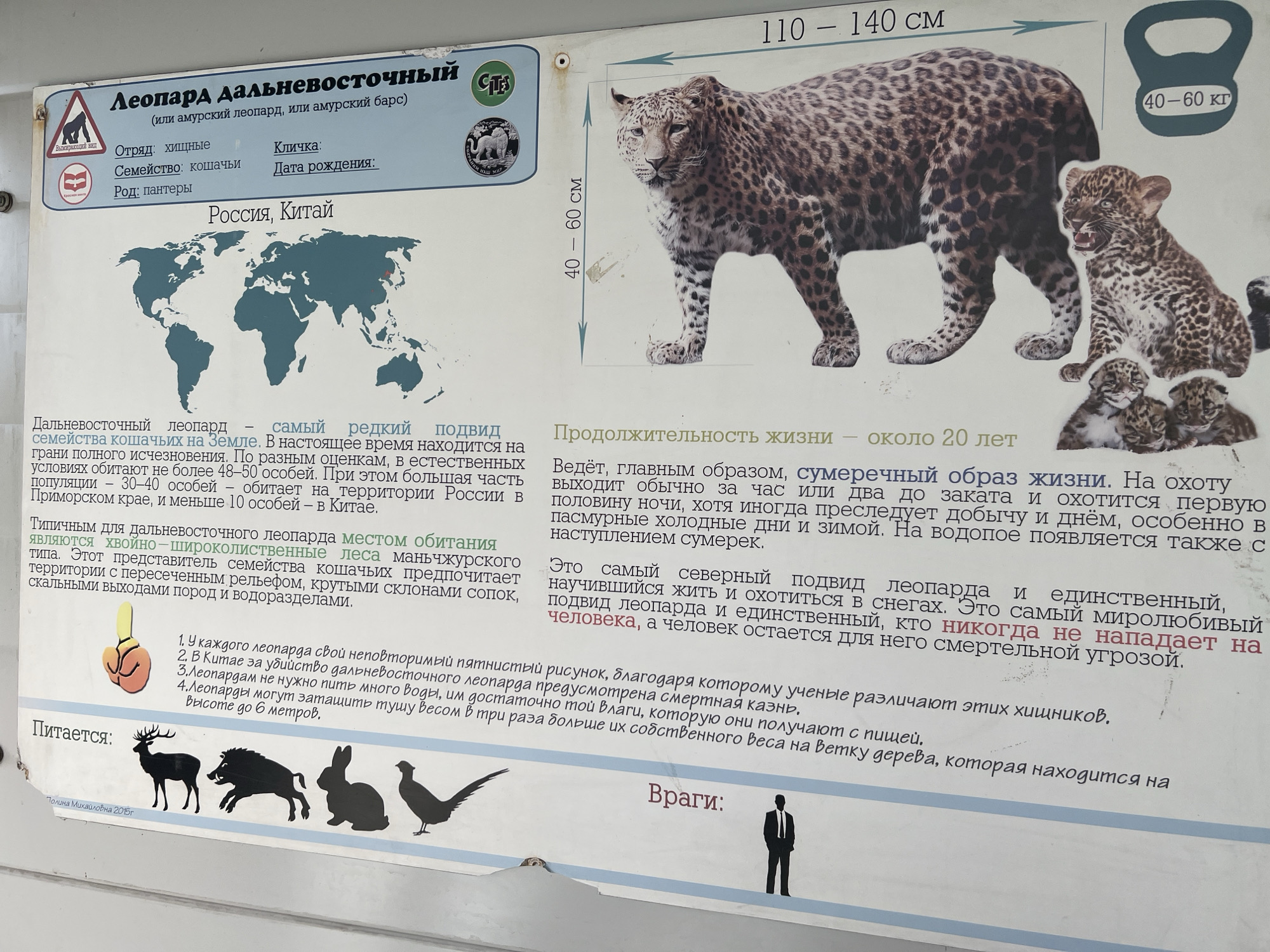
The image displays an outdoor informational placard, located in Irkutsk, Russia, providing details about the Amur leopard (Far Eastern leopard). The placard's title, "Леопард Дальневосточный" (Far Eastern Leopard), is presented in Russian, with "амурский леопард, или амурский барс" (Amur leopard, or Amur snow leopard) as synonyms. A large, central photograph depicts an adult Amur leopard, accompanied by one snarling cub and two smaller cubs resting below. Graphic measurements indicate the adult's length at 110-140 cm, shoulder height at 40-60 cm, and weight at 40-60 kg, represented by a kettlebell icon. A world map highlights the leopard's geographical distribution in Russia and China with red markers. Conservation status is denoted by a red triangular icon featuring a leopard silhouette labeled "Вымирающий вид" (Endangered species) and a red book icon. The Russian text describes the Amur leopard as the rarest big cat subspecies globally, critically endangered with an estimated wild population of 48-50 individuals (30-40 in Russia's Primorsky Krai, fewer than 10 in China). It details their classification (Order: Carnivora, Family: Feline, Genus: Panthera), an average lifespan of approximately 20 years, crepuscular/nocturnal hunting behavior, preference for coniferous-broadleaf forests, and their ability to drag prey weighing up to three times their own body weight into trees up to 6 meters high. A significant statement asserts that the Amur leopard is the "most peace-loving" big cat, *never* attacking humans, who are identified as its sole mortal threat. Below the main text, silhouettes illustrate the leopard's typical diet: a deer, a wild boar, a rabbit, and a pheasant. To the right, under the heading "Враги:" (Enemies:), a silhouette of a human figure is displayed. A small handwritten note, "Полина Михайловна 205г," is visible at the bottom left corner. The placard exhibits minor surface wear, consistent with outdoor exposure.
No transactions found