Sign in
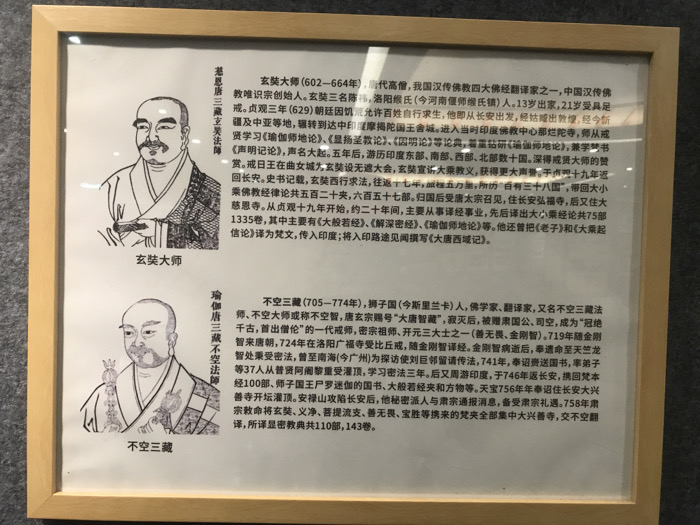
A framed display presents black and white line drawings and biographical information about two prominent Buddhist figures. The top section features Xuanzang (玄奘大师), depicted with a mustache and beard, wearing traditional monk robes. His accompanying Chinese text details his life from 602-664 CE, identifying him as a Tang Dynasty eminent monk, a key translator of Buddhist scriptures, and the founder of the Yogacara school in Han Chinese Buddhism. The text recounts his journey to India, studies at Nalanda Monastery, and extensive translation work, including "The Great Tang Records on the Western Regions."

The bottom section showcases Amoghavajra (不空三藏), also depicted as a monk with a shorter beard. His biography covers his life from 705-774 CE, noting he was from Sri Lanka, a Buddhist scholar and translator, and one of the "Three Great Masters of Kaiyuan." The text highlights his travels, his ordination in China, and his significant contributions to Esoteric Buddhism through translation and teaching.

The display is set against a plain, light-colored wall, likely in a museum or exhibition setting, with the frame appearing to be made of wood. The information is entirely in Chinese characters, providing historical context for these influential religious figures.
F
FM-qn0Jb2

Dec 9, 2024, 12:16 PM

Guang Zhou Shi, China

Stake attention in this memory

A framed display presents black and white line drawings and biographical information about two prominent Buddhist figures. The top section features Xuanzang (玄奘大师), depicted with a mustache and beard, wearing traditional monk robes. His accompanying Chinese text details his life from 602-664 CE, identifying him as a Tang Dynasty eminent monk, a key translator of Buddhist scriptures, and the founder of the Yogacara school in Han Chinese Buddhism. The text recounts his journey to India, studies at Nalanda Monastery, and extensive translation work, including "The Great Tang Records on the Western Regions." The bottom section showcases Amoghavajra (不空三藏), also depicted as a monk with a shorter beard. His biography covers his life from 705-774 CE, noting he was from Sri Lanka, a Buddhist scholar and translator, and one of the "Three Great Masters of Kaiyuan." The text highlights his travels, his ordination in China, and his significant contributions to Esoteric Buddhism through translation and teaching. The display is set against a plain, light-colored wall, likely in a museum or exhibition setting, with the frame appearing to be made of wood. The information is entirely in Chinese characters, providing historical context for these influential religious figures.

Loading AttnAds…

transactions
revenues
stakers
Earliest
Latest
Highest stake

No transactions found

More from this user

More from Guang Zhou Shi

FFM-qn0Jb2

Dec 9, 2024, 12:16 PM

Guang Zhou Shi, China

Licensed under Creative Commons Attribution 4.0 International License. You are free to share and adapt this content with proper attribution.