
Sign in
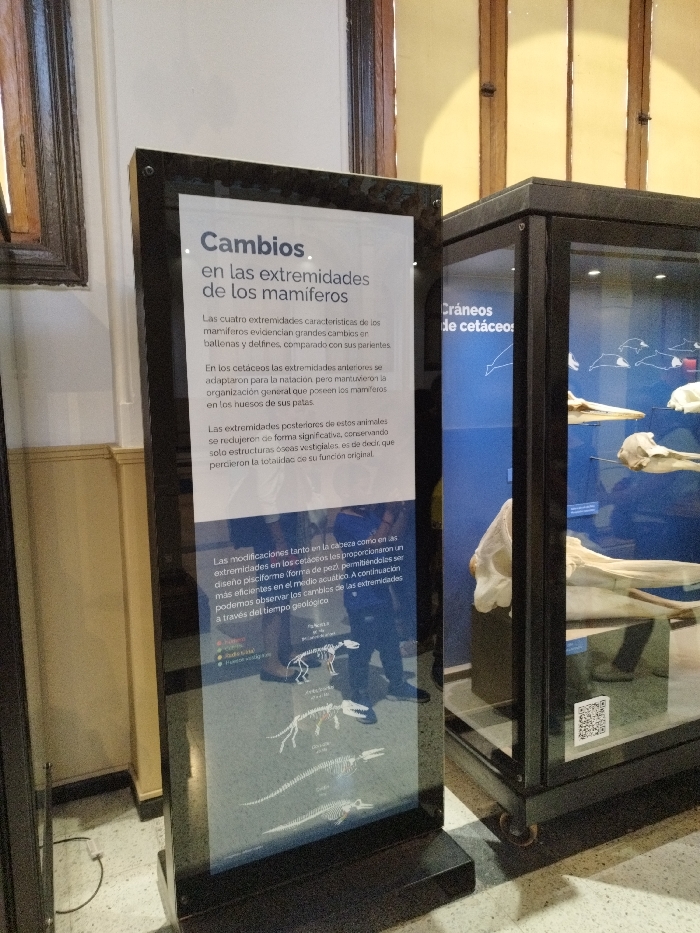
This image captures a section of a museum exhibit, likely in a natural history museum, focusing on the evolution of mammals, specifically cetaceans.

On the left, a tall, black-framed display panel features text and illustrative diagrams. The main title, "Cambios en las extremidades de los mamíferos" (Changes in the limbs of mammals), introduces the topic. The text, in Spanish, describes how the four characteristic mammalian limbs underwent significant changes in whales and dolphins. It explains that anterior limbs adapted for swimming while retaining the general bone structure of mammalian paws, and posterior limbs were significantly reduced to vestigial bony structures, losing their original function. Further down, it notes that modifications in both the head and limbs of cetaceans resulted in a pisciform (fish-like) design, allowing for greater efficiency in aquatic environments. Below this text, diagrams illustrate the skeletal changes of limbs over geological time, showing different stages of cetacean evolution. Reflections of visitors and the museum environment are visible on the panel's surface.

To the right of the panel, a glass display case showcases bone specimens. The visible text on this case reads "Cráneos de cetáceos" (Skulls of cetaceans), indicating that the display contains various cetacean skulls or skeletal parts. Inside, several pale-colored bone structures, resembling skulls and other skeletal elements, are arranged. A QR code is affixed to the inside of the glass case.

The setting appears to be an indoor space with natural light filtering through tall windows, suggesting daytime. The Spanish text confirms a location in a Spanish-speaking country, aligning with the provided context of Santiago, Chile.
Mrv

Jan 7, 2025

Santiago, Chile

Stake attention in this memory

This image captures a section of a museum exhibit, likely in a natural history museum, focusing on the evolution of mammals, specifically cetaceans. On the left, a tall, black-framed display panel features text and illustrative diagrams. The main title, "Cambios en las extremidades de los mamíferos" (Changes in the limbs of mammals), introduces the topic. The text, in Spanish, describes how the four characteristic mammalian limbs underwent significant changes in whales and dolphins. It explains that anterior limbs adapted for swimming while retaining the general bone structure of mammalian paws, and posterior limbs were significantly reduced to vestigial bony structures, losing their original function. Further down, it notes that modifications in both the head and limbs of cetaceans resulted in a pisciform (fish-like) design, allowing for greater efficiency in aquatic environments. Below this text, diagrams illustrate the skeletal changes of limbs over geological time, showing different stages of cetacean evolution. Reflections of visitors and the museum environment are visible on the panel's surface. To the right of the panel, a glass display case showcases bone specimens. The visible text on this case reads "Cráneos de cetáceos" (Skulls of cetaceans), indicating that the display contains various cetacean skulls or skeletal parts. Inside, several pale-colored bone structures, resembling skulls and other skeletal elements, are arranged. A QR code is affixed to the inside of the glass case. The setting appears to be an indoor space with natural light filtering through tall windows, suggesting daytime. The Spanish text confirms a location in a Spanish-speaking country, aligning with the provided context of Santiago, Chile.

transactions
revenues
stakers
Earliest
Latest
Highest stake

No transactions found

More from this user

More from Santiago

Mrv

Jan 7, 2025

Santiago, Chile

Licensed under Creative Commons Attribution 4.0 International License. You are free to share and adapt this content with proper attribution.