
Stake attention in this memory
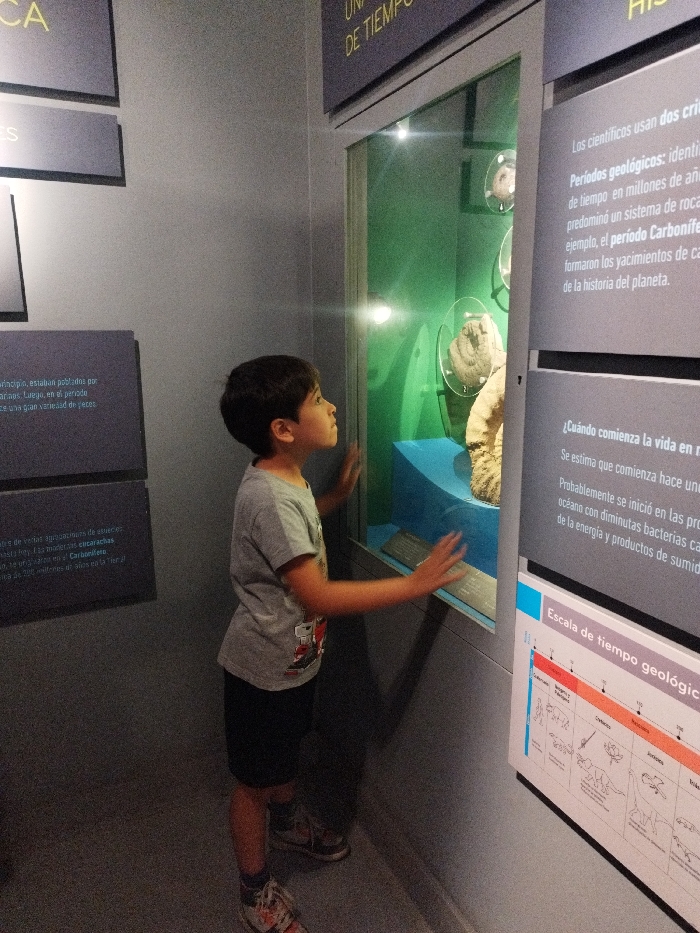
A young boy stands in a dimly lit museum, looking intently into a brightly lit glass display case. He is positioned in the lower-center of the frame, facing slightly to the right, with his hands gently resting against the glass. He wears a light-colored short-sleeved t-shirt with a graphic on it, dark shorts, and sneakers. Inside the display case, illuminated by spotlights, are several objects that appear to be geological specimens or fossils, set against a green back panel. One prominent specimen, textured and light brown, is visible in the lower part of the case, resting on a blue platform. Above it, other circular displays hold smaller items. Informational panels with Spanish text surround the boy and the display. To the right of the display case, a large panel discusses "Períodos geológicos" (Geological periods), mentioning "millones de años" (millions of years) and the "período Carbonífero" (Carboniferous period) in relation to the formation of coal deposits. Below this, another section asks "¿Cuándo comienza la vida en la Tierra?" (When does life on Earth begin?), discussing estimates of its origin and "diminutas bacterias" (tiny bacteria) in the ocean. At the bottom right, a colorful chart titled "Escala de tiempo geológico" (Geological time scale) displays illustrations of various ancient life forms across different geological eras. On the left side of the image, partially visible panels also contain Spanish text, referencing "marinos" (marine life) and "variedad de peces" (variety of fish), and possibly "cucarachas" (cockroaches) and "millones de años" (millions of years), suggesting descriptions of different ancient creatures or periods. The scene captures a moment of childhood curiosity within an educational setting in Santiago, Chile, likely a natural history museum.
No transactions found