
Sign in
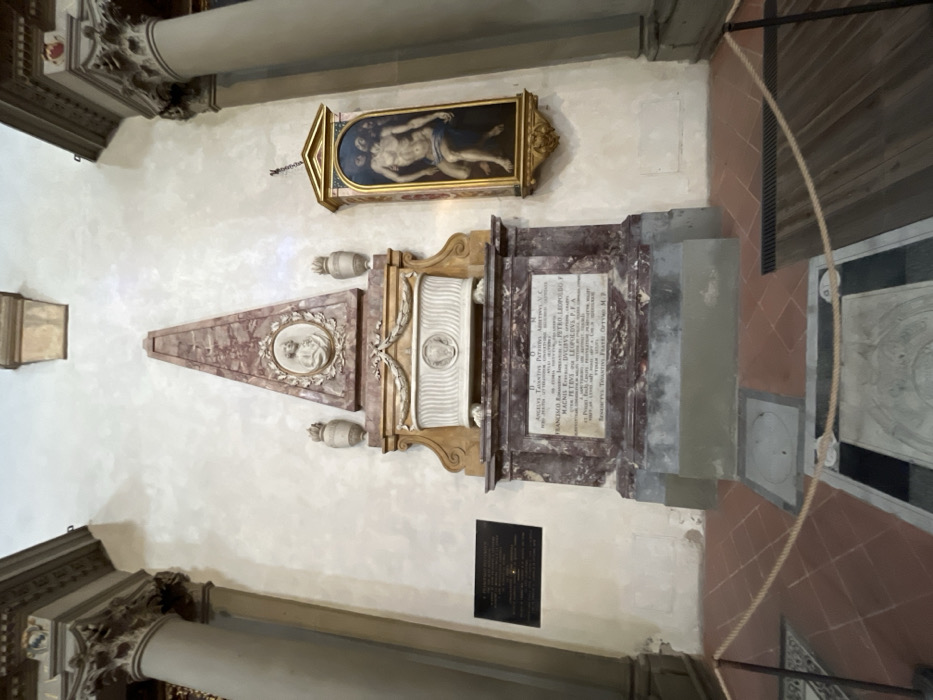
This media file captures the interior of a grand building, likely a church or chapel in Firenze, Italy. The central subject is a large, ornate funerary monument or cenotaph mounted on a light-colored wall.

The monument is composed of various types of marble, featuring reddish-brown and white sections, possibly with some gilded details. It has a complex structure: a triangular upper section made of reddish marble holds a white marble medallion with a classical-style bust in profile. Below this, a central rectangular panel features a textured white relief, flanked by decorative scrolls. The base of the monument is a substantial block of reddish marble, prominently displaying a large white inscription plaque. On either side of the triangular section's base are decorative urn-like finials.

Above the monument, a rectangular painting in a gilded frame depicts a dramatic scene with a male figure, possibly nude or draped, against a dark blue background, suggesting a mythological or religious subject.

The surrounding environment includes large, fluted columns with ornate Corinthian capitals visible on the left and bottom, indicating significant architecture. The floor on the right consists of terracotta-colored tiles laid diagonally, interspersed with lighter square tiles and what appear to be marble floor tomb slabs, some with carved designs. A light-colored rope barrier is strung across the right side of the frame, likely guiding visitors or protecting the area. Below the main monument, a small, dark plaque is affixed to the wall, but its text is illegible.

The main inscription on the large white plaque begins with "D. O. M." and identifies "IOSEPHI TADDINI PATRICII ARETINI D. O. C. ANNO MDCCCLXXXVII" (Joseph Taddini, Patrician of Arezzo, 1887). It also mentions "FRANCISCO RINGHISI," "PETRO LEONARDO F," "MARIA PETRI F," "LEOPOLDI I. P. A.," and references "PiorUM CINERUM," "CONJUGIS PATRIS MATRIS FILIAE," and "PIETATIS CAUSAM HOC MONUMENTUM," indicating a family dedication to Giuseppe Taddini and other relatives, likely for their "pious ashes" or memory. The monument commemorates several family members, including a spouse, father, mother, and daughter. The time period indicated is the late 19th century (1887). The scene suggests an indoor, sacred space, well-maintained, and likely a point of historical or religious interest.
FM-oNt2k1

Feb 9, 2025

Firenze, Italy

Stake attention in this memory

This media file captures the interior of a grand building, likely a church or chapel in Firenze, Italy. The central subject is a large, ornate funerary monument or cenotaph mounted on a light-colored wall. The monument is composed of various types of marble, featuring reddish-brown and white sections, possibly with some gilded details. It has a complex structure: a triangular upper section made of reddish marble holds a white marble medallion with a classical-style bust in profile. Below this, a central rectangular panel features a textured white relief, flanked by decorative scrolls. The base of the monument is a substantial block of reddish marble, prominently displaying a large white inscription plaque. On either side of the triangular section's base are decorative urn-like finials. Above the monument, a rectangular painting in a gilded frame depicts a dramatic scene with a male figure, possibly nude or draped, against a dark blue background, suggesting a mythological or religious subject. The surrounding environment includes large, fluted columns with ornate Corinthian capitals visible on the left and bottom, indicating significant architecture. The floor on the right consists of terracotta-colored tiles laid diagonally, interspersed with lighter square tiles and what appear to be marble floor tomb slabs, some with carved designs. A light-colored rope barrier is strung across the right side of the frame, likely guiding visitors or protecting the area. Below the main monument, a small, dark plaque is affixed to the wall, but its text is illegible. The main inscription on the large white plaque begins with "D. O. M." and identifies "IOSEPHI TADDINI PATRICII ARETINI D. O. C. ANNO MDCCCLXXXVII" (Joseph Taddini, Patrician of Arezzo, 1887). It also mentions "FRANCISCO RINGHISI," "PETRO LEONARDO F," "MARIA PETRI F," "LEOPOLDI I. P. A.," and references "PiorUM CINERUM," "CONJUGIS PATRIS MATRIS FILIAE," and "PIETATIS CAUSAM HOC MONUMENTUM," indicating a family dedication to Giuseppe Taddini and other relatives, likely for their "pious ashes" or memory. The monument commemorates several family members, including a spouse, father, mother, and daughter. The time period indicated is the late 19th century (1887). The scene suggests an indoor, sacred space, well-maintained, and likely a point of historical or religious interest.

transactions
revenues
stakers
Earliest
Latest
Highest stake

No transactions found

More from this user

More from Firenze

FM-oNt2k1

Feb 9, 2025

Firenze, Italy

Licensed under Creative Commons Attribution 4.0 International License. You are free to share and adapt this content with proper attribution.