Sign in
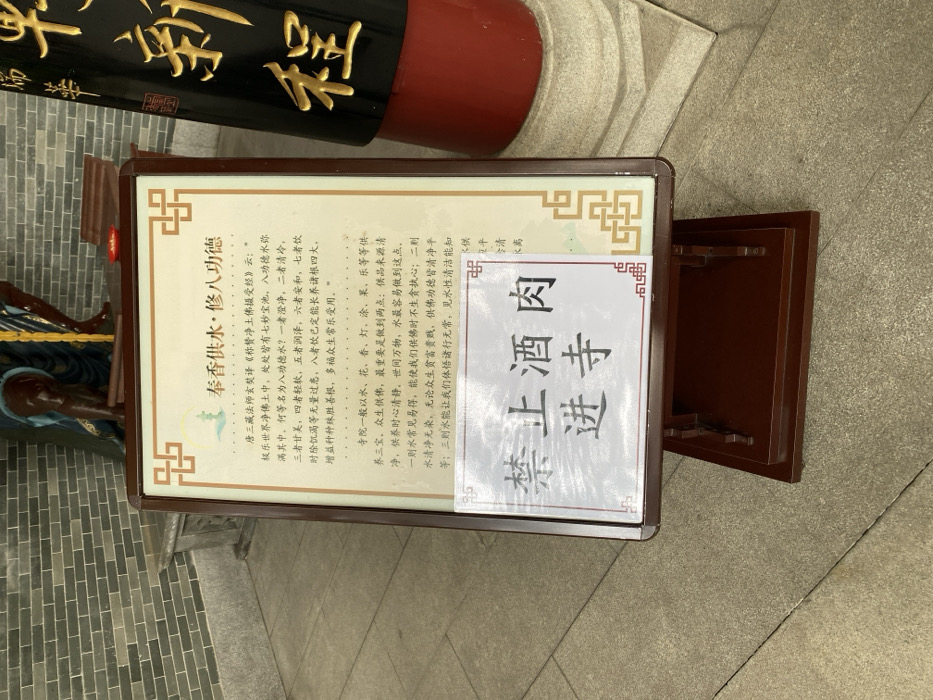
This image captures a vertical shot of an informational display stand at what appears to be a Buddhist temple or cultural site in Guangzhou, China. The stand is made of dark brown wood and holds two distinct signs.

The larger, upper sign is an elongated, framed display featuring Chinese text. Its title, "奉香供水・修八功德," translates to "Offering Incense and Water - Cultivating Eight Merits." The text, attributed to a sutra translated by Xuanzang (Tang Sanzang), elaborates on the concept of "Eight Merits Water" found in the Pure Land, describing its qualities such as clarity, coolness, sweetness, and the benefits of consuming it. It further discusses the significance of pure offerings in a temple, emphasizing water as an easily accessible and pure offering that promotes spiritual merit and equanimity.

Overlapping the lower part of this main sign is a smaller, white rectangular sign with prominent black Chinese characters. This sign reads "禁止酒肉 进寺," which translates to "No alcohol or meat allowed in the temple," indicating a common rule for visitors to Buddhist establishments.

To the left of the display, a partial view of a statue is visible, depicting a figure in blue and brown robes. In the upper background, a large, black cylindrical object adorned with golden Chinese characters adds to the cultural context. The ground beneath the stand is paved with light grey tiles, and a texture resembling a brick wall is discernible on the far left. The overall scene suggests an area providing guidance and rules for those entering a sacred or religious space.
F
FM-CaIMM2

Dec 24, 2024, 6:50 AM

Guang Zhou Shi, China

Stake attention in this memory

This image captures a vertical shot of an informational display stand at what appears to be a Buddhist temple or cultural site in Guangzhou, China. The stand is made of dark brown wood and holds two distinct signs. The larger, upper sign is an elongated, framed display featuring Chinese text. Its title, "奉香供水・修八功德," translates to "Offering Incense and Water - Cultivating Eight Merits." The text, attributed to a sutra translated by Xuanzang (Tang Sanzang), elaborates on the concept of "Eight Merits Water" found in the Pure Land, describing its qualities such as clarity, coolness, sweetness, and the benefits of consuming it. It further discusses the significance of pure offerings in a temple, emphasizing water as an easily accessible and pure offering that promotes spiritual merit and equanimity. Overlapping the lower part of this main sign is a smaller, white rectangular sign with prominent black Chinese characters. This sign reads "禁止酒肉 进寺," which translates to "No alcohol or meat allowed in the temple," indicating a common rule for visitors to Buddhist establishments. To the left of the display, a partial view of a statue is visible, depicting a figure in blue and brown robes. In the upper background, a large, black cylindrical object adorned with golden Chinese characters adds to the cultural context. The ground beneath the stand is paved with light grey tiles, and a texture resembling a brick wall is discernible on the far left. The overall scene suggests an area providing guidance and rules for those entering a sacred or religious space.

Loading AttnAds…

transactions
revenues
stakers
Earliest
Latest
Highest stake

No transactions found

More from this user

More from Guang Zhou Shi

FFM-CaIMM2

Dec 24, 2024, 6:50 AM

Guang Zhou Shi, China

Licensed under Creative Commons Attribution 4.0 International License. You are free to share and adapt this content with proper attribution.