
Stake attention in this memory
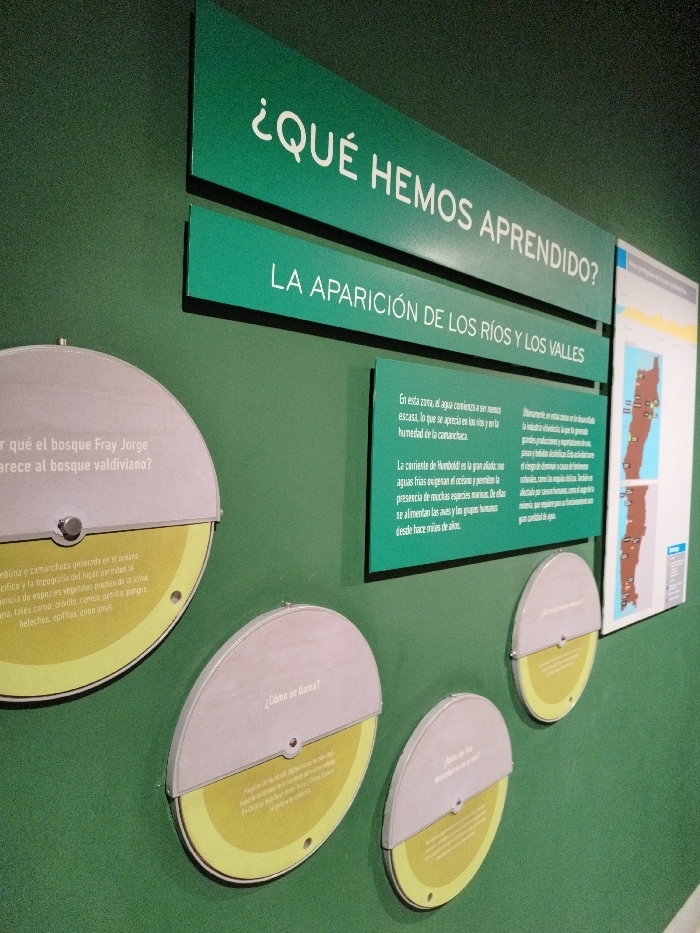
An educational exhibit, likely located in Santiago, Chile, displays information about geography, ecology, and human impact on the environment. The main setup features dark green wall panels with white Spanish text. The primary titles on the top panels read "¿QUÉ HEMOS APRENDIDO?" (What have we learned?) and "LA APARICIÓN DE LOS RÍOS Y LOS VALLES" (The appearance of rivers and valleys). To the left, a large circular interactive display, partially visible, asks "Por qué el bosque Fray Jorge se parece al bosque valdiviano?" (Why does the Fray Jorge forest resemble the Valdivian forest?). Visible text on its lower rotating section mentions "niebla o camanchaca generada en el océano pacífico" (fog or camanchaca generated in the Pacific Ocean), "topografía del lugar" (topography of the place), and specific plant species from the Valdivian forest like "olivillo, canela, peumo, pangui, helechos, epífitas." A central rectangular panel provides further details. Its left column explains that "En esta zona, el agua comienza a ser menos escasa, lo que se aprecia en los ríos y en la humedad de la camanchaca." (In this area, water begins to be less scarce, which is seen in the rivers and in the humidity of the camanchaca.) It also highlights the "corriente de Humboldt" (Humboldt current), stating its cold waters oxygenate the ocean, supporting marine life, which has sustained "aves y los grupos humanos desde hace miles de años" (birds and human groups for thousands of years). The right column discusses recent industrial development in these areas, including "cobre, pescado y industria silvoagrícola" (copper, fish, and silvo-agricultural industry), and warns of the "riesgo de disminuir o causar deficiencias naturales, como las sequías cíclicas" (risk of decreasing or causing natural deficiencies, such as cyclical droughts), also noting the high water demand for "minería" (mining). Below this panel are several smaller circular interactive displays. One is clearly labeled "¿Cómo se llama?" (What is it called?). On the far right, a large white panel displays a map, distinctly showing the long, narrow outline of Chile with regional divisions and several red markers, reinforcing the geographical focus. The exhibit is well-lit, indicating an indoor setting.
No transactions found