Sign in
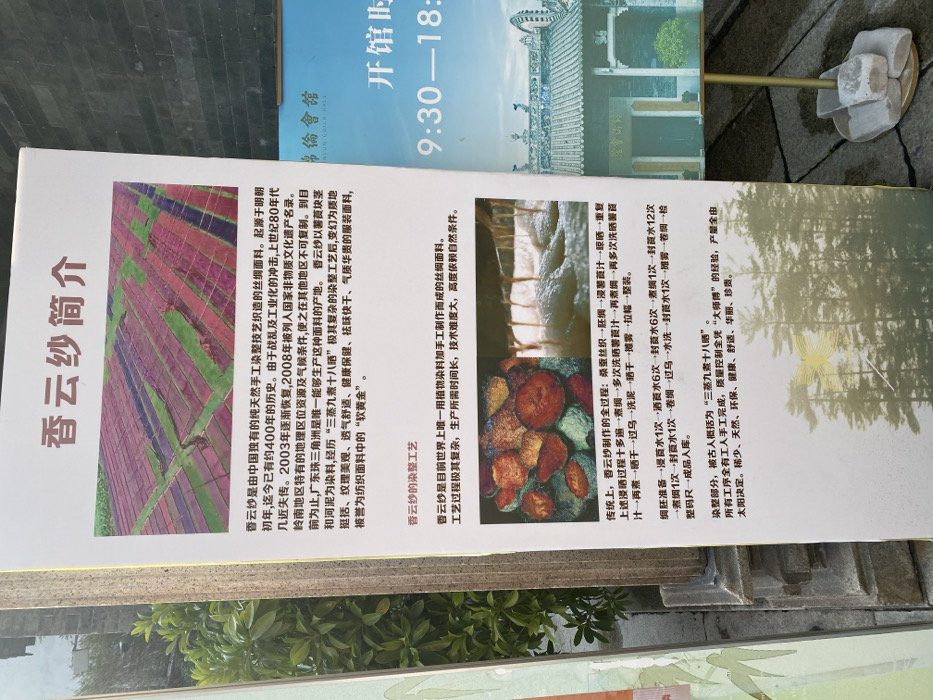
This image features a large outdoor informational signboard detailing the history and production of Xiangyunsha (香云纱) silk. The signboard, written in Chinese, introduces Xiangyunsha as a unique natural, hand-dyed silk fabric with a 400-year history, originating from the early Ming Dynasty. It mentions its near-loss in the 1980s, its revival in 2003, and its designation as a national intangible cultural heritage in 2008. The text highlights that due to specific geographical and climatic conditions, Xiangyunsha can only be produced in the Pearl River Delta of Guangdong, China.

The signboard explains that dioscorea (potato yam) tubers and river mud are used as dyes, undergoing a complex process called "three steaming, nine boiling, eighteen drying." The resulting fabric is described as stiff, beautifully textured, breathable, comfortable, healthy, odor-removing, fast-drying, and luxurious, earning it the nickname "soft gold." A section titled "Xiangyunsha Dyeing and Finishing Process" details the intricate, manual steps involved, emphasizing its complexity, long production time, and reliance on natural conditions. The process includes multiple cycles of soaking, drying, boiling, and mud treatment, with quality control heavily dependent on experienced "masters" and production dictated by the sun.

Visual elements on the signboard include an image of a field with red and purple fabrics laid out, likely for drying, and another image showing brown, round objects, possibly the dioscorea tubers used in dyeing.

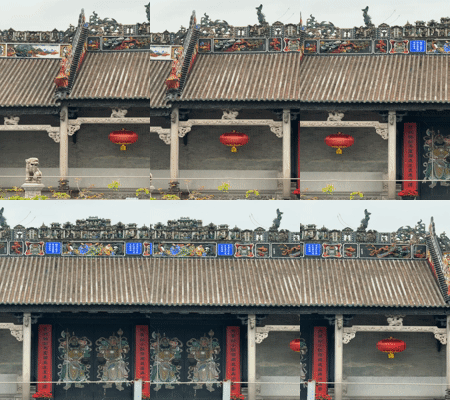
In the background, part of another signboard is visible, displaying "开馆时" (Opening Hours) and "9:30-18:" (9:30 AM - 6:00 PM), along with "弗倫會館" (Fuluin Guild Hall). A traditional Chinese-style building roof and lush green foliage are also visible behind the signboards, suggesting the location is a cultural or historical site. The ground appears to be paved with stone or concrete, and a metal stand with a concrete base supports one of the signs.
F
FM-CaIMM2

Dec 19, 2024, 6:41 AM

Guang Zhou Shi, China

Stake attention in this memory

This image features a large outdoor informational signboard detailing the history and production of Xiangyunsha (香云纱) silk. The signboard, written in Chinese, introduces Xiangyunsha as a unique natural, hand-dyed silk fabric with a 400-year history, originating from the early Ming Dynasty. It mentions its near-loss in the 1980s, its revival in 2003, and its designation as a national intangible cultural heritage in 2008. The text highlights that due to specific geographical and climatic conditions, Xiangyunsha can only be produced in the Pearl River Delta of Guangdong, China. The signboard explains that dioscorea (potato yam) tubers and river mud are used as dyes, undergoing a complex process called "three steaming, nine boiling, eighteen drying." The resulting fabric is described as stiff, beautifully textured, breathable, comfortable, healthy, odor-removing, fast-drying, and luxurious, earning it the nickname "soft gold." A section titled "Xiangyunsha Dyeing and Finishing Process" details the intricate, manual steps involved, emphasizing its complexity, long production time, and reliance on natural conditions. The process includes multiple cycles of soaking, drying, boiling, and mud treatment, with quality control heavily dependent on experienced "masters" and production dictated by the sun. Visual elements on the signboard include an image of a field with red and purple fabrics laid out, likely for drying, and another image showing brown, round objects, possibly the dioscorea tubers used in dyeing. In the background, part of another signboard is visible, displaying "开馆时" (Opening Hours) and "9:30-18:" (9:30 AM - 6:00 PM), along with "弗倫會館" (Fuluin Guild Hall). A traditional Chinese-style building roof and lush green foliage are also visible behind the signboards, suggesting the location is a cultural or historical site. The ground appears to be paved with stone or concrete, and a metal stand with a concrete base supports one of the signs.

Loading AttnAds…

transactions
revenues
stakers
Earliest
Latest
Highest stake

No transactions found

More from this user

More from Guang Zhou Shi

FFM-CaIMM2

Dec 19, 2024, 6:41 AM

Guang Zhou Shi, China

Licensed under Creative Commons Attribution 4.0 International License. You are free to share and adapt this content with proper attribution.