
Stake attention in this memory
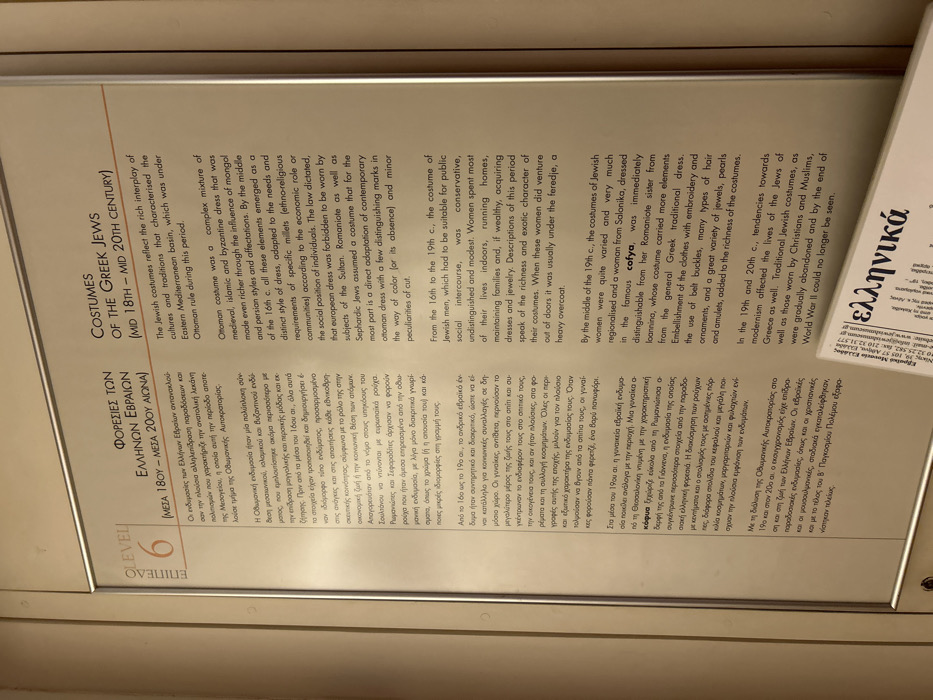
The image displays a framed informational panel, likely located within the Jewish Museum of Greece in Athens. The panel provides historical details about "COSTUMES OF THE GREEK JEWS (MID 18TH – MID 20TH CENTURY)," with text presented in both English and Greek. The text explains that Jewish costumes during this period reflected the diverse cultural influences of the Eastern Mediterranean basin under Ottoman rule. It notes that Ottoman attire was a complex mix of medieval, Islamic, and Byzantine styles, further enhanced by Mongol and Persian elements. By the 16th century, distinct dress codes emerged for various ethno-religious communities, adapted to their social and economic roles, with European dress being prohibited. Romaniote and Sephardic Jews adopted Ottoman dress with minor distinctions in color and cut. Between the 16th and 19th centuries, Jewish men's clothing was described as conservative and modest for public interactions. Women, typically spending most of their lives indoors, showcased rich and exotic dresses and jewelry. When outdoors, they would wear a "ferredje," a heavy overcoat. By the mid-19th century, Jewish women's costumes became highly regionalized, with a woman from Salonika identified by her "cofya" being distinct from a Romaniote woman from Ioannina whose attire featured more Greek traditional elements. Elaborate embroidery, belt buckles, hair ornaments, and a variety of jewels, pearls, and amulets added to the richness of these costumes. The panel concludes by stating that during the 19th and 20th centuries, modernism and the dissolution of the Ottoman Empire led to the abandonment of traditional Jewish costumes, mirroring the trends seen among Christian and Muslim populations. By the end of World War II, these traditional garments were no longer in use. A small white box to the right, possibly a brochure holder, shows "ελληνικά" (Greek) and the contact information for the Jewish Museum of Greece, including its address: Níkis 19, 105 57 Athína, Ελλάδα. The panel also features "ΕΠΙΠΕΔΟ 6" (Level 6), indicating a floor or section. A reflection of an overhead light fixture is visible on the display's glass surface.
No transactions found