
Stake attention in this memory
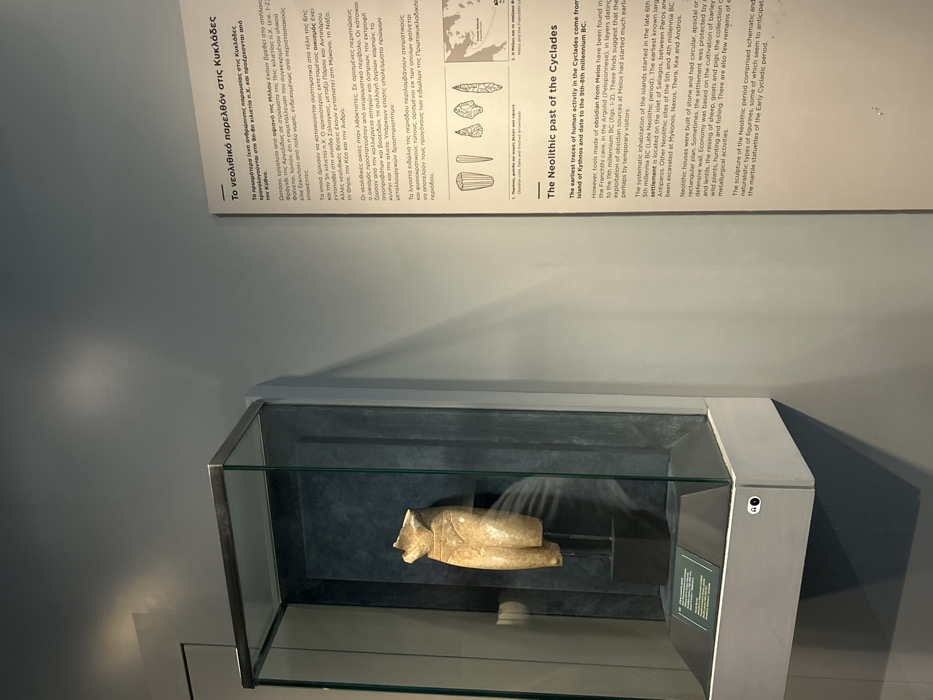
This indoor museum display features a light-colored, abstract artifact, possibly a Neolithic figurine, encased within a glass display case. The artifact has an elongated form with a distinct head and is made of what appears to be stone or ceramic, exhibiting a light, earthy tone and a somewhat rough texture. The display case has a metallic frame and a dark, possibly velvet-lined interior, with the artifact positioned centrally. To the right of the display case, a large informational panel is mounted on a light grey wall. The panel is titled "The Neolithic past of the Cyclades" in both Greek and English. The English text details the earliest traces of human activity in the Cyclades, dating to the 9th-8th millennium BC on Kythnos. It mentions obsidian tools from Melos found in the Franchthi cave (11th millennium BC), suggesting early exploitation of resources. The text describes the systematic inhabitation of the islands in the late 6th-5th millennia BC, highlighting sites like Saliagos, Mykonos, Naxos, Thera, Kea, and Andros. It further explains Neolithic houses, the economy based on agriculture, livestock, hunting, fishing, and early metallurgical activities. The panel concludes by mentioning "schematic and naturalistic types of figurines" from the Neolithic period, some of which anticipate Early Cycladic marble statuettes. Small illustrations of tools are visible on the panel. The scene is lit by artificial lighting, which creates soft shadows from the display case on the wall. The image is oriented with the display and text panel rotated 90 degrees counter-clockwise.
No transactions found