
Sign in
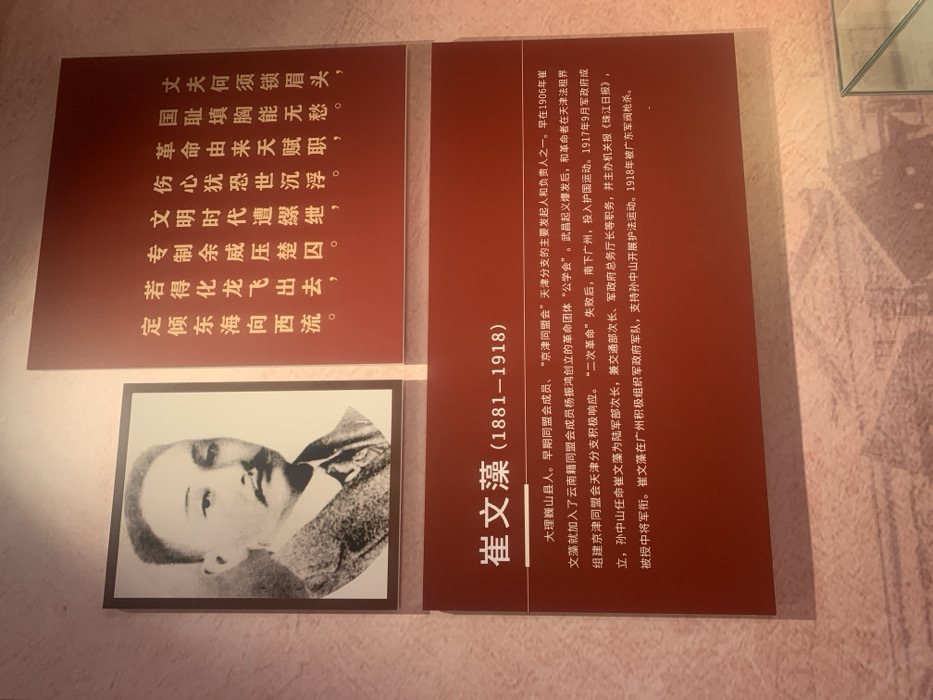
The image displays an indoor historical exhibit featuring three display panels and a black and white portrait. The scene is set in what appears to be a museum or memorial hall, with reddish-brown panels adorned with gold-colored Chinese text mounted on a light-colored wall.

The central subject is Cui Wenzao (崔文藻), whose name and life years (1881-1918) are prominently displayed. A black and white photographic portrait of a man, identified as Cui Wenzao, is positioned below the biographical panel. He is depicted with a serious expression, looking slightly upwards and to the right.

The text on the right-most panel provides a detailed biography of Cui Wenzao. It states he was from Dali Weishan County and an early member of the Tongmenghui (同盟会), a key initiator and leader of its Tianjin branch. He joined the "Gongxuehui" revolutionary group in 1906. After the Wuchang Uprising, he actively responded by forming the Tongmenghui's Tianjin branch. Following the failure of the "Second Revolution," he went south to Guangzhou and joined the National Protection Movement. In September 1917, Sun Yat-sen's military government appointed him as Deputy Minister of War, concurrently Deputy Minister of Communications, and Director of the Military Government's General Affairs Department. He also managed the official newspaper "Zhujiang Daily" and was granted the rank of Lieutenant General. Cui Wenzao actively organized military government troops in Guangzhou to support Sun Yat-sen's constitutional protection movement and was assassinated by a Guangdong warlord in 1918.

The left-most panel features a classical Chinese poem, likely associated with Cui Wenzao or the revolutionary spirit of his era. The poem expresses patriotic and revolutionary sentiments, with lines such as "Why should a man frown, when national shame fills his heart with endless sorrow? Revolution is a natural duty..."

The overall scene functions as a memorial or educational display, honoring Cui Wenzao and his contributions to the Chinese revolution. The location context provided by the user and within the text indicates a connection to Dali, China.
Emma🇨🇳💕

Feb 1, 2025

Dali, China

Stake attention in this memory

The image displays an indoor historical exhibit featuring three display panels and a black and white portrait. The scene is set in what appears to be a museum or memorial hall, with reddish-brown panels adorned with gold-colored Chinese text mounted on a light-colored wall. The central subject is Cui Wenzao (崔文藻), whose name and life years (1881-1918) are prominently displayed. A black and white photographic portrait of a man, identified as Cui Wenzao, is positioned below the biographical panel. He is depicted with a serious expression, looking slightly upwards and to the right. The text on the right-most panel provides a detailed biography of Cui Wenzao. It states he was from Dali Weishan County and an early member of the Tongmenghui (同盟会), a key initiator and leader of its Tianjin branch. He joined the "Gongxuehui" revolutionary group in 1906. After the Wuchang Uprising, he actively responded by forming the Tongmenghui's Tianjin branch. Following the failure of the "Second Revolution," he went south to Guangzhou and joined the National Protection Movement. In September 1917, Sun Yat-sen's military government appointed him as Deputy Minister of War, concurrently Deputy Minister of Communications, and Director of the Military Government's General Affairs Department. He also managed the official newspaper "Zhujiang Daily" and was granted the rank of Lieutenant General. Cui Wenzao actively organized military government troops in Guangzhou to support Sun Yat-sen's constitutional protection movement and was assassinated by a Guangdong warlord in 1918. The left-most panel features a classical Chinese poem, likely associated with Cui Wenzao or the revolutionary spirit of his era. The poem expresses patriotic and revolutionary sentiments, with lines such as "Why should a man frown, when national shame fills his heart with endless sorrow? Revolution is a natural duty..." The overall scene functions as a memorial or educational display, honoring Cui Wenzao and his contributions to the Chinese revolution. The location context provided by the user and within the text indicates a connection to Dali, China.

transactions
revenues
stakers
Earliest
Latest
Highest stake

No transactions found

More from this user

More from Dali

Emma🇨🇳💕

Feb 1, 2025

Dali, China

Licensed under Creative Commons Attribution 4.0 International License. You are free to share and adapt this content with proper attribution.