Sign in
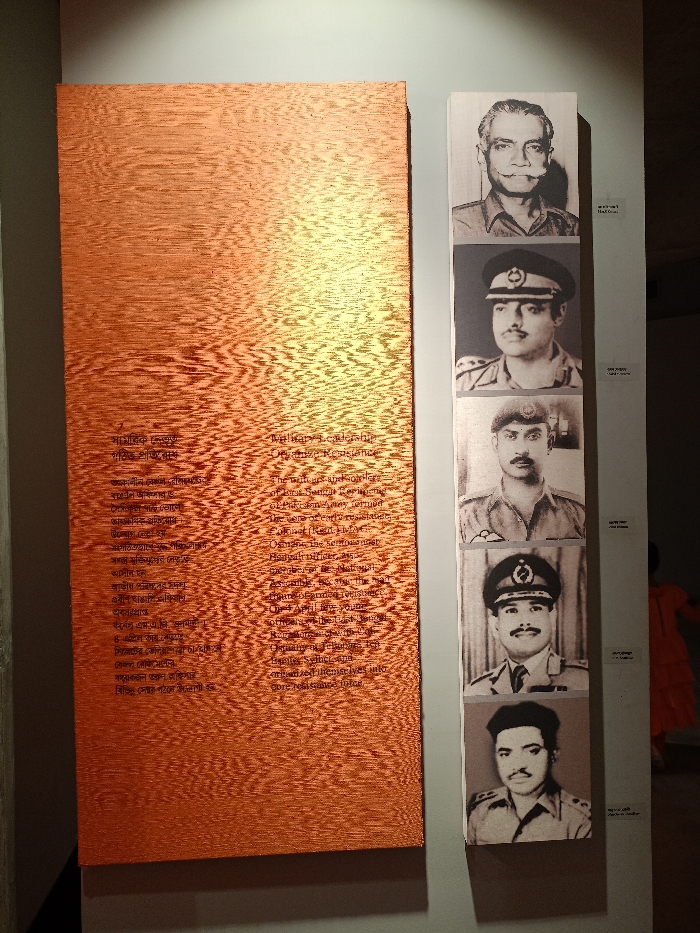
The image displays an indoor exhibition setting, likely a museum or historical display. On the left, a large vertical rectangular board with a textured, metallic-orange surface features text in both Bengali and English. The English text is visible and reads: "Military Leadership Organize Resistance. The officers and soldiers of East Bengal Regiment of Pakistan army formed the core of early resistance. Colonel (Retd.) M.A.G. Osmani, the foremost Bengali officer, and member of the National Assembly, became the first Commander-in-Chief. On 4 April 1971 under Osmani's leadership, the officers, soldiers, EPR, police, ansar and armed civilians organized themselves into core resistance force." The Bengali text appears to be a parallel translation or related information.

To the right of this board is a narrower, vertical white board featuring five black-and-white portraits stacked one above the other. These portraits depict men, primarily in military uniforms, suggesting their role in the "Military Leadership" mentioned on the adjacent board. While some names are faintly visible next to the portraits, they are largely illegible. The top portrait shows an older man with a mustache, not in uniform. The subsequent four portraits are of younger men, all appearing to be in military attire.

The scene is well-lit, with a spotlight highlighting the displays. The background wall is a plain, light greenish-gray. The overall arrangement presents a historical account of military resistance, specifically referencing the context of Bangladesh given the mention of the East Bengal Regiment and M.A.G. Osmani, prominent figures in the 1971 Liberation War.
F
FM-Ylxbz1

Dec 16, 2024, 10:24 AM

Dhaka, Bangladesh

Stake attention in this memory

The image displays an indoor exhibition setting, likely a museum or historical display. On the left, a large vertical rectangular board with a textured, metallic-orange surface features text in both Bengali and English. The English text is visible and reads: "Military Leadership Organize Resistance. The officers and soldiers of East Bengal Regiment of Pakistan army formed the core of early resistance. Colonel (Retd.) M.A.G. Osmani, the foremost Bengali officer, and member of the National Assembly, became the first Commander-in-Chief. On 4 April 1971 under Osmani's leadership, the officers, soldiers, EPR, police, ansar and armed civilians organized themselves into core resistance force." The Bengali text appears to be a parallel translation or related information. To the right of this board is a narrower, vertical white board featuring five black-and-white portraits stacked one above the other. These portraits depict men, primarily in military uniforms, suggesting their role in the "Military Leadership" mentioned on the adjacent board. While some names are faintly visible next to the portraits, they are largely illegible. The top portrait shows an older man with a mustache, not in uniform. The subsequent four portraits are of younger men, all appearing to be in military attire. The scene is well-lit, with a spotlight highlighting the displays. The background wall is a plain, light greenish-gray. The overall arrangement presents a historical account of military resistance, specifically referencing the context of Bangladesh given the mention of the East Bengal Regiment and M.A.G. Osmani, prominent figures in the 1971 Liberation War.

Loading AttnAds…

transactions
revenues
stakers
Earliest
Latest
Highest stake

No transactions found

More from this user

More from Dhaka

FFM-Ylxbz1

Dec 16, 2024, 10:24 AM

Dhaka, Bangladesh

Licensed under Creative Commons Attribution 4.0 International License. You are free to share and adapt this content with proper attribution.