
Stake attention in this memory
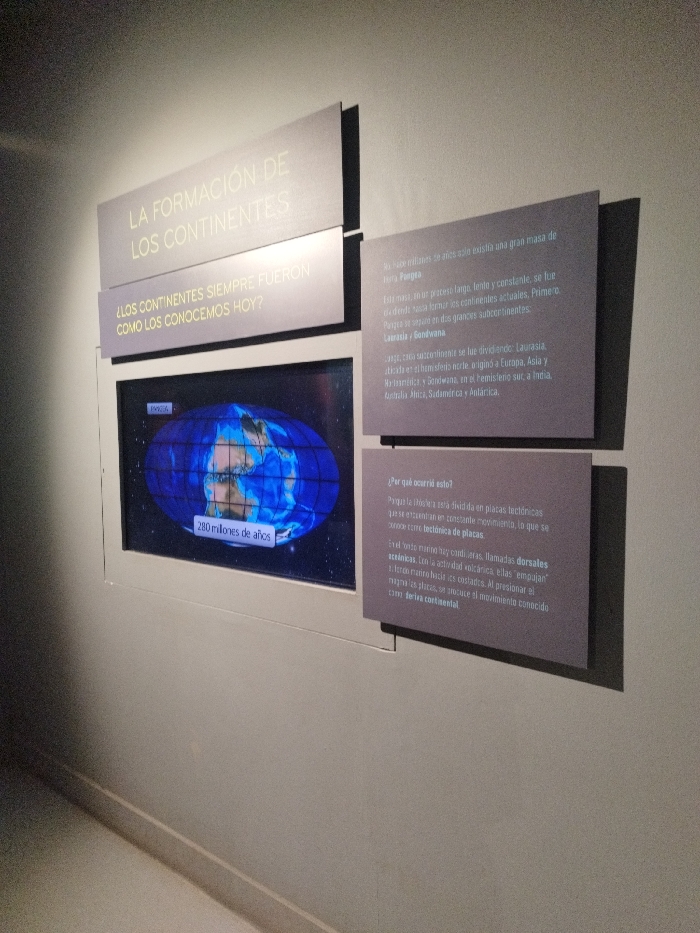
An indoor exhibit in Santiago, Chile, displays information about the formation of continents. The scene features a series of informative panels and a digital screen mounted on a light grey wall. At the top, two title panels are visible: "LA FORMACIÓN DE LOS CONTINENTES" (THE FORMATION OF THE CONTINENTS) and "¿LOS CONTINENTES SIEMPRE FUERON COMO LOS CONOCEMOS HOY?" (WERE THE CONTINENTS ALWAYS AS WE KNOW THEM TODAY?). Below these titles, a rectangular screen shows a blue and brown map of the Earth depicting a supercontinent configuration, labeled "280 millones de años" (280 million years). To the right of the screen, two additional text panels provide further details. The upper panel explains that 200 million years ago, a single landmass, Pangea, existed. Over time, it slowly and constantly divided into the current continents. Initially, Pangea separated into two major subcontinents: Laurasia and Gondwana. Laurasia, located in the northern hemisphere, gave rise to Europe, Asia, and North America, while Gondwana, in the southern hemisphere, formed India, Australia, Africa, South America, and Antarctica. The lower right panel, titled "¿Por qué ocurrió esto?" (Why did this happen?), discusses plate tectonics. It states that the lithosphere is divided into tectonic plates that are in constant movement. It also mentions oceanic ridges (dorsales oceánicas) and volcanic activity pushing magma, which in turn moves the plates, a process known as continental drift (deriva continental). The lighting suggests an indoor, museum-like setting, with no people visible.
No transactions found