
Sign in
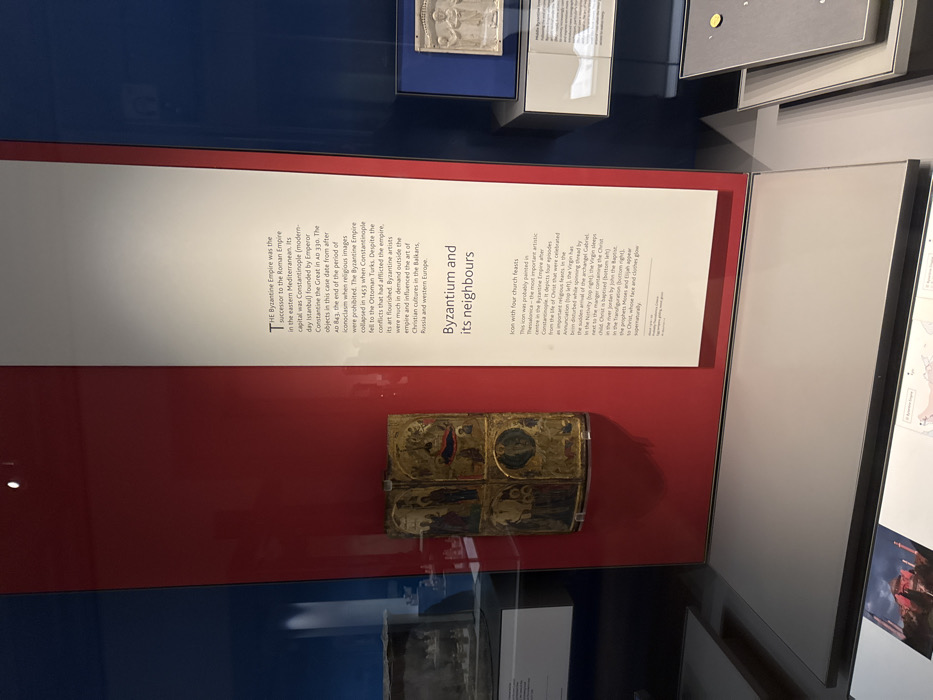
This image captures a museum exhibit, likely located in London, United Kingdom, focusing on the Byzantine Empire. The central display features a prominent gold-colored, rectangular icon with four distinct panels, each depicting a religious scene.

An adjacent white informational panel provides context, titled "Byzantium and its neighbours." The text explains that "THE Byzantine Empire was the successor to the Roman Empire in the eastern Mediterranean," with Constantinople (modern-day Istanbul) founded in AD 330. It states that the objects on display date from after AD 843, following the period of iconoclasm, and notes the empire's fall in 1453 to the Ottoman Turks. The panel highlights the flourishing Byzantine art and its influence on Christian cultures in the Balkans, Russia, and Western Europe.

A smaller text panel specifically describes the icon as an "Icon with four church feasts," probably painted in Thessalonica. It details the four episodes from the life of Christ depicted: the Annunciation (top left), the Nativity (top right), Christ's baptism by John the Baptist in the river Jordan (bottom left), and the Transfiguration with Moses and Elijah (bottom right).

The museum setting features a bold red wall section behind the icon and informational panel, flanked by blue wall segments above and below. Other display cases are visible, including one further up with a white rectangular object featuring relief carvings and another containing a small gold disc. Reflections are noticeable on the glass of the display cases, indicative of gallery lighting.
punit03

Dec 13, 2024, 4:33 PM

London, UK

Stake attention in this memory

This image captures a museum exhibit, likely located in London, United Kingdom, focusing on the Byzantine Empire. The central display features a prominent gold-colored, rectangular icon with four distinct panels, each depicting a religious scene. An adjacent white informational panel provides context, titled "Byzantium and its neighbours." The text explains that "THE Byzantine Empire was the successor to the Roman Empire in the eastern Mediterranean," with Constantinople (modern-day Istanbul) founded in AD 330. It states that the objects on display date from after AD 843, following the period of iconoclasm, and notes the empire's fall in 1453 to the Ottoman Turks. The panel highlights the flourishing Byzantine art and its influence on Christian cultures in the Balkans, Russia, and Western Europe. A smaller text panel specifically describes the icon as an "Icon with four church feasts," probably painted in Thessalonica. It details the four episodes from the life of Christ depicted: the Annunciation (top left), the Nativity (top right), Christ's baptism by John the Baptist in the river Jordan (bottom left), and the Transfiguration with Moses and Elijah (bottom right). The museum setting features a bold red wall section behind the icon and informational panel, flanked by blue wall segments above and below. Other display cases are visible, including one further up with a white rectangular object featuring relief carvings and another containing a small gold disc. Reflections are noticeable on the glass of the display cases, indicative of gallery lighting.

Loading AttnAds…

transactions
revenues
stakers
Earliest
Latest
Highest stake

No transactions found

More from this user

More from London

punit03

Dec 13, 2024, 4:33 PM

London, UK

Licensed under Creative Commons Attribution 4.0 International License. You are free to share and adapt this content with proper attribution.