Sign in
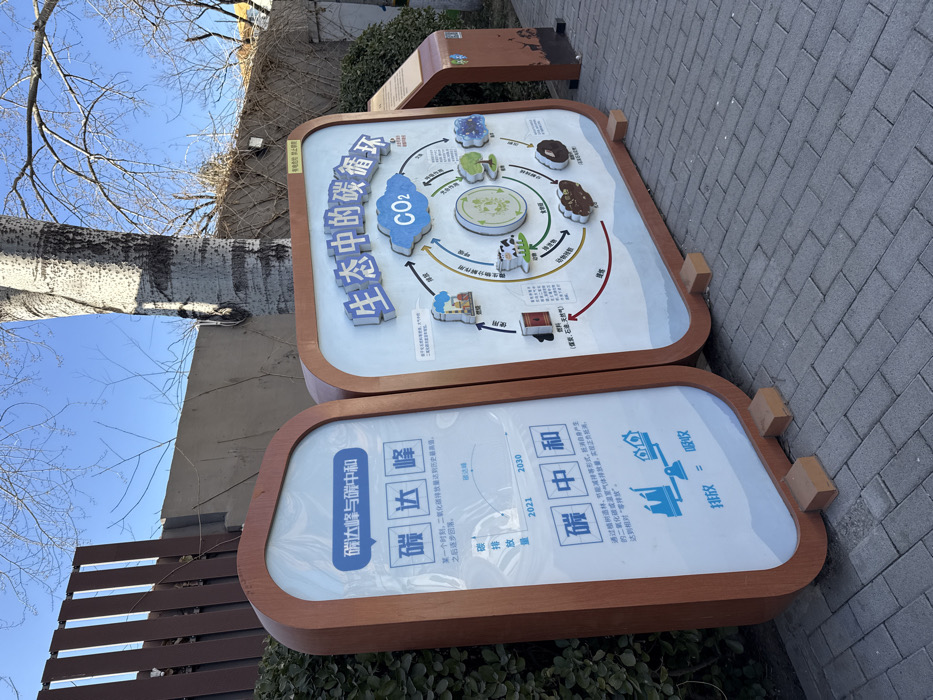
This full-shot, outdoor image, likely taken in Beijing, China, features two vertically oriented, rectangular informational boards with rounded wooden frames, displayed on a paved surface. The sky is bright blue with a few bare tree branches visible on the left, suggesting a clear day in late winter or early spring.

The top board illustrates the "生态中的碳循环" (Carbon Cycle in Ecosystems). A central circular diagram shows CO2 in the atmosphere, absorbed by plants via "光合作用" (photosynthesis), which are then consumed by animals (represented by a cow). Organic matter undergoes "分解作用" (decomposition), returning CO2 to the atmosphere. Human activities are also depicted, showing "使用" (use) of "化石燃料 (煤、石油、天然气)" (fossil fuels - coal, petroleum, natural gas) from underground, powering factories that "产生" (generate) CO2, and residential houses also contributing.

The bottom board explains "碳达峰与碳中和" (Carbon Peak and Carbon Neutrality). It defines "碳达峰" (Carbon Peak) as the moment when "二氧化碳排放量达到历史最高。之后逐步回落。" (carbon dioxide emissions reach an historical high, then gradually decline). A graph illustrates "碳排放量" (Carbon emissions) peaking between 2021 and 2030. "碳中和" (Carbon Neutrality) is defined as achieving "相对‘零排放’" (relative 'net-zero emissions') by "通过植树造林、节能减排等形式" (through afforestation, energy conservation, and emission reduction) to offset "二氧化碳或温室气体排放量" (carbon dioxide or greenhouse gas emissions). A simple equation "排放 = 吸收" (Emissions = Absorption/Offset) is shown with icons of a factory and a tree.

The boards are positioned on a grey brick-paved path, with a tree trunk visible on the far left and a dark fence or wall in the background. No people are present in the frame.
Laurent

Feb 25, 2025, 7:57 AM

Beijing, China

Stake attention in this memory

This full-shot, outdoor image, likely taken in Beijing, China, features two vertically oriented, rectangular informational boards with rounded wooden frames, displayed on a paved surface. The sky is bright blue with a few bare tree branches visible on the left, suggesting a clear day in late winter or early spring. The top board illustrates the "生态中的碳循环" (Carbon Cycle in Ecosystems). A central circular diagram shows CO2 in the atmosphere, absorbed by plants via "光合作用" (photosynthesis), which are then consumed by animals (represented by a cow). Organic matter undergoes "分解作用" (decomposition), returning CO2 to the atmosphere. Human activities are also depicted, showing "使用" (use) of "化石燃料 (煤、石油、天然气)" (fossil fuels - coal, petroleum, natural gas) from underground, powering factories that "产生" (generate) CO2, and residential houses also contributing. The bottom board explains "碳达峰与碳中和" (Carbon Peak and Carbon Neutrality). It defines "碳达峰" (Carbon Peak) as the moment when "二氧化碳排放量达到历史最高。之后逐步回落。" (carbon dioxide emissions reach an historical high, then gradually decline). A graph illustrates "碳排放量" (Carbon emissions) peaking between 2021 and 2030. "碳中和" (Carbon Neutrality) is defined as achieving "相对‘零排放’" (relative 'net-zero emissions') by "通过植树造林、节能减排等形式" (through afforestation, energy conservation, and emission reduction) to offset "二氧化碳或温室气体排放量" (carbon dioxide or greenhouse gas emissions). A simple equation "排放 = 吸收" (Emissions = Absorption/Offset) is shown with icons of a factory and a tree. The boards are positioned on a grey brick-paved path, with a tree trunk visible on the far left and a dark fence or wall in the background. No people are present in the frame.

Loading AttnAds…

transactions
revenues
stakers
Earliest
Latest
Highest stake

No transactions found

More from this user

More from Beijing

Laurent

Feb 25, 2025, 7:57 AM

Beijing, China

Licensed under Creative Commons Attribution 4.0 International License. You are free to share and adapt this content with proper attribution.