Stake attention in this memory
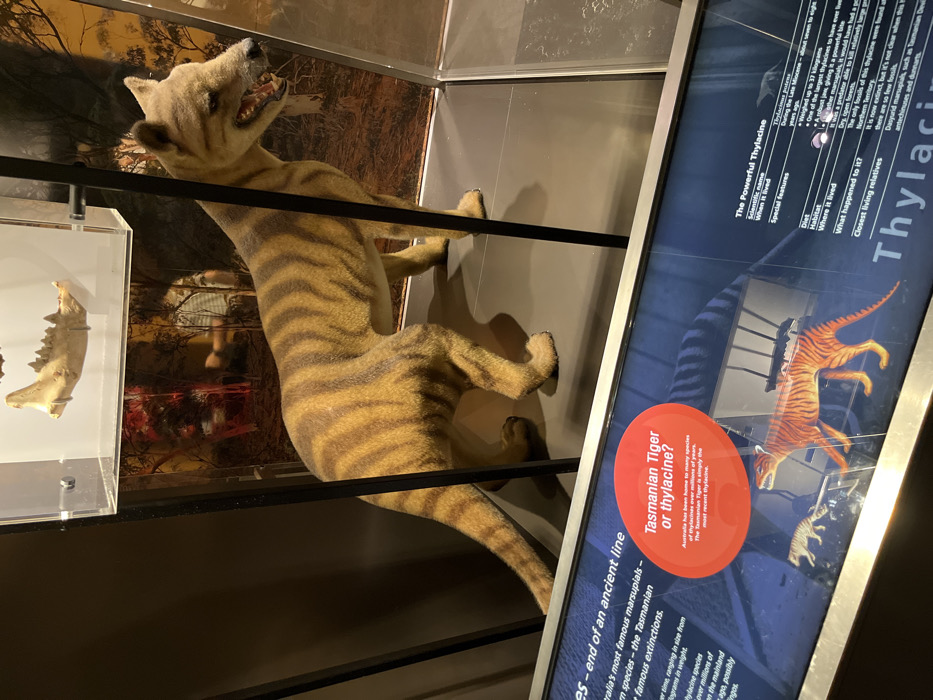
This media file captures a museum exhibit in Sydney, Australia, showcasing a taxidermy model of a Thylacine, also known as the Tasmanian Tiger. The central subject is the life-sized, yellowish-brown marsupial model with prominent dark stripes running across its back and tail. It is displayed in a glass case, posed dynamically with its mouth open, revealing teeth, suggesting a predatory nature. The background inside the case is a painted diorama, depicting a natural environment with trees and earthy tones. To the right of the display case is a brightly lit information panel. A red circular overlay on this panel poses the question, "Tasmanian Tiger or thylacine?", followed by text clarifying that the Tasmanian Tiger is the most recent of many thylacine species Australia has hosted over millions of years. The panel's main title is "The Powerful Thylacine," with sections detailing its "Scientific name," "When it lived," "Special features," "Diet," "Habitat," "Where it lived," "What happened to it?", and "Closest living relatives." Visible text snippets state it lived during the Late Miocene (seven to eight million years ago), weighed up to 37 kilograms, possessed robust jaws, was a predator in dry open forests, and is now extinct. The panel also features an artistic rendering of a striped animal, likely a thylacine, in a running pose. Reflections of people, including a torso wearing a light-colored, possibly striped, shirt, are visible in the glass of the display case, indicating an indoor setting with visitors. In a smaller clear case below the thylacine's head, a bone or fossil fragment is displayed. The image effectively portrays a museum exhibit designed to inform the public about this iconic extinct animal.
No transactions found