
Sign in
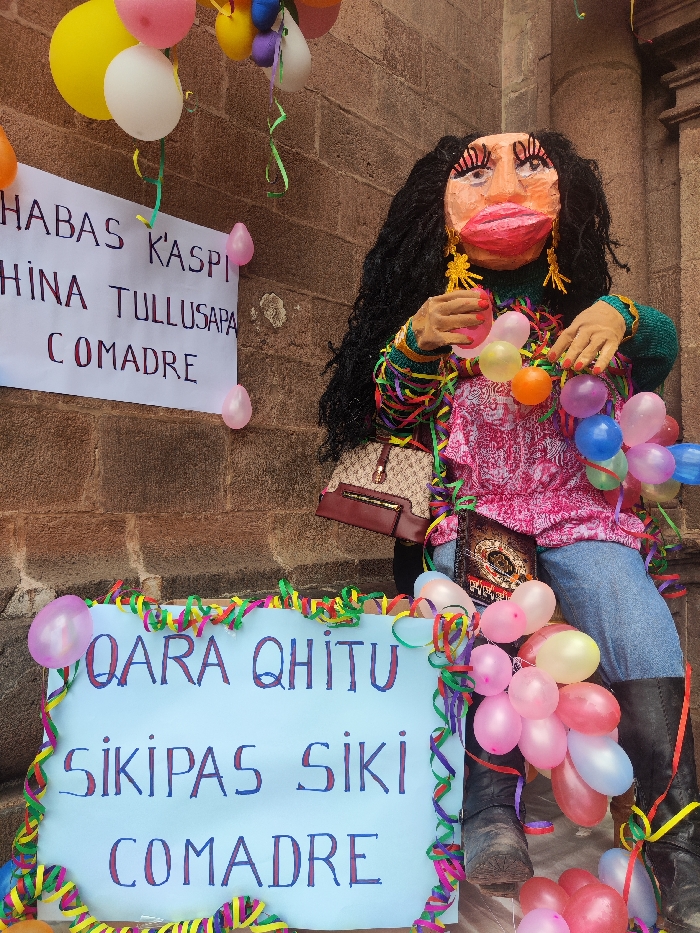
The image captures a vibrant and festive scene, centered around a large, elaborately decorated effigy of a woman. The effigy features a distinct paper mache face with exaggerated features: very large pink lips, wide eyes adorned with long black eyelashes, and prominent black eyebrows. It has long, black, curly hair, possibly made of yarn.

The effigy is dressed in a green knitted long-sleeved top worn over a pink patterned blouse, blue jeans, and black boots. Accessories include large gold, starburst-shaped dangling earrings and a brown patterned handbag slung over its left shoulder. Its hands, which appear to be sculpted, have painted red fingernails and are holding clusters of small, colorful balloons (pink, yellow, orange, blue, white). Numerous colorful streamers (red, green, blue, yellow, purple) are wrapped around its arms and torso, further contributing to the festive attire. A small, dark-covered book or object with intricate designs is tucked into its waist area.

The background consists of a reddish-brown brick or stone wall, suggesting an old building or structure, with architectural details resembling columns visible on the right. The entire setting is adorned with an abundance of colorful balloons and streamers. Bunches of yellow, pink, white, and purple balloons hang from above, some with green ribbons. Smaller pink balloons are attached directly to the wall near the upper sign, and more colorful balloons are scattered around the base of the effigy and the lower sign.

Two signs, likely made of poster board, are prominent in the scene:
1.  The upper sign, attached to the wall, reads:
    "HABAS K'ASPI"
    "HINA TULLUSAPA"
    "COMADRE"
    The letters are primarily dark blue or purple, with "COMADRE" in dark red/maroon.
2.  The lower sign, propped up in front of the effigy, reads:
    "QARA QHITU"
    "SIKIPAS SIKI"
    "COMADRE"
    Similar to the upper sign, the letters are dark blue or purple, with "COMADRE" in dark red/maroon. Both signs are bordered with colorful streamers.

The overall impression is that of a carnival or folk festival celebration, likely associated with a cultural event in an Andean region of South America, given the mix of indigenous language phrases and Spanish ("Comadre") on the signs. The effigy itself is a central figure in this colorful and joyous event, possibly representing a caricature or a traditional figure associated with the festivities. The lighting suggests it is daytime.
Milu 🌸

Feb 12, 2026

Cuzco, Peru

Stake attention in this memory

Festive
Humorous
Exaggerated
Bizarre
Playful

The image captures a vibrant and festive scene, centered around a large, elaborately decorated effigy of a woman. The effigy features a distinct paper mache face with exaggerated features: very large pink lips, wide eyes adorned with long black eyelashes, and prominent black eyebrows. It has long, black, curly hair, possibly made of yarn. The effigy is dressed in a green knitted long-sleeved top worn over a pink patterned blouse, blue jeans, and black boots. Accessories include large gold, starburst-shaped dangling earrings and a brown patterned handbag slung over its left shoulder. Its hands, which appear to be sculpted, have painted red fingernails and are holding clusters of small, colorful balloons (pink, yellow, orange, blue, white). Numerous colorful streamers (red, green, blue, yellow, purple) are wrapped around its arms and torso, further contributing to the festive attire. A small, dark-covered book or object with intricate designs is tucked into its waist area. The background consists of a reddish-brown brick or stone wall, suggesting an old building or structure, with architectural details resembling columns visible on the right. The entire setting is adorned with an abundance of colorful balloons and streamers. Bunches of yellow, pink, white, and purple balloons hang from above, some with green ribbons. Smaller pink balloons are attached directly to the wall near the upper sign, and more colorful balloons are scattered around the base of the effigy and the lower sign. Two signs, likely made of poster board, are prominent in the scene: 1. The upper sign, attached to the wall, reads: "HABAS K'ASPI" "HINA TULLUSAPA" "COMADRE" The letters are primarily dark blue or purple, with "COMADRE" in dark red/maroon. 2. The lower sign, propped up in front of the effigy, reads: "QARA QHITU" "SIKIPAS SIKI" "COMADRE" Similar to the upper sign, the letters are dark blue or purple, with "COMADRE" in dark red/maroon. Both signs are bordered with colorful streamers. The overall impression is that of a carnival or folk festival celebration, likely associated with a cultural event in an Andean region of South America, given the mix of indigenous language phrases and Spanish ("Comadre") on the signs. The effigy itself is a central figure in this colorful and joyous event, possibly representing a caricature or a traditional figure associated with the festivities. The lighting suggests it is daytime.

transactions
revenues
stakers
Earliest
Latest
Highest stake

No transactions found

More from this user

More from Cuzco

Milu 🌸

Feb 12, 2026

Cuzco, Peru

Licensed under Creative Commons Attribution 4.0 International License. You are free to share and adapt this content with proper attribution.