
Sign in
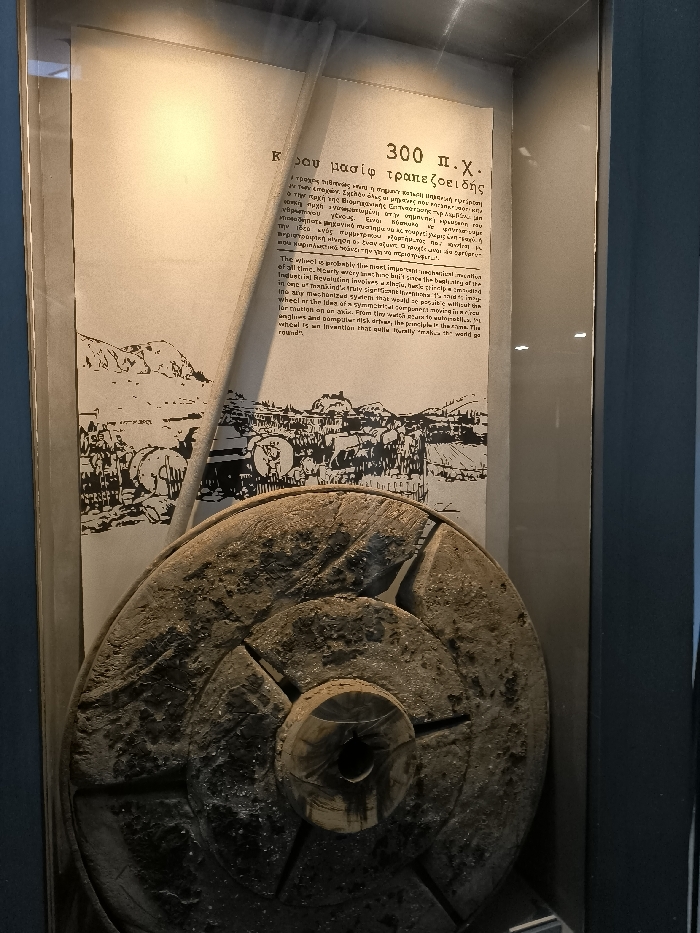
This media file captures an exhibit inside a display case, likely in a museum in Athens, Greece. The primary subject in the foreground is a large, rough-textured, circular stone object, resembling a millstone or an ancient wheel. It is segmented into several wedge-like sections, with a central circular hub where an axle would have been fitted. The stone appears weathered and worn, with visible grooves and debris.

Behind the stone object, a document with both text and an illustration is displayed. The document has a cream or light yellow hue, suggesting aged paper. A bright light source is illuminating the upper part of the document, causing a glare.

The visible text on the document includes both Greek and English. The Greek text at the top mentions "300 π.χ." (300 BC) and "Κτου μασίφ τραπεζοειδής". Below, the English text states: "The wheel is probably the most important mechanical invention of all time. Nearly every machine built since the beginning of the Industrial Revolution involves a wheel; here is one, a mankind's truly significant invention. Is there any mechanized system that would be possible without the wheel or the idea of a symmetrical component moving in circular motion on an axis? From tiny watch gears to automobiles, engines and computer disk drives, the principle is the same. The wheel is an invention that quite literally 'makes the world go round'."

At the bottom of the document, a black and white illustration depicts an ancient or historical scene with multiple wheeled vehicles, possibly chariots or carts, in a landscape with distant mountains or structures. The scene suggests activities related to transport or industry.

The setting is an indoor exhibit, indicated by the display case and artificial lighting. The overall impression is one of historical education, showcasing the significance of the wheel.
FM-DtDaN2

Jan 12, 2025

Athina, Greece

Stake attention in this memory

This media file captures an exhibit inside a display case, likely in a museum in Athens, Greece. The primary subject in the foreground is a large, rough-textured, circular stone object, resembling a millstone or an ancient wheel. It is segmented into several wedge-like sections, with a central circular hub where an axle would have been fitted. The stone appears weathered and worn, with visible grooves and debris. Behind the stone object, a document with both text and an illustration is displayed. The document has a cream or light yellow hue, suggesting aged paper. A bright light source is illuminating the upper part of the document, causing a glare. The visible text on the document includes both Greek and English. The Greek text at the top mentions "300 π.χ." (300 BC) and "Κτου μασίφ τραπεζοειδής". Below, the English text states: "The wheel is probably the most important mechanical invention of all time. Nearly every machine built since the beginning of the Industrial Revolution involves a wheel; here is one, a mankind's truly significant invention. Is there any mechanized system that would be possible without the wheel or the idea of a symmetrical component moving in circular motion on an axis? From tiny watch gears to automobiles, engines and computer disk drives, the principle is the same. The wheel is an invention that quite literally 'makes the world go round'." At the bottom of the document, a black and white illustration depicts an ancient or historical scene with multiple wheeled vehicles, possibly chariots or carts, in a landscape with distant mountains or structures. The scene suggests activities related to transport or industry. The setting is an indoor exhibit, indicated by the display case and artificial lighting. The overall impression is one of historical education, showcasing the significance of the wheel.

transactions
revenues
stakers
Earliest
Latest
Highest stake

No transactions found

More from this user

More from Athina

FM-DtDaN2

Jan 12, 2025

Athina, Greece

Licensed under Creative Commons Attribution 4.0 International License. You are free to share and adapt this content with proper attribution.