
Sign in
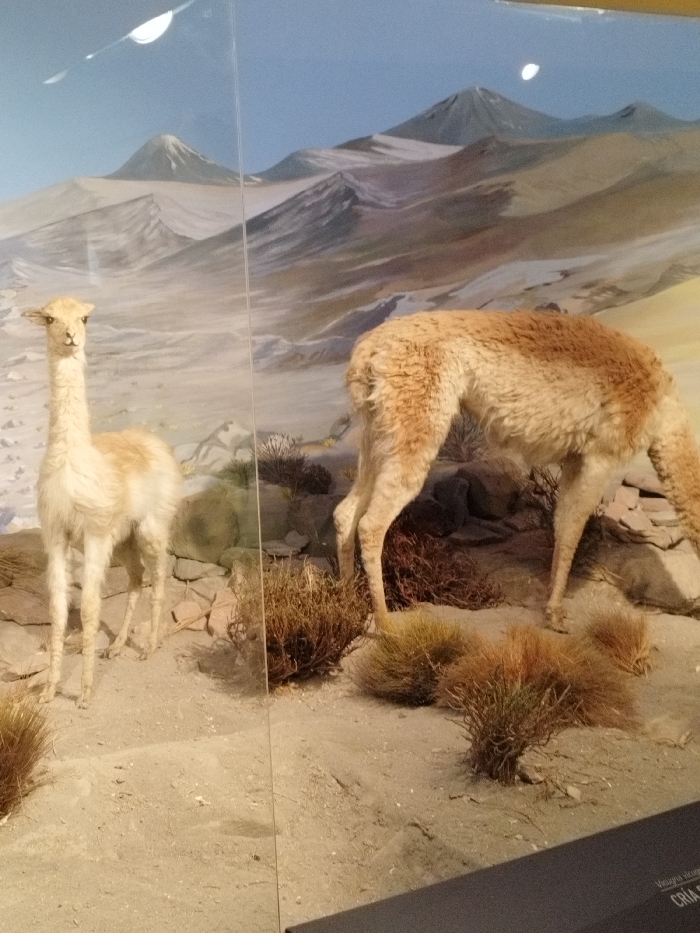
The image captures a museum diorama showcasing two taxidermied vicuñas within a glass enclosure, set against a painted backdrop of the Andean mountains. The scene depicts an arid, high-altitude environment, featuring sandy slopes and peaks, some with remnants of snow, under a light blue sky.

In the foreground, one vicuña stands prominently on the left, facing the viewer with its long neck and head held high. It has light, creamy-colored fur. To its right, another vicuña, with slightly darker, more golden-brown fur, is positioned with its body bent down, appearing to graze on the sparse, dry vegetation on the rocky, sandy ground. Several tufts of reddish-brown and green-yellow dry grasses or bushes are scattered around the base of the display.

A prominent vertical line, likely the seam of the glass panel, runs down the middle of the image. Reflections of overhead lights or the museum ceiling are visible in the upper part of the glass. At the bottom right, a dark informational plaque is partially visible, showing white text that reads "Vicugna vicugna," the scientific name for a vicuña, and below it, partially, "CRÍA S," which likely refers to a young animal ("cria"). The exhibit effectively creates an immersive representation of the vicuña's natural habitat, likely in a museum in Santiago, Chile.
Mrv

Jan 7, 2025

Santiago, Chile

Stake attention in this memory

The image captures a museum diorama showcasing two taxidermied vicuñas within a glass enclosure, set against a painted backdrop of the Andean mountains. The scene depicts an arid, high-altitude environment, featuring sandy slopes and peaks, some with remnants of snow, under a light blue sky. In the foreground, one vicuña stands prominently on the left, facing the viewer with its long neck and head held high. It has light, creamy-colored fur. To its right, another vicuña, with slightly darker, more golden-brown fur, is positioned with its body bent down, appearing to graze on the sparse, dry vegetation on the rocky, sandy ground. Several tufts of reddish-brown and green-yellow dry grasses or bushes are scattered around the base of the display. A prominent vertical line, likely the seam of the glass panel, runs down the middle of the image. Reflections of overhead lights or the museum ceiling are visible in the upper part of the glass. At the bottom right, a dark informational plaque is partially visible, showing white text that reads "Vicugna vicugna," the scientific name for a vicuña, and below it, partially, "CRÍA S," which likely refers to a young animal ("cria"). The exhibit effectively creates an immersive representation of the vicuña's natural habitat, likely in a museum in Santiago, Chile.

transactions
revenues
stakers
Earliest
Latest
Highest stake

No transactions found

More from this user

More from Santiago

Mrv

Jan 7, 2025

Santiago, Chile

Licensed under Creative Commons Attribution 4.0 International License. You are free to share and adapt this content with proper attribution.