Sign in
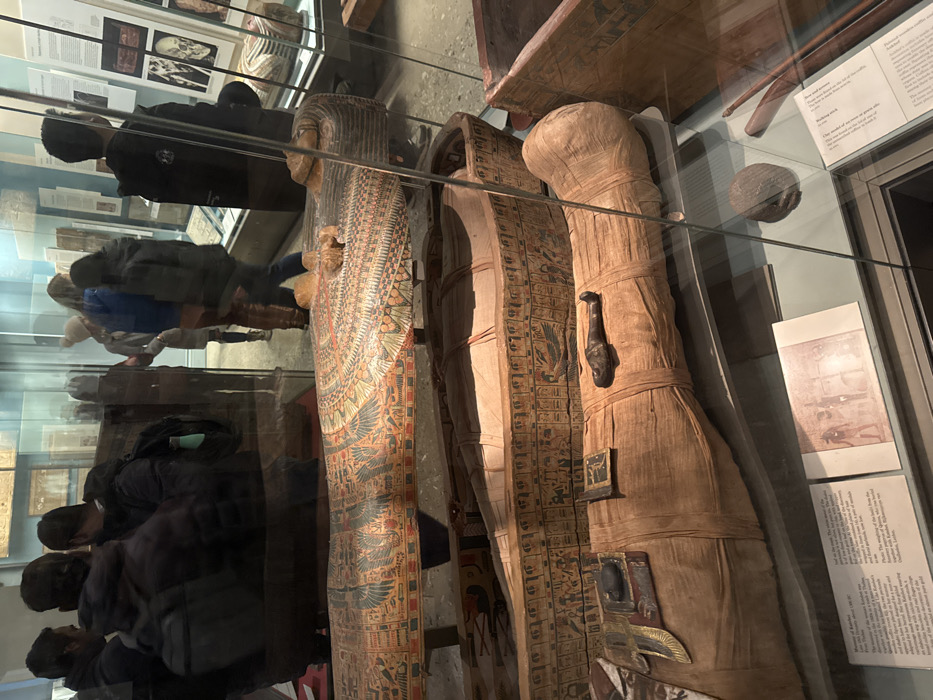
This image captures an exhibit within a museum, showcasing ancient Egyptian funerary objects and mummified remains behind a glass display case. The scene is dominated by two primary items: a vibrantly painted wooden coffin or sarcophagus on the left, and a wrapped mummy or inner coffin to its right.

The coffin on the left features a stylized human face and is richly decorated with multi-colored hieroglyphs and winged deities, illustrating intricate Egyptian artistry. Adjacent to it, a linen-wrapped mummy or inner coffin is also adorned with rows of hieroglyphic text and various attached amulets, including a dark, stylized head and rectangular plaques. Further to the right, another more simply wrapped form, likely a mummy, is visible, alongside other artifacts such as a round, textured object and a long, slender tool.

The glass of the display case heavily reflects the museum interior and visitors. Reflections of several individuals, including one prominent person in a dark jacket and hat, are visible, suggesting people are actively viewing the exhibit.

Informational plaques are present on the right side of the display. One plaque titled "Bone and papyrus" discusses "Ancient Egyptian scribes" and "medical papyri" providing insight into "diseases suffered by the ancient Egyptians," with studies in "1907" confirming conditions like "arthritis, dental problems." Another plaque, titled "Funerary rituals: the preparation of the dead," explains the mummification process, including the placement of organs in "canopic jars." Crucially, this plaque also mentions "Tutankhamun and the burial goods of Yuya and Tuya, also in the British Museum, London," confirming the specific location as the British Museum in London, United Kingdom.
punit03

Dec 13, 2024, 3:32 PM

London, UK

Stake attention in this memory

This image captures an exhibit within a museum, showcasing ancient Egyptian funerary objects and mummified remains behind a glass display case. The scene is dominated by two primary items: a vibrantly painted wooden coffin or sarcophagus on the left, and a wrapped mummy or inner coffin to its right. The coffin on the left features a stylized human face and is richly decorated with multi-colored hieroglyphs and winged deities, illustrating intricate Egyptian artistry. Adjacent to it, a linen-wrapped mummy or inner coffin is also adorned with rows of hieroglyphic text and various attached amulets, including a dark, stylized head and rectangular plaques. Further to the right, another more simply wrapped form, likely a mummy, is visible, alongside other artifacts such as a round, textured object and a long, slender tool. The glass of the display case heavily reflects the museum interior and visitors. Reflections of several individuals, including one prominent person in a dark jacket and hat, are visible, suggesting people are actively viewing the exhibit. Informational plaques are present on the right side of the display. One plaque titled "Bone and papyrus" discusses "Ancient Egyptian scribes" and "medical papyri" providing insight into "diseases suffered by the ancient Egyptians," with studies in "1907" confirming conditions like "arthritis, dental problems." Another plaque, titled "Funerary rituals: the preparation of the dead," explains the mummification process, including the placement of organs in "canopic jars." Crucially, this plaque also mentions "Tutankhamun and the burial goods of Yuya and Tuya, also in the British Museum, London," confirming the specific location as the British Museum in London, United Kingdom.

Loading AttnAds…

transactions
revenues
stakers
Earliest
Latest
Highest stake

No transactions found

More from this user

More from London

punit03

Dec 13, 2024, 3:32 PM

London, UK

Licensed under Creative Commons Attribution 4.0 International License. You are free to share and adapt this content with proper attribution.