Sign in
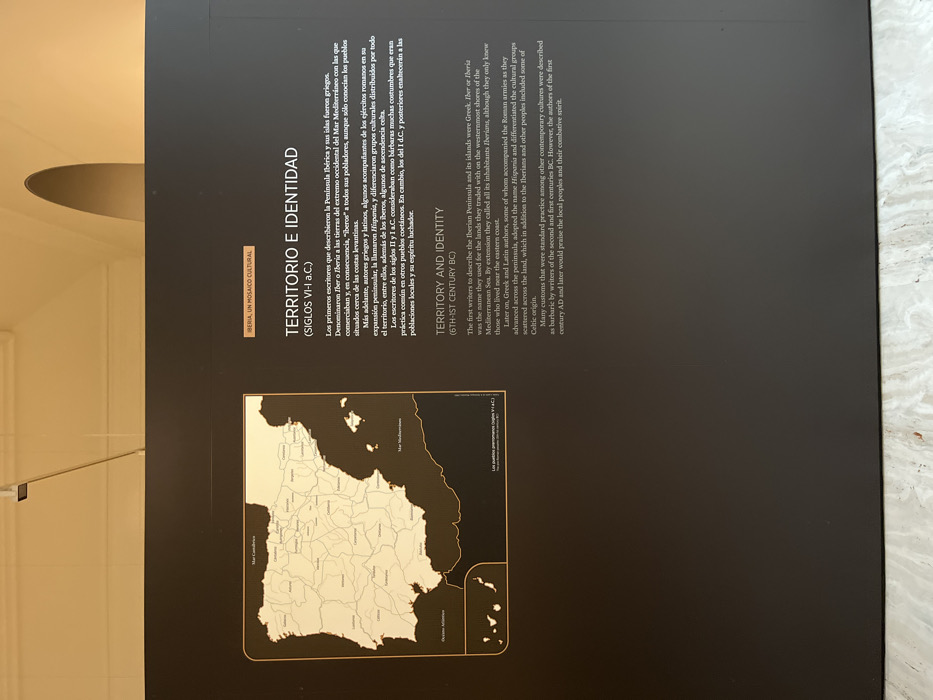
The image shows a museum exhibit inside the Museo Nacional de Antropología in Madrid, Spain (latitude: 40.424, longitude: -3.689). The exhibit features a large dark brown rectangular panel with a caption in Spanish and English about the territory and identity of the Iberian Peninsula. The exhibit text describes how the first writers to describe the peninsula used the term "Iberia" or "Hibernia," and that these writers traded with its inhabitants, but only knew those who lived near the eastern coast. The exhibit text goes on to explain that later, Greek and Latin writers accompanied Roman armies as they advanced across the peninsula and adopted names that differentiated the cultural groups of inhabitants of the land, which in addition to the Iberians and Hispani, included some of Celtic origin.  The exhibit text describes many customs that were standard practice among contemporary cultures that were described as barbaric by writers of the second and first centuries BC, but that authors of the first century AD would later praise the local peoples and their combative spirit. The exhibit also features a large map of the Iberian Peninsula with the names of different places and regions in Spanish.  The map is outlined in a gold-like frame.
FM-lnhCZ2

Apr 12, 2025, 1:58 PM

Madrid, Spain

Stake attention in this memory

historical
informative
educational
cultural
academic

The image shows a museum exhibit inside the Museo Nacional de Antropología in Madrid, Spain (latitude: 40.424, longitude: -3.689). The exhibit features a large dark brown rectangular panel with a caption in Spanish and English about the territory and identity of the Iberian Peninsula. The exhibit text describes how the first writers to describe the peninsula used the term "Iberia" or "Hibernia," and that these writers traded with its inhabitants, but only knew those who lived near the eastern coast. The exhibit text goes on to explain that later, Greek and Latin writers accompanied Roman armies as they advanced across the peninsula and adopted names that differentiated the cultural groups of inhabitants of the land, which in addition to the Iberians and Hispani, included some of Celtic origin. The exhibit text describes many customs that were standard practice among contemporary cultures that were described as barbaric by writers of the second and first centuries BC, but that authors of the first century AD would later praise the local peoples and their combative spirit. The exhibit also features a large map of the Iberian Peninsula with the names of different places and regions in Spanish. The map is outlined in a gold-like frame.

Loading AttnAds…

transactions
revenues
stakers
Earliest
Latest
Highest stake

No transactions found

More from this user

More from Madrid

FM-lnhCZ2

Apr 12, 2025, 1:58 PM

Madrid, Spain

Licensed under Creative Commons Attribution 4.0 International License. You are free to share and adapt this content with proper attribution.