Sign in
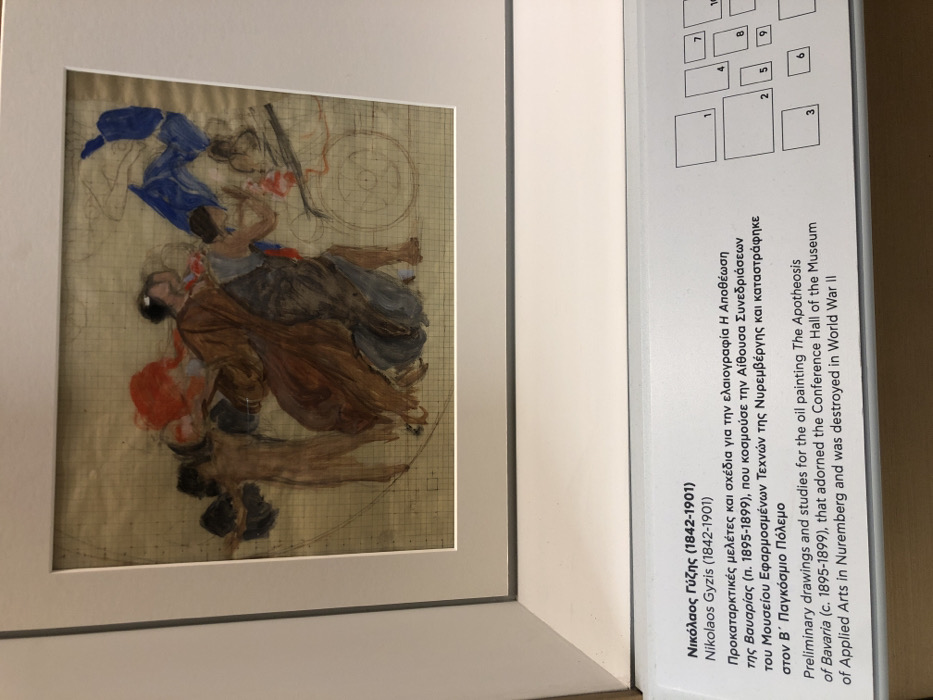
The image captures a framed artwork displayed in what appears to be a museum or gallery in Athens, Greece. The artwork is a preliminary drawing or sketch by Nikolaos Gyzis (1842-1901), rendered on gridded paper. It depicts a dynamic, multi-figure composition, likely an allegorical scene, with some areas colored in muted tones of blue, reddish-brown, and dark grey. The figures are draped in classical attire, suggesting an "apotheosis" or an ascent. The use of gridded paper indicates a focus on composition and scale, common for preparatory studies.

To the right of the framed artwork, a white informational label provides details in both Greek and English. The text identifies the piece as "Preliminary drawings and studies for the oil painting The Apotheosis of Bavaria (c. 1895-1899), that adorned the Conference Hall of the Museum of Applied Arts in Nuremberg and was destroyed in World War II." Above the text, a diagram with numbered rectangular shapes (1 through 10) is visible, possibly illustrating a layout or sequence related to the artwork's original context. The overall setting is brightly lit, showcasing the artwork and its explanatory label.
FM-nSho83

Dec 18, 2024

Athina, Greece

Stake attention in this memory

The image captures a framed artwork displayed in what appears to be a museum or gallery in Athens, Greece. The artwork is a preliminary drawing or sketch by Nikolaos Gyzis (1842-1901), rendered on gridded paper. It depicts a dynamic, multi-figure composition, likely an allegorical scene, with some areas colored in muted tones of blue, reddish-brown, and dark grey. The figures are draped in classical attire, suggesting an "apotheosis" or an ascent. The use of gridded paper indicates a focus on composition and scale, common for preparatory studies. To the right of the framed artwork, a white informational label provides details in both Greek and English. The text identifies the piece as "Preliminary drawings and studies for the oil painting The Apotheosis of Bavaria (c. 1895-1899), that adorned the Conference Hall of the Museum of Applied Arts in Nuremberg and was destroyed in World War II." Above the text, a diagram with numbered rectangular shapes (1 through 10) is visible, possibly illustrating a layout or sequence related to the artwork's original context. The overall setting is brightly lit, showcasing the artwork and its explanatory label.

transactions
revenues
stakers
Earliest
Latest
Highest stake

No transactions found

More from this user

More from Athina

FM-nSho83

Dec 18, 2024

Athina, Greece

Licensed under Creative Commons Attribution 4.0 International License. You are free to share and adapt this content with proper attribution.