
Stake attention in this memory
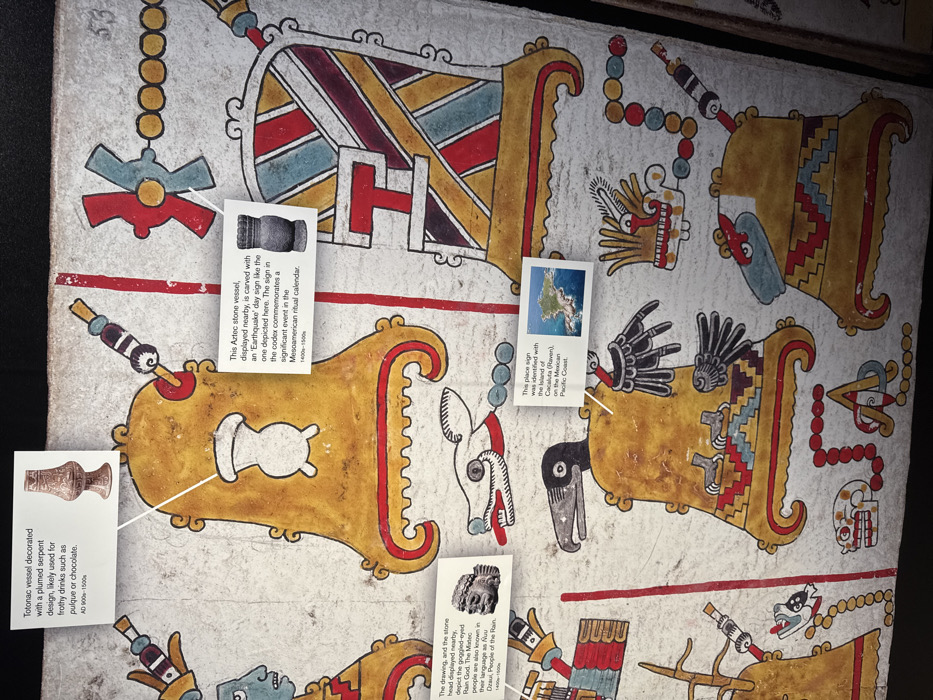
An overhead view captures a section of a large, colorful Mesoamerican codex or mural on display, likely within a museum exhibition in London, United Kingdom. The artwork features intricate, stylized figures and symbols in a vibrant palette of yellow, red, blue, green, and black on a light, textured background. Several white informational labels with explanatory text and small reference images are placed on the artwork, connected by thin white lines to specific elements within the design. These labels elucidate the cultural significance of the depicted imagery. One label identifies a stylized vessel as a "Totonac vessel decorated with a plumed serpent design, likely used for frothy drinks such as pulque or chocolate," dated AD 900-1500. Another describes an "Aztec stone vessel" with an 'Earthquake' day sign, commemorating a "significant event in the Mesoamerican ritual calendar" from 1400-1500. A third label, accompanied by a small image of an island, explains that a bird-like figure represents "the Island of Cacaluta (Raven) on the Mexican Pacific Coast." The final visible label points to a goggled-eyed figure, identifying it as the "Rain God," known as "Nuu Dzaui, People of the Rain" in Mixtec culture, dated 1400-1500. The scene presents a static display, inviting viewers to learn about ancient Mesoamerican civilizations and their art, rituals, and mythology. The artwork's detailed designs and the historical context provided by the labels highlight the rich cultural heritage being preserved and shared. The textured surface of the artwork suggests it is either a reproduction or a well-preserved original artifact.
Loading AttnAds…
No transactions found