Sign in
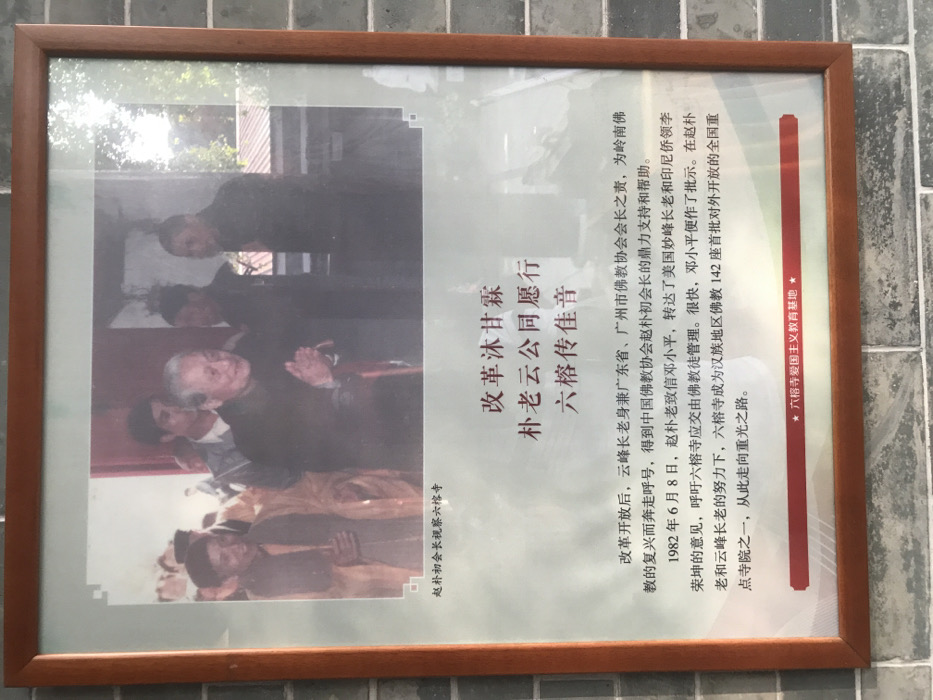
A framed picture hangs on a textured wall. The picture contains a historical photograph and a block of Chinese text. The photograph, taken in daylight, features several men gathered in what appears to be a formal setting, possibly a temple courtyard. In the foreground, an elderly man with white hair and glasses, wearing a dark suit, respectfully holds his hands together. Other men in dark suits and traditional robes are visible around him. Hints of outdoor scenery, possibly trees or a building, can be seen in the background.

The accompanying Chinese text provides context for the image:
- The main title reads "改革沐甘霖 朴老云公同愿行 六榕传佳音," which translates to "Reform brings sweet rain, Elder Pu and Elder Yun act together, Liurong Temple spreads good news."
- A subtitle states "赵朴初会长视察六榕寺," meaning "Chairman Zhao Puchu inspects Liurong Temple."
- The detailed description explains that following China's reform and opening-up, Elder Yunfeng, then president of the Guangdong and Guangzhou Buddhist Associations, worked to revive Buddhism in Lingnan. He received strong support from Zhao Puchu, chairman of the Buddhist Association of China.
- It further details that on June 8, 1982, Zhao Puchu wrote to Deng Xiaoping, conveying appeals from American Dharma Master Miaofeng and Indonesian overseas Chinese leader Li Rongkun for Liurong Temple to be managed by Buddhist monks. Deng Xiaoping approved this request.
- As a result of the efforts by Zhao Puchu and Elder Yunfeng, Liurong Temple became one of the first 142 key temples in Han Chinese regions nationwide to be opened to the public, thus embarking on a "path of renewed glory."
- At the bottom, a star emblem is accompanied by the text "六榕寺爱国主义教育基地," designating Liurong Temple as a "Patriotic Education Base."

The image captures a significant event related to the re-establishment and management of Buddhist temples in China during a period of reform.
F
FM-qn0Jb2

Dec 11, 2024

Guangzhou, China

Stake attention in this memory

A framed picture hangs on a textured wall. The picture contains a historical photograph and a block of Chinese text. The photograph, taken in daylight, features several men gathered in what appears to be a formal setting, possibly a temple courtyard. In the foreground, an elderly man with white hair and glasses, wearing a dark suit, respectfully holds his hands together. Other men in dark suits and traditional robes are visible around him. Hints of outdoor scenery, possibly trees or a building, can be seen in the background. The accompanying Chinese text provides context for the image: - The main title reads "改革沐甘霖 朴老云公同愿行 六榕传佳音," which translates to "Reform brings sweet rain, Elder Pu and Elder Yun act together, Liurong Temple spreads good news." - A subtitle states "赵朴初会长视察六榕寺," meaning "Chairman Zhao Puchu inspects Liurong Temple." - The detailed description explains that following China's reform and opening-up, Elder Yunfeng, then president of the Guangdong and Guangzhou Buddhist Associations, worked to revive Buddhism in Lingnan. He received strong support from Zhao Puchu, chairman of the Buddhist Association of China. - It further details that on June 8, 1982, Zhao Puchu wrote to Deng Xiaoping, conveying appeals from American Dharma Master Miaofeng and Indonesian overseas Chinese leader Li Rongkun for Liurong Temple to be managed by Buddhist monks. Deng Xiaoping approved this request. - As a result of the efforts by Zhao Puchu and Elder Yunfeng, Liurong Temple became one of the first 142 key temples in Han Chinese regions nationwide to be opened to the public, thus embarking on a "path of renewed glory." - At the bottom, a star emblem is accompanied by the text "六榕寺爱国主义教育基地," designating Liurong Temple as a "Patriotic Education Base." The image captures a significant event related to the re-establishment and management of Buddhist temples in China during a period of reform.

transactions
revenues
stakers
Earliest
Latest
Highest stake

No transactions found

More from this user

More from Guangzhou

FFM-qn0Jb2

Dec 11, 2024

Guangzhou, China

Licensed under Creative Commons Attribution 4.0 International License. You are free to share and adapt this content with proper attribution.