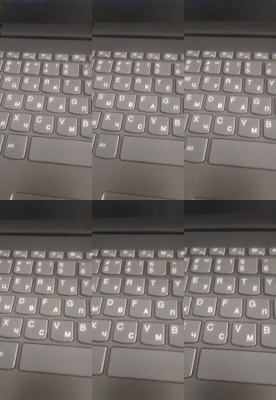
![The image presents a close-up, rotated view of the right-hand side of a computer keyboard, specifically focusing on the numeric keypad and adjacent functional keys. The keyboard is dark gray or black, suggesting a laptop.
**Subjects:** The primary subject is the keyboard itself. No people or other objects are explicitly visible.
**Activity or event:** No active event is depicted; the keyboard is static. Its presence implies potential future use for typing or data entry.
**Notable details:** The keyboard features a dual-language layout, displaying both Latin characters (e.g., 'Num Lock', 'Enter', 'Shift', 'Backspace', 'Delete', 'Home', 'End', 'PgUp', 'PgDn', numbers 0-9) and Cyrillic characters (e.g., 'Ъ', 'Э', 'X', and other smaller Cyrillic characters on number keys like 'Ч' on '7', 'Ш' on '8', 'Н' on '4', 'П' on '5', 'Е' on '1', 'Ц' on '2', 'Д' on '0'). This dual script is characteristic of regions like Uzbekistan, where both Latin and Cyrillic alphabets are in use, aligning with the specified location context of Urgench, Uzbekistan. A small white LED light is illuminated above the "Num Lock" key, indicating its active status. Some keys, like "Backspace" and "Enter," show minor signs of wear, and a few specks of dust are visible on the surface. The image is taken from an oblique angle, rotated approximately 90 degrees counter-clockwise.
**Visible text:** The keys display various words and symbols including: PrtSc, Insert, Delete, Backspace, Num Lock, Home, Enter, Shift, End, PgUp, PgDn, and numbers 0, 1, 2, 4, 5, 7, 8. Symbols like ÷, -, +, =, /, \, `, `, { }, [ ], <, >, ^, and arrow keys are also visible. Cyrillic characters such as Ъ, Э, and Х are also clearly present on certain keys.](https://firebasestorage.googleapis.com/v0/b/patr-3a75e.appspot.com/o/uploads%2Fimage_picker_e42e5a7f-212c-49d4-9.jpg?alt=media)
Stake attention in this memory
The image presents a close-up, rotated view of the right-hand side of a computer keyboard, specifically focusing on the numeric keypad and adjacent functional keys. The keyboard is dark gray or black, suggesting a laptop. **Subjects:** The primary subject is the keyboard itself. No people or other objects are explicitly visible. **Activity or event:** No active event is depicted; the keyboard is static. Its presence implies potential future use for typing or data entry. **Notable details:** The keyboard features a dual-language layout, displaying both Latin characters (e.g., 'Num Lock', 'Enter', 'Shift', 'Backspace', 'Delete', 'Home', 'End', 'PgUp', 'PgDn', numbers 0-9) and Cyrillic characters (e.g., 'Ъ', 'Э', 'X', and other smaller Cyrillic characters on number keys like 'Ч' on '7', 'Ш' on '8', 'Н' on '4', 'П' on '5', 'Е' on '1', 'Ц' on '2', 'Д' on '0'). This dual script is characteristic of regions like Uzbekistan, where both Latin and Cyrillic alphabets are in use, aligning with the specified location context of Urgench, Uzbekistan. A small white LED light is illuminated above the "Num Lock" key, indicating its active status. Some keys, like "Backspace" and "Enter," show minor signs of wear, and a few specks of dust are visible on the surface. The image is taken from an oblique angle, rotated approximately 90 degrees counter-clockwise. **Visible text:** The keys display various words and symbols including: PrtSc, Insert, Delete, Backspace, Num Lock, Home, Enter, Shift, End, PgUp, PgDn, and numbers 0, 1, 2, 4, 5, 7, 8. Symbols like ÷, -, +, =, /, \, `, `, { }, [ ], <, >, ^, and arrow keys are also visible. Cyrillic characters such as Ъ, Э, and Х are also clearly present on certain keys.
Loading AttnAds…
No transactions found