
Sign in
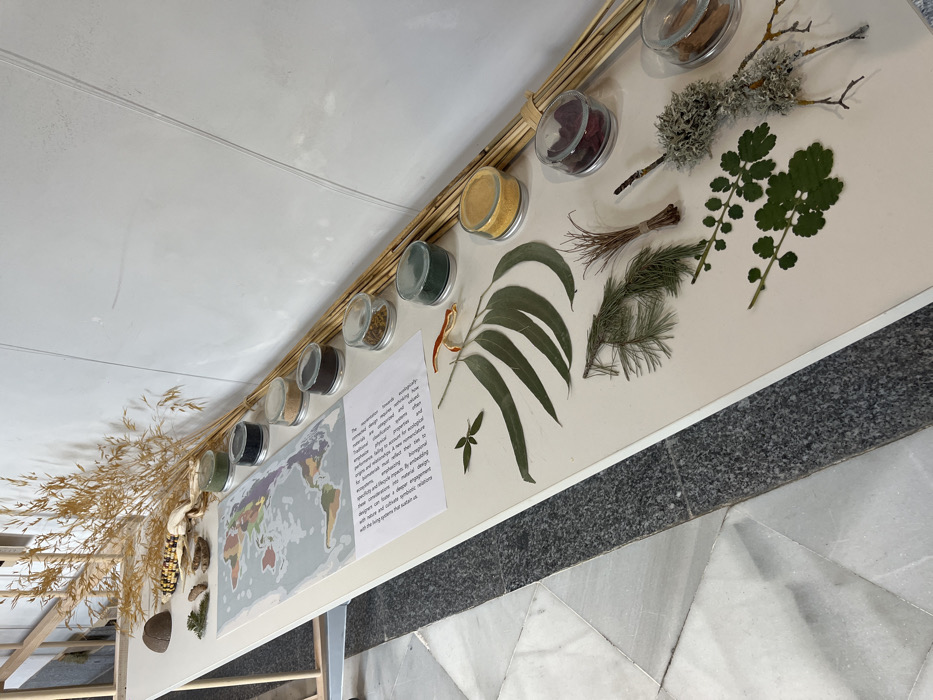
This media file captures a close-up of an educational or exhibition display featuring various natural materials, set up on a white tabletop. The display is arranged with an assortment of plant-based items and a world map.

On the left side, a bundle of dried, light-brown grasses and stalks extends upwards. Below this, on the table, are items like a dried ear of corn, a coconut half, and other small natural objects. A laminated world map is prominently placed, showing different colored regions, suggesting a focus on global resources or ecosystems.

To the right of the map, a series of small, clear glass jars with silver lids contain different finely ground or chopped natural materials, appearing as powders or small fragments, in various colors such as black, dark brown, light brown, green, and yellow. Another jar further to the right holds red, dried plant matter.

Alongside the jars and spread across the white surface are several distinct plant specimens: large, elongated green leaves resembling eucalyptus, bundles of pine needles, thinner dried twigs, and sprigs of green leaves that look like ferns or similar foliage. A small, lighter green leaf structure is also visible. Some long, thin, dried orange strips (possibly citrus peel or similar) are also present. Further to the right, a branch covered in lichen and another with dark green, lobed leaves are displayed.

A piece of white paper with text is placed between the jars and the plant specimens. The visible text reads: "The momentum towards ecologically oriented design requires rethinking how materials are integrated and used. Traditional design systems often emphasise physical properties and aesthetics, falling to account for ecological parameters. To develop a new nomenclature, designers must collect their ties to biomimicry, emphasizing the biosocial for environmental impacts. By embedding epigenetic and lifecycle impacts into design, these considerations may inspire designers can foster a deeper engagement with nature and cultivate symbiotic relations with the living systems that sustain us."

The setting appears to be indoors, possibly in a classroom, museum, or exhibition space, with a white ceiling visible at the top and a floor with grey granite and white marble tiles in a geometric pattern at the bottom. The overall impression is one of an informational exhibit designed to educate about natural materials and ecological design principles. The location context provided is Segovia, Spain.
FM-YafwI3

Feb 22, 2025, 2:33 PM

Segovia, Spain

Stake attention in this memory

This media file captures a close-up of an educational or exhibition display featuring various natural materials, set up on a white tabletop. The display is arranged with an assortment of plant-based items and a world map. On the left side, a bundle of dried, light-brown grasses and stalks extends upwards. Below this, on the table, are items like a dried ear of corn, a coconut half, and other small natural objects. A laminated world map is prominently placed, showing different colored regions, suggesting a focus on global resources or ecosystems. To the right of the map, a series of small, clear glass jars with silver lids contain different finely ground or chopped natural materials, appearing as powders or small fragments, in various colors such as black, dark brown, light brown, green, and yellow. Another jar further to the right holds red, dried plant matter. Alongside the jars and spread across the white surface are several distinct plant specimens: large, elongated green leaves resembling eucalyptus, bundles of pine needles, thinner dried twigs, and sprigs of green leaves that look like ferns or similar foliage. A small, lighter green leaf structure is also visible. Some long, thin, dried orange strips (possibly citrus peel or similar) are also present. Further to the right, a branch covered in lichen and another with dark green, lobed leaves are displayed. A piece of white paper with text is placed between the jars and the plant specimens. The visible text reads: "The momentum towards ecologically oriented design requires rethinking how materials are integrated and used. Traditional design systems often emphasise physical properties and aesthetics, falling to account for ecological parameters. To develop a new nomenclature, designers must collect their ties to biomimicry, emphasizing the biosocial for environmental impacts. By embedding epigenetic and lifecycle impacts into design, these considerations may inspire designers can foster a deeper engagement with nature and cultivate symbiotic relations with the living systems that sustain us." The setting appears to be indoors, possibly in a classroom, museum, or exhibition space, with a white ceiling visible at the top and a floor with grey granite and white marble tiles in a geometric pattern at the bottom. The overall impression is one of an informational exhibit designed to educate about natural materials and ecological design principles. The location context provided is Segovia, Spain.

Loading AttnAds…

transactions
revenues
stakers
Earliest
Latest
Highest stake

No transactions found

More from this user

More from Segovia

FM-YafwI3

Feb 22, 2025, 2:33 PM

Segovia, Spain

Licensed under Creative Commons Attribution 4.0 International License. You are free to share and adapt this content with proper attribution.