Sign in
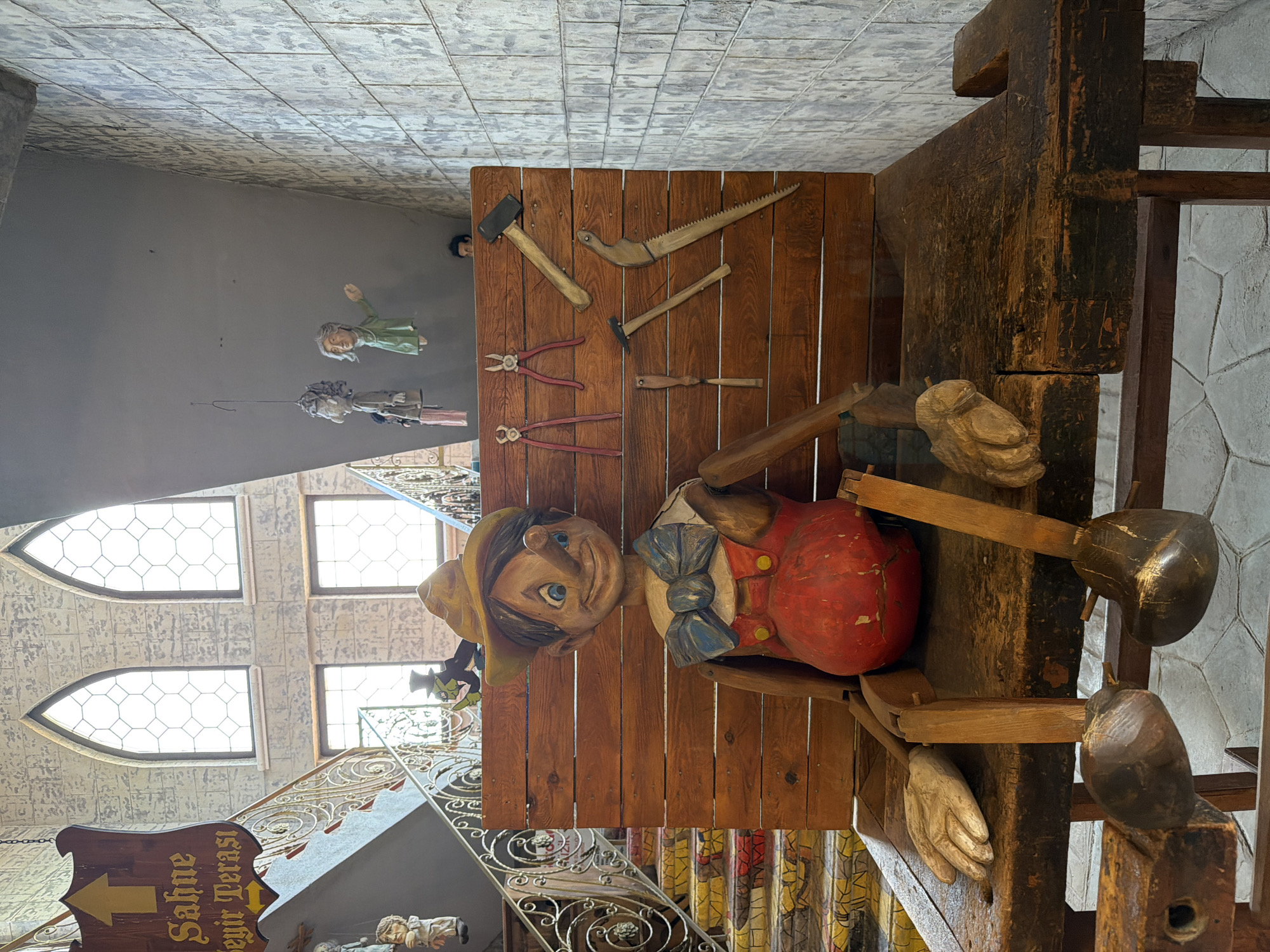
This image captures a whimsical interior scene, likely within a museum or themed attraction in Tepebaşı, Turkey, centered around the character of Pinocchio.

The primary subject is a large, partially assembled wooden Pinocchio figure displayed prominently on a rustic wooden workbench. Pinocchio is depicted with blue eyes, a cheerful expression, a yellow hat, a red vest, and a blue bow tie. His wooden legs and lower arms are separate, positioned near his torso, suggesting he is either mid-creation or presented in a disassembled state.

The workbench itself is made of dark wooden planks, and it serves as a display for various woodworking tools, mostly carved from wood. These include two hammers, two different types of hand saws, two pairs of pliers (one red-handled), a chisel-like tool, and a wooden mallet.

In the background, against a plain gray wall, two smaller puppet figures hang as if suspended from above. One puppet is a boy in a green tunic, and the other is a more generic figure with a manipulating stick or wire.

The setting features high ceilings and textured, light-colored walls, possibly stone or stucco. Bright daylight streams in through distinctive windows with geometric, hexagonal panes – some arched, some rectangular – suggesting it is daytime. An ornate, wrought-iron railing for stairs or a balcony is visible on the left, leading to an upper level. Part of a person's head is faintly visible peeking from behind the workbench on the right side, suggesting human presence in the space.

A brown wooden sign with a yellow arrow pointing left is visible in the lower left quadrant. It bears Turkish text that reads "Sahne" (Stage) and "Seyir Terası" (Observation Terrace), indicating directions within the building. The overall atmosphere evokes a sense of traditional craftsmanship and storytelling.
elysium

Apr 29, 2026

Tepebaşı, Turkey

Moment

Stake attention in this memory

nostalgic
whimsical
childlike
curious
playful

This image captures a whimsical interior scene, likely within a museum or themed attraction in Tepebaşı, Turkey, centered around the character of Pinocchio. The primary subject is a large, partially assembled wooden Pinocchio figure displayed prominently on a rustic wooden workbench. Pinocchio is depicted with blue eyes, a cheerful expression, a yellow hat, a red vest, and a blue bow tie. His wooden legs and lower arms are separate, positioned near his torso, suggesting he is either mid-creation or presented in a disassembled state. The workbench itself is made of dark wooden planks, and it serves as a display for various woodworking tools, mostly carved from wood. These include two hammers, two different types of hand saws, two pairs of pliers (one red-handled), a chisel-like tool, and a wooden mallet. In the background, against a plain gray wall, two smaller puppet figures hang as if suspended from above. One puppet is a boy in a green tunic, and the other is a more generic figure with a manipulating stick or wire. The setting features high ceilings and textured, light-colored walls, possibly stone or stucco. Bright daylight streams in through distinctive windows with geometric, hexagonal panes – some arched, some rectangular – suggesting it is daytime. An ornate, wrought-iron railing for stairs or a balcony is visible on the left, leading to an upper level. Part of a person's head is faintly visible peeking from behind the workbench on the right side, suggesting human presence in the space. A brown wooden sign with a yellow arrow pointing left is visible in the lower left quadrant. It bears Turkish text that reads "Sahne" (Stage) and "Seyir Terası" (Observation Terrace), indicating directions within the building. The overall atmosphere evokes a sense of traditional craftsmanship and storytelling.

transactions
revenues
stakers
Earliest
Latest
Highest stake

No transactions found

More from this user

More from Tepebaşı

elysium

Apr 29, 2026

Tepebaşı, Turkey

Licensed under Creative Commons Attribution 4.0 International License. You are free to share and adapt this content with proper attribution.