Sign in
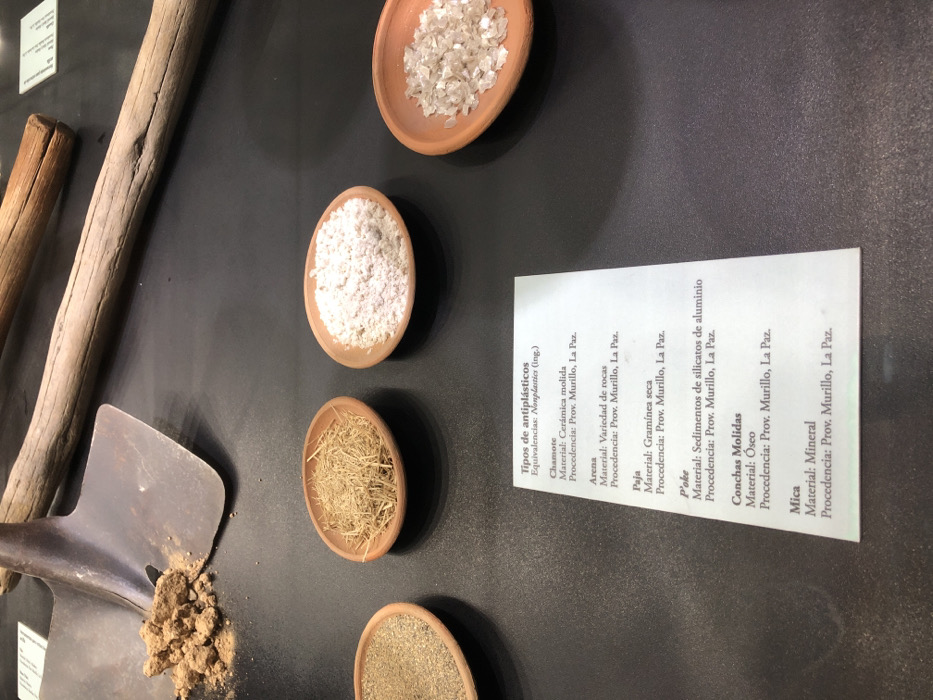
This image captures an indoor museum or educational exhibit, displaying various natural materials used as "antiplastics." The scene features a dark, possibly black, tabletop surface, upon which several items are arranged.

The primary subjects are multiple small, terracotta-colored bowls, each containing a different substance. From top to bottom, these include:
1. Translucent, flaky, light-colored material, likely mica.
2. Fine, white, powdery material, which appears to be ground ceramic (chamote).
3. Light brown, dried, fibrous material resembling chopped straw (paja).
4. A light brown to grayish granular material, possibly sand (arena) or aluminum silicate sediments (p'oke).
A fifth bowl is partially visible at the bottom, also containing granular material.

To the left, a metal shovel rests on the dark surface, with a small pile of light brown, earthy material scattered on and beside its blade. Behind the shovel, two long, light-colored wooden pieces, possibly tool handles or staffs, are visible.

A prominent white sign stands upright in the center-right of the frame, providing detailed information in Spanish. The title reads "Tipos de antiplásticos" (Types of antiplastics), followed by a list of materials: Chamote (ground ceramic), Arena (variety of rocks), Paja (dry grass), P'oke (aluminum silicate sediments), Conchas Molidas (ground shells/bone), and Mica (mineral). Each entry specifies the material and its provenance as "Prov. Murillo, La Paz," indicating the origin of these samples within Bolivia. The exhibit serves to educate viewers about these raw materials and their local sources, likely in the context of traditional crafts or construction.
MNela

Jan 9, 2025, 8:33 PM

La Paz, Bolivia

Stake attention in this memory

This image captures an indoor museum or educational exhibit, displaying various natural materials used as "antiplastics." The scene features a dark, possibly black, tabletop surface, upon which several items are arranged. The primary subjects are multiple small, terracotta-colored bowls, each containing a different substance. From top to bottom, these include: 1. Translucent, flaky, light-colored material, likely mica. 2. Fine, white, powdery material, which appears to be ground ceramic (chamote). 3. Light brown, dried, fibrous material resembling chopped straw (paja). 4. A light brown to grayish granular material, possibly sand (arena) or aluminum silicate sediments (p'oke). A fifth bowl is partially visible at the bottom, also containing granular material. To the left, a metal shovel rests on the dark surface, with a small pile of light brown, earthy material scattered on and beside its blade. Behind the shovel, two long, light-colored wooden pieces, possibly tool handles or staffs, are visible. A prominent white sign stands upright in the center-right of the frame, providing detailed information in Spanish. The title reads "Tipos de antiplásticos" (Types of antiplastics), followed by a list of materials: Chamote (ground ceramic), Arena (variety of rocks), Paja (dry grass), P'oke (aluminum silicate sediments), Conchas Molidas (ground shells/bone), and Mica (mineral). Each entry specifies the material and its provenance as "Prov. Murillo, La Paz," indicating the origin of these samples within Bolivia. The exhibit serves to educate viewers about these raw materials and their local sources, likely in the context of traditional crafts or construction.

Loading AttnAds…

transactions
revenues
stakers
Earliest
Latest
Highest stake

No transactions found

More from this user

More from La Paz

MNela

Jan 9, 2025, 8:33 PM

La Paz, Bolivia

Licensed under Creative Commons Attribution 4.0 International License. You are free to share and adapt this content with proper attribution.