
Sign in
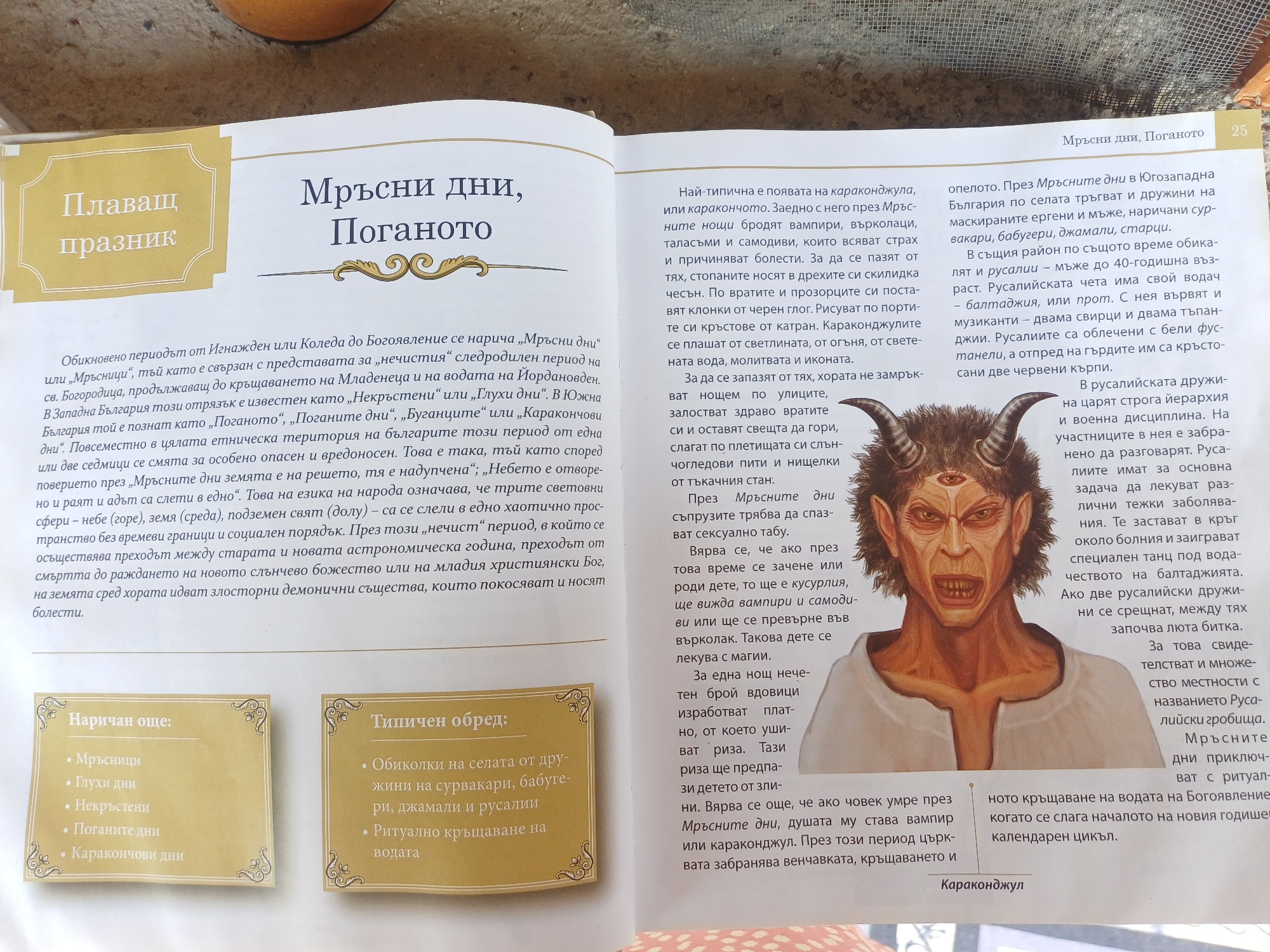
The image displays an open book, showcasing a page detailing Bulgarian folk traditions. The main title of the page is "Мръсни дни, Поганото" (Impure Days, Pagan), with a smaller header "Плаващ празник" (Floating Holiday/Feast) on the left. The page number "25" is visible at the top right.

The text describes a period in Bulgarian folklore, typically from Ignazhden (Christmas) to Epiphany (Yordanovden), referred to as "Impure Days" or "Pagan Days." This time is considered dangerous and chaotic, when the boundaries between heaven, earth, and the underworld blur, allowing malevolent demonic entities like vampires, werewolves, talasums, samodivi, and karakondjuls to roam.

The page includes an illustration of a red-skinned, horned, three-eyed demonic figure, labeled "Караконджул" (Karakondjul).

The text outlines various protective measures people take during this period, such as carrying garlic, placing blackthorn branches and tar crosses on doors, keeping candles lit, and using holy water. Other customs mentioned include a sexual taboo for married couples, with beliefs about children conceived during this time; a ritual where widows weave protective cloth; and prohibitions on weddings, baptisms, and funerals.

Two sidebars provide additional information:
*   "Наричан още:" (Also called:), listing alternative names for the period: "Мръсници" (Impure Ones), "Глухи дни" (Deaf Days), "Некръстени" (Unbaptized), "Поганите дни" (Pagan Days), "Каракончови дни" (Karakondjul Days).
*   "Типичен обред:" (Typical ritual:), listing "Обиколки на селата от дружини на сурвакари, бабугери, джамали и русалии" (Village processions by groups of survakari, babugeri, dzhamali, and rusalii) and "Ритуално кръщаване на водата" (Ritual baptism of water).

The text further details the "rusalii" tradition in Southwestern Bulgaria, where groups of up to 40-year-old men, led by a "baltadzhia" and accompanied by musicians (svirci and tapandjii), wear white fustanelas with red scarves and perform dances to heal the sick. The period concludes with the ritual baptism of water on Epiphany, marking the start of the new calendar year.
Krasimira Nikolova

Jun 4, 2026

Bregovo, Bulgaria

Moment

Stake attention in this memory

mysterious
creepy
foreboding
supernatural
traditional

The image displays an open book, showcasing a page detailing Bulgarian folk traditions. The main title of the page is "Мръсни дни, Поганото" (Impure Days, Pagan), with a smaller header "Плаващ празник" (Floating Holiday/Feast) on the left. The page number "25" is visible at the top right. The text describes a period in Bulgarian folklore, typically from Ignazhden (Christmas) to Epiphany (Yordanovden), referred to as "Impure Days" or "Pagan Days." This time is considered dangerous and chaotic, when the boundaries between heaven, earth, and the underworld blur, allowing malevolent demonic entities like vampires, werewolves, talasums, samodivi, and karakondjuls to roam. The page includes an illustration of a red-skinned, horned, three-eyed demonic figure, labeled "Караконджул" (Karakondjul). The text outlines various protective measures people take during this period, such as carrying garlic, placing blackthorn branches and tar crosses on doors, keeping candles lit, and using holy water. Other customs mentioned include a sexual taboo for married couples, with beliefs about children conceived during this time; a ritual where widows weave protective cloth; and prohibitions on weddings, baptisms, and funerals. Two sidebars provide additional information: * "Наричан още:" (Also called:), listing alternative names for the period: "Мръсници" (Impure Ones), "Глухи дни" (Deaf Days), "Некръстени" (Unbaptized), "Поганите дни" (Pagan Days), "Каракончови дни" (Karakondjul Days). * "Типичен обред:" (Typical ritual:), listing "Обиколки на селата от дружини на сурвакари, бабугери, джамали и русалии" (Village processions by groups of survakari, babugeri, dzhamali, and rusalii) and "Ритуално кръщаване на водата" (Ritual baptism of water). The text further details the "rusalii" tradition in Southwestern Bulgaria, where groups of up to 40-year-old men, led by a "baltadzhia" and accompanied by musicians (svirci and tapandjii), wear white fustanelas with red scarves and perform dances to heal the sick. The period concludes with the ritual baptism of water on Epiphany, marking the start of the new calendar year.

transactions
revenues
stakers
Earliest
Latest
Highest stake

No transactions found

More from this user

More from Bregovo

Krasimira Nikolova

Jun 4, 2026

Bregovo, Bulgaria

Licensed under Creative Commons Attribution 4.0 International License. You are free to share and adapt this content with proper attribution.