
Stake attention in this memory
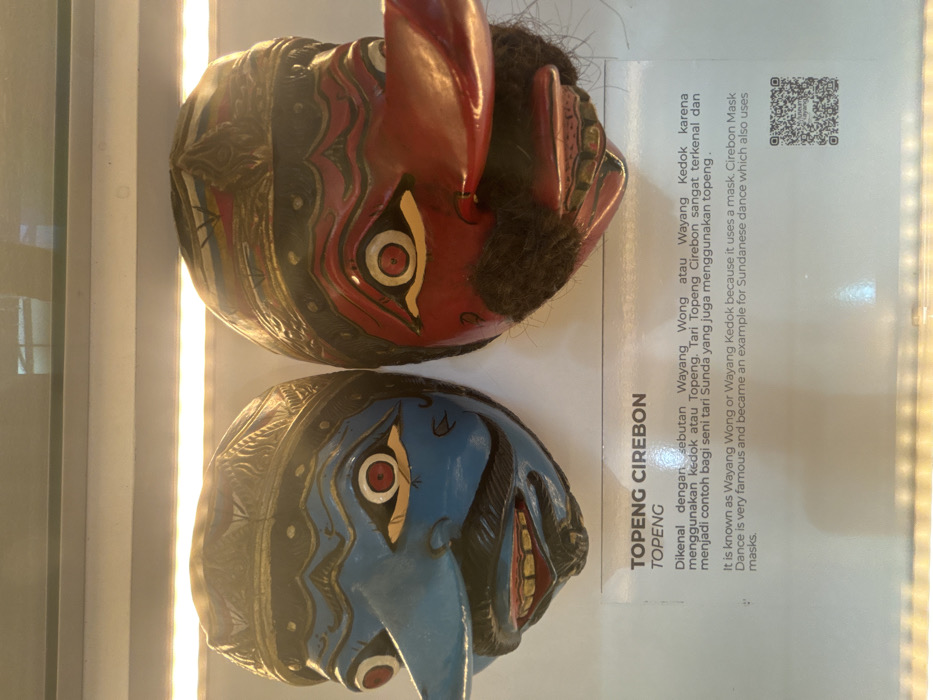
Two traditional Indonesian masks, likely carved from wood, are displayed horizontally, illuminated by a bright vertical light strip to their left. The image is rotated, making the masks appear on their sides and the accompanying text vertical. The upper mask is predominantly red, featuring stylized, wide-open eyes with white sclera, red irises, and black pupils. It has an elongated nose and an open mouth revealing teeth. Dark, fibrous material, resembling hair or fur, frames its face above the forehead and on the cheeks. Intricate patterns in black and gold adorn its forehead and cheeks. Below it, the second mask is primarily blue, also featuring stylized, wide-open eyes similar in design to the red mask. This blue mask has a distinctive, long, downward-pointing nose or beak-like feature. Its mouth is also open, revealing teeth. Similar intricate black and gold patterns decorate its forehead and cheeks. Both masks exhibit a somewhat intense or theatrical expression, characteristic of traditional performance masks. The masks are displayed against a light background, likely a wall or display case, with reflections visible from the lighting. A descriptive label is positioned to the right of the masks. The visible text identifies them as "TOPENG CIREBON." The Indonesian description states: "Dikenal dengan sebutan Wayang Wong atau Wayang Kedok karena menggunakan kedok atau Topeng. Tari Topeng Cirebon sangat terkenal dan menjadi contoh bagi seni tari Sunda yang juga menggunakan topeng." The English translation reads: "It is known as Wayang Wong or Wayang Kedok because it uses a mask. Cirebon Mask Dance is very famous and became an example for Sundanese dance which also uses masks." A QR code is also visible on the label. The setting is likely a museum, cultural exhibition, or gallery in West Jakarta, Indonesia, showcasing traditional Cirebon masks used in Sundanese dance.
Loading AttnAds…
No transactions found