Sign in
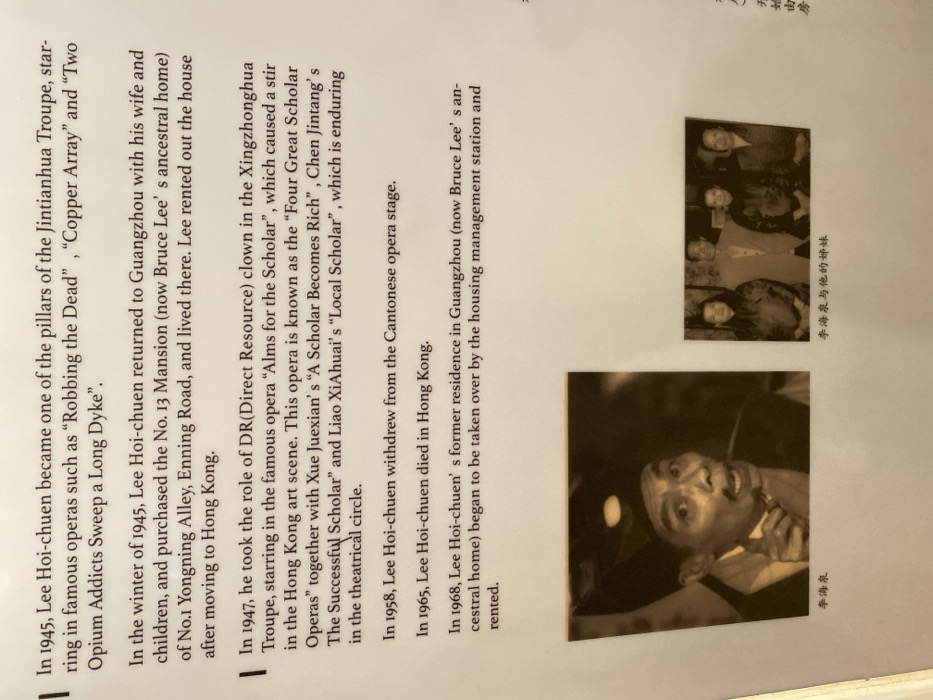
A tilted page from a book or document features biographical text about Lee Hoi-chuen, a Cantonese opera performer, alongside two sepia-toned photographs.

The text covers events from 1945 to 1968. It describes Lee Hoi-chuen as a pillar of the Jintianhua Troupe, starring in operas like "Robbing the Dead" and "Copper Array." In 1945, he returned to Guangzhou with his family, purchased the No. 13 Mansion on Enning Road (now Bruce Lee's ancestral home), and later rented it out after moving to Hong Kong. By 1947, he was a DR(Direct Resource) clown in the Xingzhonghua Troupe, known for his role in "Alms for the Scholar," an opera part of the "Four Great Scholar Operas." Lee Hoi-chuen withdrew from the Cantonese opera stage in 1958, died in Hong Kong in 1965, and his former Guangzhou residence was taken over by housing management in 1968.

The upper photograph is a group portrait featuring five individuals, identified by the caption "李海泉与他的姊妹" (Lee Hoi-chuen and his sisters). They are dressed in formal or traditional attire, posing for the camera, suggesting a family gathering or formal occasion.

The lower photograph is a close-up portrait of a man, identified as "李海泉" (Lee Hoi-chuen) by its caption. He has an animated expression, looking upwards with an open mouth, possibly captured during a performance or an expressive moment. Both photographs are sepia-toned, indicating their age, likely from the mid-20th century. The setting for the photos appears to be indoors.
F
FM-CaIMM2

Jan 4, 2025, 8:28 AM

Guang Zhou Shi, China

Stake attention in this memory

A tilted page from a book or document features biographical text about Lee Hoi-chuen, a Cantonese opera performer, alongside two sepia-toned photographs. The text covers events from 1945 to 1968. It describes Lee Hoi-chuen as a pillar of the Jintianhua Troupe, starring in operas like "Robbing the Dead" and "Copper Array." In 1945, he returned to Guangzhou with his family, purchased the No. 13 Mansion on Enning Road (now Bruce Lee's ancestral home), and later rented it out after moving to Hong Kong. By 1947, he was a DR(Direct Resource) clown in the Xingzhonghua Troupe, known for his role in "Alms for the Scholar," an opera part of the "Four Great Scholar Operas." Lee Hoi-chuen withdrew from the Cantonese opera stage in 1958, died in Hong Kong in 1965, and his former Guangzhou residence was taken over by housing management in 1968. The upper photograph is a group portrait featuring five individuals, identified by the caption "李海泉与他的姊妹" (Lee Hoi-chuen and his sisters). They are dressed in formal or traditional attire, posing for the camera, suggesting a family gathering or formal occasion. The lower photograph is a close-up portrait of a man, identified as "李海泉" (Lee Hoi-chuen) by its caption. He has an animated expression, looking upwards with an open mouth, possibly captured during a performance or an expressive moment. Both photographs are sepia-toned, indicating their age, likely from the mid-20th century. The setting for the photos appears to be indoors.

Loading AttnAds…

transactions
revenues
stakers
Earliest
Latest
Highest stake

No transactions found

More from this user

More from Guang Zhou Shi

FFM-CaIMM2

Jan 4, 2025, 8:28 AM

Guang Zhou Shi, China

Licensed under Creative Commons Attribution 4.0 International License. You are free to share and adapt this content with proper attribution.