Sign in
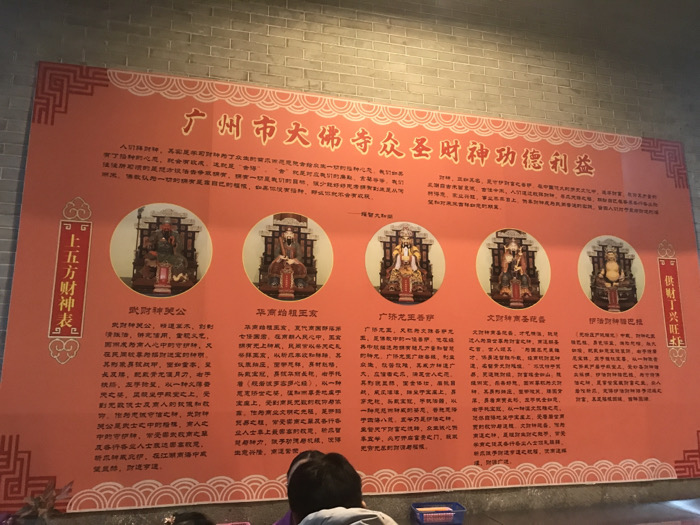
The image shows a large, rectangular red information board mounted on a light-colored brick wall, likely inside a temple or religious building. The board is titled "广州市大佛寺众圣财神功德利益" (Guangzhou City Dafo Temple - Merits and Benefits of the Holy Gods of Wealth).

The board provides an introduction to the concept of gods of wealth and then details five specific deities, each with an accompanying illustration of their statue. The text on the left border reads "上五方财神表" (Table of the Five Directions Gods of Wealth), and on the right border, "供财丁兴旺" (For prosperity in wealth and offspring).

The five deities described, from left to right, are:
1.  **武财神关公** (Martial God of Wealth Guan Gong): Depicted as a warrior, associated with integrity, loyalty, and protection, particularly for businessmen and those needing courage.
2.  **华夏始祖王亥** (Ancestor Wang Hai, founder of Huaxia): Considered an ancestor and god of commerce, bringing prosperity and good fortune in business.
3.  **广济龙王善萨** (Guangji Dragon King Bodhisattva): A powerful dragon king deity, revered for his ability to bring abundant wealth and good fortune across various domains.
4.  **文财神商圣范蠡** (Civil God of Wealth Fan Li, the Sage of Commerce): Known for his wisdom, business acumen, and strategic thinking, he brings wealth through intelligent enterprise.
5.  **伊沙伊姆巴拉** (Jambhala): An Indian/Tibetan Buddhist deity, worshipped for his blessings of wealth, prosperity, and financial stability.

Each deity's section includes a brief description of their appearance, attributes, and the specific benefits they bestow. The board also features decorative patterns along its borders. At the very bottom of the frame, parts of a few people's heads and shoulders are visible, suggesting visitors are viewing the display. The lighting appears artificial, indicating an indoor setting.
F
FM-qn0Jb2

Dec 9, 2024, 12:08 PM

Guang Zhou Shi, China

Stake attention in this memory

The image shows a large, rectangular red information board mounted on a light-colored brick wall, likely inside a temple or religious building. The board is titled "广州市大佛寺众圣财神功德利益" (Guangzhou City Dafo Temple - Merits and Benefits of the Holy Gods of Wealth). The board provides an introduction to the concept of gods of wealth and then details five specific deities, each with an accompanying illustration of their statue. The text on the left border reads "上五方财神表" (Table of the Five Directions Gods of Wealth), and on the right border, "供财丁兴旺" (For prosperity in wealth and offspring). The five deities described, from left to right, are: 1. **武财神关公** (Martial God of Wealth Guan Gong): Depicted as a warrior, associated with integrity, loyalty, and protection, particularly for businessmen and those needing courage. 2. **华夏始祖王亥** (Ancestor Wang Hai, founder of Huaxia): Considered an ancestor and god of commerce, bringing prosperity and good fortune in business. 3. **广济龙王善萨** (Guangji Dragon King Bodhisattva): A powerful dragon king deity, revered for his ability to bring abundant wealth and good fortune across various domains. 4. **文财神商圣范蠡** (Civil God of Wealth Fan Li, the Sage of Commerce): Known for his wisdom, business acumen, and strategic thinking, he brings wealth through intelligent enterprise. 5. **伊沙伊姆巴拉** (Jambhala): An Indian/Tibetan Buddhist deity, worshipped for his blessings of wealth, prosperity, and financial stability. Each deity's section includes a brief description of their appearance, attributes, and the specific benefits they bestow. The board also features decorative patterns along its borders. At the very bottom of the frame, parts of a few people's heads and shoulders are visible, suggesting visitors are viewing the display. The lighting appears artificial, indicating an indoor setting.

Loading AttnAds…

transactions
revenues
stakers
Earliest
Latest
Highest stake

No transactions found

More from this user

More from Guang Zhou Shi

FFM-qn0Jb2

Dec 9, 2024, 12:08 PM

Guang Zhou Shi, China

Licensed under Creative Commons Attribution 4.0 International License. You are free to share and adapt this content with proper attribution.