
Stake attention in this memory
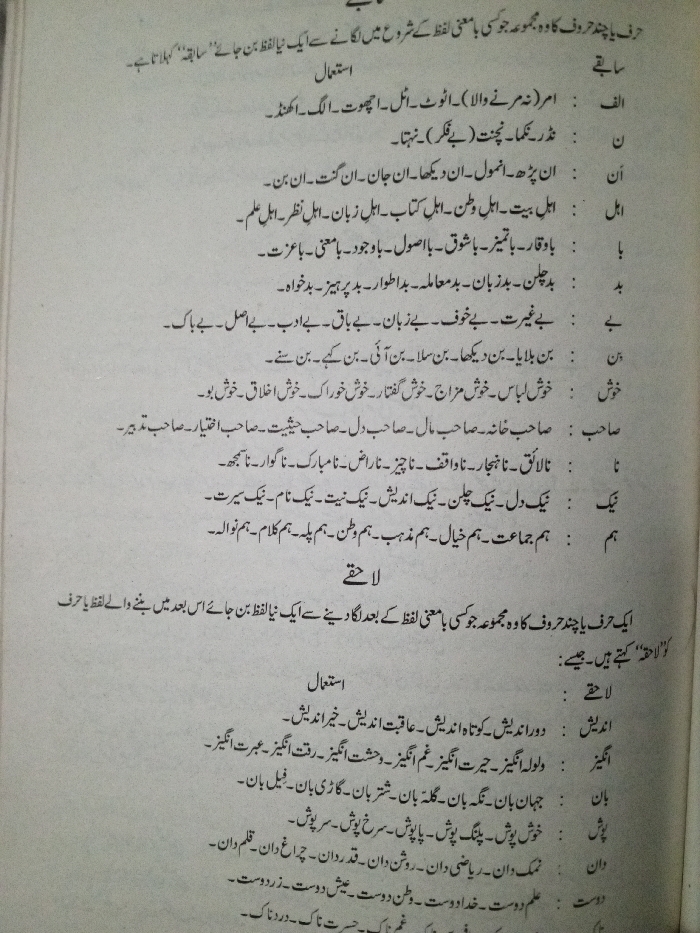
The image displays a close-up view of a printed page from an Urdu language textbook or educational material. The page is dedicated to explaining and providing examples of prefixes (سابقے) and suffixes (لاحقے). The upper section, titled 'سابقے' (Prefixes), begins with a definition in Urdu: 'A letter or a group of letters that, when added to the beginning of a meaningful word, forms a new word, is called a prefix.' Below this, various prefixes are listed with their corresponding example words. These include 'الف' (Alif) with words like امر (immortal); 'ن' (Noon) with نڈر (fearless); 'ان' (An) with ان پڑھ (illiterate); 'اہل' (Ahl) with اہلِ بیت (people of the house); 'با' (Ba) with باوقار (respectable); 'بد' (Bad) with بد چلن (ill-behaved); 'بے' (Be) with بے غیرت (shameless); 'بن' (Bin) with بن بلایا (uninvited); 'خوش' (Khush) with خوش لباس (well-dressed); 'صاحب' (Sahib) with صاحب خانہ (landlord); 'نا' (Na) with نالائق (incompetent); 'نیک' (Nek) with نیک دل (good-hearted); and 'ہم' (Ham) with ہم جماعت (classmate). The lower section, titled 'لاحقے' (Suffixes), also starts with a definition: 'A letter or a group of letters that, when added after a meaningful word, forms a new word or letter, is called a suffix.' This section provides examples of suffixes such as 'اندیش' (Andeesh) with دوراندیش (far-sighted); 'انگیز' (Angeez) with ولولہ انگیز (inspiring); 'بان' (Baan) with جہان بان (world-protector); 'پاش' (Pash) with خوش پوش (well-dressed); 'دان' (Daan) with نمک دان (salt shaker); 'دوست' (Dost) with علم دوست (knowledge-loving); and 'ناک' (Naak) with غم ناک (sad). The paper has a slightly off-white hue, and the text is printed in black ink. The overall appearance suggests a page from an educational resource, likely originating from Renala Khurd, Pakistan, designed to teach Urdu grammar and vocabulary.
Loading AttnAds…
No transactions found