
Stake attention in this memory
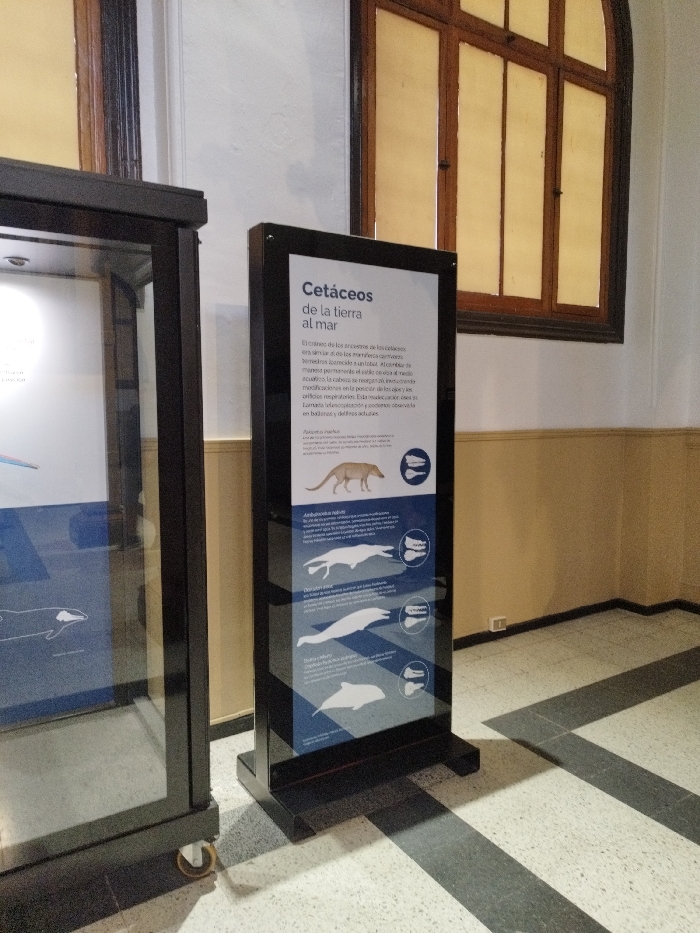
This media file captures an indoor scene, likely within a museum or exhibition hall in Santiago, Chile. The primary subject is a tall, black, freestanding display sign featuring information about cetaceans. To the left, part of a glass display case is visible, indicating an exhibition setting. In the background, a large wooden-framed window with multiple panes allows some natural light into the space, illuminating the beige-colored walls. The floor is tiled with a pattern of light and dark grey stripes. The display sign is titled "Cetáceos de la tierra al mar" (Cetaceans from land to sea). The accompanying text, mostly in Spanish, describes the evolutionary journey of cetaceans, detailing how the skulls of their ancestors, similar to terrestrial carnivorous mammals like wolves, underwent "telescopic" changes as they adapted to an aquatic environment. This evolution involved modifications in the position of the eyes and respiratory orifices, a process observable in modern whales and dolphins. Below the main text, a series of illustrations depicts different stages of cetacean evolution, each accompanied by its name and a diagram of its skull. From top to bottom, these illustrations show: 1. An early land-dwelling ancestor, labeled "Pakicetus," with its skull. 2. An early amphibious cetacean, labeled "Ambulocetus natans," also with its skull. 3. A more aquatic early cetacean, labeled "Dorudon atrox," and its skull. 4. A modern dolphin, labeled "Delfín actual," alongside its distinct skull. The lighting in the room appears to be a mix of natural light from the window and artificial light, creating shadows on the floor. No people are visible in the image.
No transactions found