
Sign in
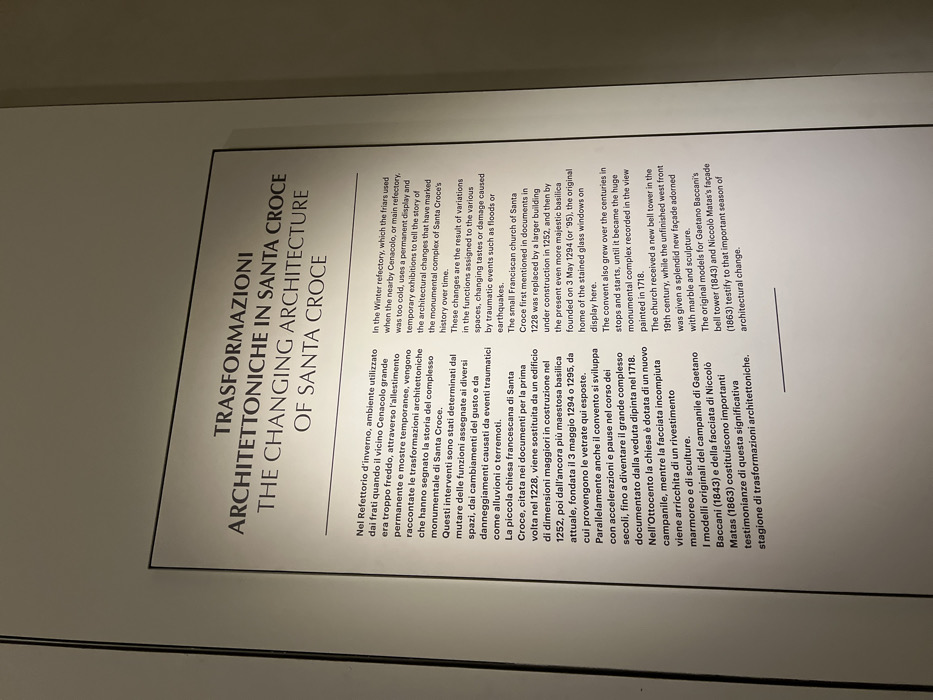
An informational panel, likely displayed in a museum or exhibition space in Firenze, Italy, presents text in both Italian and English. The panel is titled "TRASFORMAZIONI ARCHITETTONICHE IN SANTA CROCE / THE CHANGING ARCHITECTURE OF SANTA CROCE."

The text describes how the Winter Refectory at Santa Croce serves as a venue for exhibitions detailing the architectural evolution of the monumental complex. It explains that these transformations were driven by changes in function, aesthetic preferences, and damage from traumatic events such as floods or earthquakes. The panel chronicles the replacement of the original small Franciscan church (first mentioned in 1228) with a larger building in 1252, and subsequently with the current basilica, founded in 1294 or 1295. It also mentions the gradual expansion of the convent over centuries, forming the complex depicted in a 1718 painting. Notable additions in the 19th century include a new bell tower and the embellishment of the unfinished west façade with marble and sculpture. The text concludes by citing the original models for Gaetano Baccani's bell tower (1843) and Niccolò Matas's façade (1863) as significant testaments to this period of architectural change. The panel appears well-lit, typical of an indoor display.
FM-nv0sw2

Feb 5, 2025, 2:01 PM

Firenze, Italy

Stake attention in this memory

An informational panel, likely displayed in a museum or exhibition space in Firenze, Italy, presents text in both Italian and English. The panel is titled "TRASFORMAZIONI ARCHITETTONICHE IN SANTA CROCE / THE CHANGING ARCHITECTURE OF SANTA CROCE." The text describes how the Winter Refectory at Santa Croce serves as a venue for exhibitions detailing the architectural evolution of the monumental complex. It explains that these transformations were driven by changes in function, aesthetic preferences, and damage from traumatic events such as floods or earthquakes. The panel chronicles the replacement of the original small Franciscan church (first mentioned in 1228) with a larger building in 1252, and subsequently with the current basilica, founded in 1294 or 1295. It also mentions the gradual expansion of the convent over centuries, forming the complex depicted in a 1718 painting. Notable additions in the 19th century include a new bell tower and the embellishment of the unfinished west façade with marble and sculpture. The text concludes by citing the original models for Gaetano Baccani's bell tower (1843) and Niccolò Matas's façade (1863) as significant testaments to this period of architectural change. The panel appears well-lit, typical of an indoor display.

transactions
revenues
stakers
Earliest
Latest
Highest stake

No transactions found

More from this user

More from Firenze

FM-nv0sw2

Feb 5, 2025, 2:01 PM

Firenze, Italy

Licensed under Creative Commons Attribution 4.0 International License. You are free to share and adapt this content with proper attribution.