
Sign in
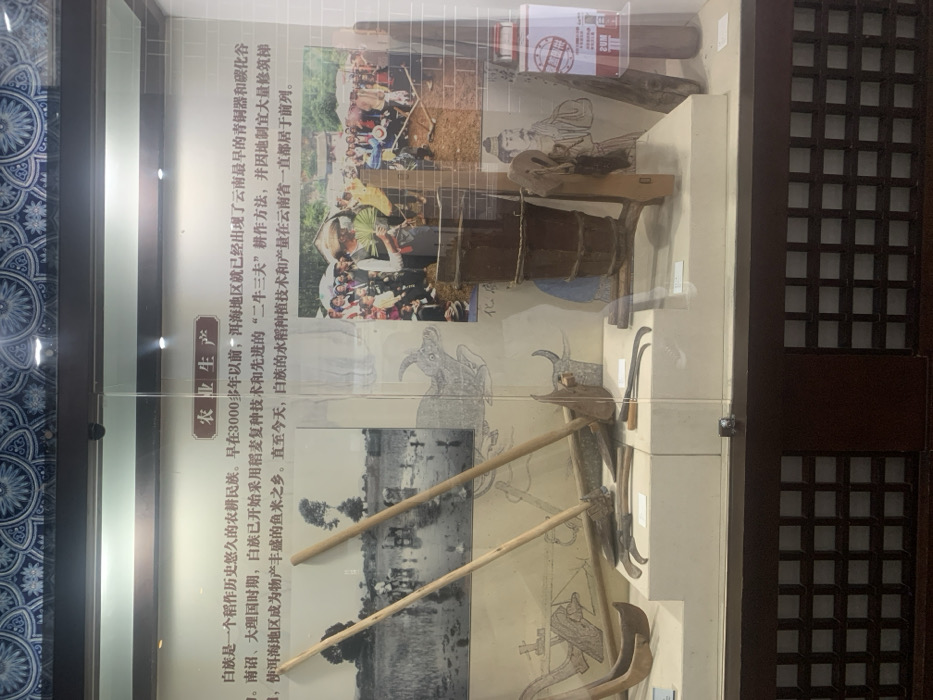
This image displays a museum exhibit dedicated to the "农业生产" (Agricultural Production) of the Bai ethnic group in Dali, China. The display case features a large text panel, historical photographs, and several traditional farming tools.

The text panel describes the Bai people as an agrarian group with a long history of rice cultivation. It states that the earliest bronzeware and carbonized grain in Yunnan appeared in the Erhai region over 3000 years ago. During the Nanzhao and Dali Kingdom periods, the Bai adopted advanced rice and wheat intercropping techniques and the "two oxen and three men" plowing method, alongside extensive irrigation systems, making the Erhai region a land of abundant fish and rice. The text highlights that Bai rice cultivation technology and yield remain at the forefront in Yunnan Province to this day.

Several visuals accompany the text: a large color photograph shows a gathering of people, some in traditional dress, in a field setting, suggesting a communal farming activity or celebration. An older, black-and-white photograph depicts a rural landscape with fields. Stylized line drawings, including an ox or water buffalo, are also visible on the back panel.

The physical artifacts in the exhibit include various wooden-handled agricultural tools such as hoes, sickles, and shovels. A wooden bucket and what appears to be a wooden sieve or winnower are also displayed. A small red label on one wooden item reads "正宗" (Authentic). The exhibit is presented in a glass case, showing some reflections, and is framed by a blue and white patterned wall on the left and a dark wooden lattice on the right.
Emma🇨🇳💕

Feb 1, 2025

Dali, China

Stake attention in this memory

This image displays a museum exhibit dedicated to the "农业生产" (Agricultural Production) of the Bai ethnic group in Dali, China. The display case features a large text panel, historical photographs, and several traditional farming tools. The text panel describes the Bai people as an agrarian group with a long history of rice cultivation. It states that the earliest bronzeware and carbonized grain in Yunnan appeared in the Erhai region over 3000 years ago. During the Nanzhao and Dali Kingdom periods, the Bai adopted advanced rice and wheat intercropping techniques and the "two oxen and three men" plowing method, alongside extensive irrigation systems, making the Erhai region a land of abundant fish and rice. The text highlights that Bai rice cultivation technology and yield remain at the forefront in Yunnan Province to this day. Several visuals accompany the text: a large color photograph shows a gathering of people, some in traditional dress, in a field setting, suggesting a communal farming activity or celebration. An older, black-and-white photograph depicts a rural landscape with fields. Stylized line drawings, including an ox or water buffalo, are also visible on the back panel. The physical artifacts in the exhibit include various wooden-handled agricultural tools such as hoes, sickles, and shovels. A wooden bucket and what appears to be a wooden sieve or winnower are also displayed. A small red label on one wooden item reads "正宗" (Authentic). The exhibit is presented in a glass case, showing some reflections, and is framed by a blue and white patterned wall on the left and a dark wooden lattice on the right.

transactions
revenues
stakers
Earliest
Latest
Highest stake

No transactions found

More from this user

More from Dali

Emma🇨🇳💕

Feb 1, 2025

Dali, China

Licensed under Creative Commons Attribution 4.0 International License. You are free to share and adapt this content with proper attribution.