Sign in
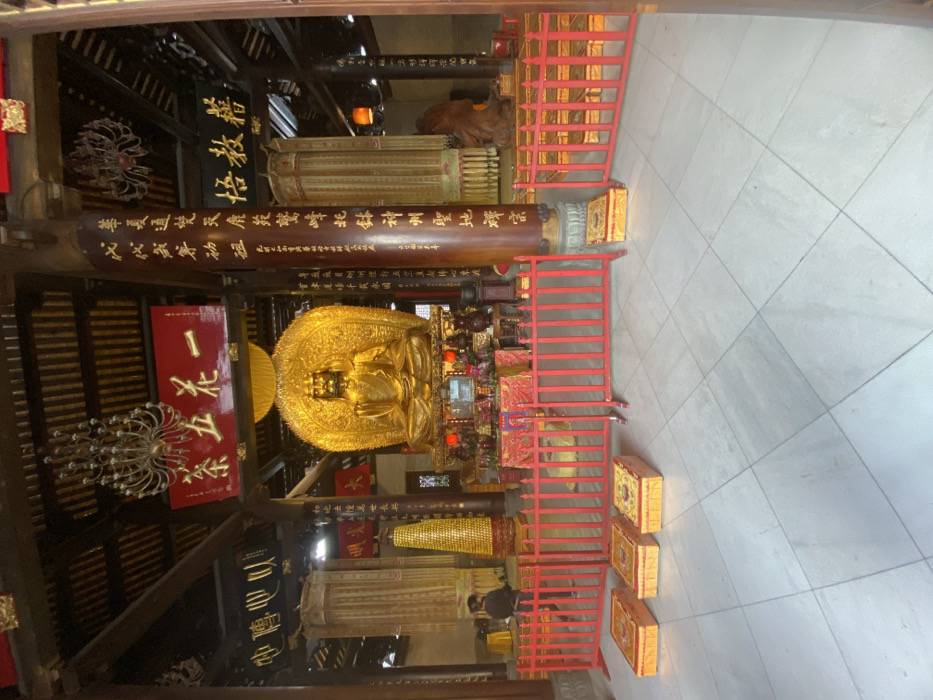
The image captures the interior of a Buddhist temple, likely located in Guang Zhou Shi, China. The central focus is a large, ornate golden statue of a seated Buddha, rendered with intricate details and backed by a radiant golden halo or mandorla. The Buddha appears to be in a meditative pose.

The setting is characterized by traditional Chinese temple architecture, featuring sturdy wooden pillars, some of which are inscribed with gilded Chinese characters. Overhead, complex wooden ceiling beams are visible, along with decorative chandeliers or lighting fixtures. A vibrant red plaque with gold Chinese characters hangs to the left of the Buddha statue. A red wooden fence or barrier runs across the foreground, separating the sacred area from the general viewing or congregational space. On the tiled floor beyond this barrier, several golden, decorative boxes are arranged, likely used for offerings or donations. A person is partially visible near the fence on the left, observing the scene.

The atmosphere conveyed is one of reverence and cultural richness. The lighting suggests an indoor setting during daylight hours, either naturally lit or illuminated by artificial means.

Visible Chinese text from various inscriptions includes:
- On a red plaque: "茶五花一" (Cha Wu Hua Yi).
- On a pillar: "明光證大" (Ming Guang Zheng Da) and "悟教善" (Wu Jiao Shan), as well as a longer inscription: "代代新年初祖" (Ancestors of the New Year generation by generation) followed by "華夏通梵天鹿苑鹫峰托鉢神州聖地禪宗" (China's connection to the Indian realms of Deer Park and Vulture Peak, alms-begging, the sacred land of China, Zen Buddhism).
- Another inscription reads: "傳我廠自辦理台五兰直是佛心東武" (My factory manages a five-orchid platform directly, embodying the Buddha's heart, eastern martial arts/region), which may contain colloquial or specific historical references.
F
FM-CaIMM2

Dec 19, 2024, 8:38 AM

Guang Zhou Shi, China

Stake attention in this memory

The image captures the interior of a Buddhist temple, likely located in Guang Zhou Shi, China. The central focus is a large, ornate golden statue of a seated Buddha, rendered with intricate details and backed by a radiant golden halo or mandorla. The Buddha appears to be in a meditative pose. The setting is characterized by traditional Chinese temple architecture, featuring sturdy wooden pillars, some of which are inscribed with gilded Chinese characters. Overhead, complex wooden ceiling beams are visible, along with decorative chandeliers or lighting fixtures. A vibrant red plaque with gold Chinese characters hangs to the left of the Buddha statue. A red wooden fence or barrier runs across the foreground, separating the sacred area from the general viewing or congregational space. On the tiled floor beyond this barrier, several golden, decorative boxes are arranged, likely used for offerings or donations. A person is partially visible near the fence on the left, observing the scene. The atmosphere conveyed is one of reverence and cultural richness. The lighting suggests an indoor setting during daylight hours, either naturally lit or illuminated by artificial means. Visible Chinese text from various inscriptions includes: - On a red plaque: "茶五花一" (Cha Wu Hua Yi). - On a pillar: "明光證大" (Ming Guang Zheng Da) and "悟教善" (Wu Jiao Shan), as well as a longer inscription: "代代新年初祖" (Ancestors of the New Year generation by generation) followed by "華夏通梵天鹿苑鹫峰托鉢神州聖地禪宗" (China's connection to the Indian realms of Deer Park and Vulture Peak, alms-begging, the sacred land of China, Zen Buddhism). - Another inscription reads: "傳我廠自辦理台五兰直是佛心東武" (My factory manages a five-orchid platform directly, embodying the Buddha's heart, eastern martial arts/region), which may contain colloquial or specific historical references.

Loading AttnAds…

transactions
revenues
stakers
Earliest
Latest
Highest stake

No transactions found

More from this user

More from Guang Zhou Shi

FFM-CaIMM2

Dec 19, 2024, 8:38 AM

Guang Zhou Shi, China

Licensed under Creative Commons Attribution 4.0 International License. You are free to share and adapt this content with proper attribution.