
Sign in
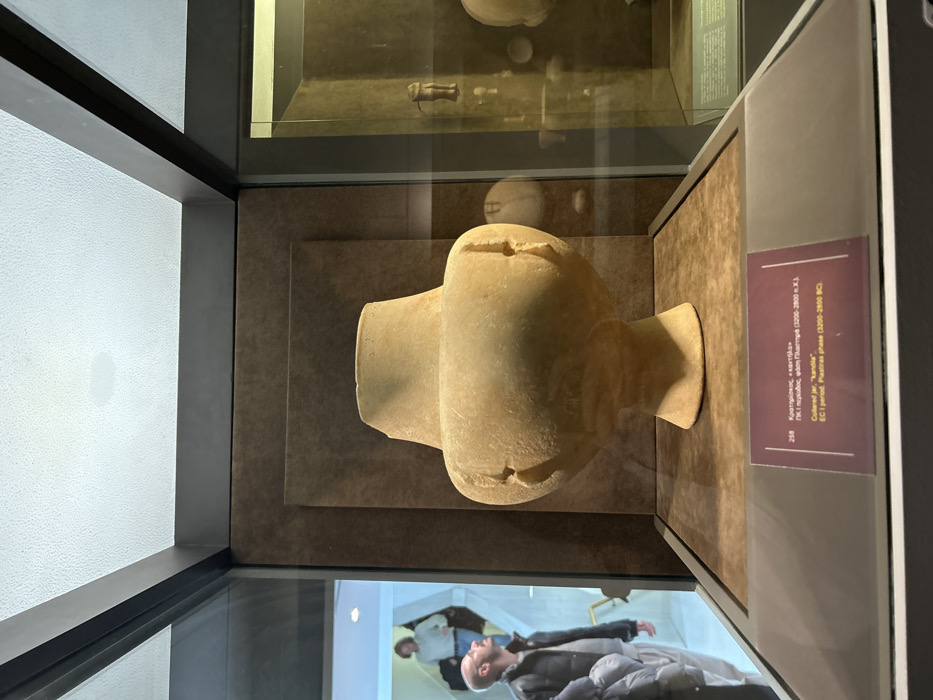
An ancient collared ceramic jar, referred to as a "kandia," is the central subject of this image, displayed horizontally within a well-lit museum exhibition case. The jar is made of light-colored pottery, showing some signs of age and minor cracks, particularly around its wider, central section. It rests on a multi-tiered, brown-hued stand inside the glass enclosure.

The polished glass of the display case reflects the surroundings, most prominently revealing two museum visitors in the lower half of the frame. One reflection clearly shows a man with a beard, wearing a dark jacket, looking down into the case. Behind him, another reflection, possibly of a woman or child, in a lighter top, is also visible. These reflections indicate an active museum environment where people are observing the exhibits.

To the right of the jar, a small information label is affixed to the case. The visible text provides details in both Greek and English: "258 Κρατηρίσκος, «καντήλα» ΠΚ Ι περίοδος, φάση πλαστηρα (3200-2800 π.Χ.). Collared jar, "kandia" EC I period, Plastiras phase (3200-2800 BC)." This identifies the artifact as dating from the Early Cycladic I period, specifically the Plastiras phase, between 3200 and 2800 BC.

Above the main display, another glass-encased exhibit is partially visible, showing smaller, less defined artifacts. The overall setting is indoors, likely a museum in Athina, Greece, characterized by artificial lighting and the reflective surfaces of display cases. The time of day is not discernible due to the indoor lighting.
FM-zLJPr2

Jan 11, 2025

Athina, Greece

Stake attention in this memory

An ancient collared ceramic jar, referred to as a "kandia," is the central subject of this image, displayed horizontally within a well-lit museum exhibition case. The jar is made of light-colored pottery, showing some signs of age and minor cracks, particularly around its wider, central section. It rests on a multi-tiered, brown-hued stand inside the glass enclosure. The polished glass of the display case reflects the surroundings, most prominently revealing two museum visitors in the lower half of the frame. One reflection clearly shows a man with a beard, wearing a dark jacket, looking down into the case. Behind him, another reflection, possibly of a woman or child, in a lighter top, is also visible. These reflections indicate an active museum environment where people are observing the exhibits. To the right of the jar, a small information label is affixed to the case. The visible text provides details in both Greek and English: "258 Κρατηρίσκος, «καντήλα» ΠΚ Ι περίοδος, φάση πλαστηρα (3200-2800 π.Χ.). Collared jar, "kandia" EC I period, Plastiras phase (3200-2800 BC)." This identifies the artifact as dating from the Early Cycladic I period, specifically the Plastiras phase, between 3200 and 2800 BC. Above the main display, another glass-encased exhibit is partially visible, showing smaller, less defined artifacts. The overall setting is indoors, likely a museum in Athina, Greece, characterized by artificial lighting and the reflective surfaces of display cases. The time of day is not discernible due to the indoor lighting.

transactions
revenues
stakers
Earliest
Latest
Highest stake

No transactions found

More from this user

More from Athina

FM-zLJPr2

Jan 11, 2025

Athina, Greece

Licensed under Creative Commons Attribution 4.0 International License. You are free to share and adapt this content with proper attribution.