Stake attention in this memory
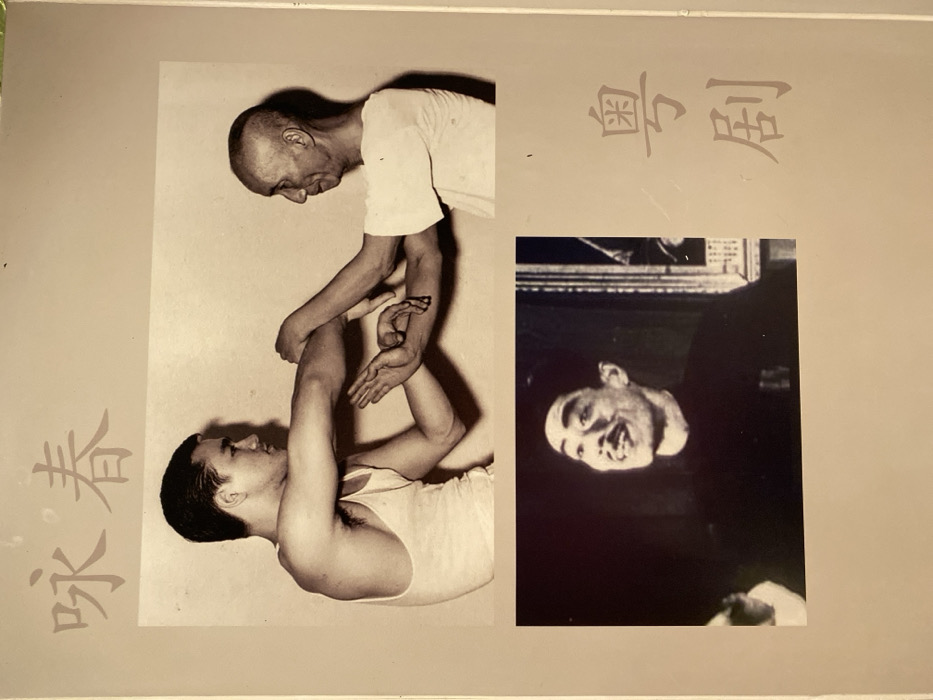
The image displays a collection of three distinct photographs and Chinese characters arranged on a light-colored surface. The central and largest photograph, rendered in sepia tone, captures two Asian men engaged in what appears to be a martial arts training session. An older, bald man, wearing a light short-sleeved top and with a focused expression, leans over a younger man dressed in a light sleeveless undershirt, who is reclined. Their arms are intertwined in a close-quarters grappling or "sticky hands" (Chi Sau) drill, characteristic of Wing Chun kung fu. The older man has a visible marking or tattoo on his left forearm. The setting is a minimalist indoor environment with a plain, light background, likely a dojo or training hall. To the right, a smaller, black and white photograph features an Asian man's head and upper chest, rotated ninety degrees clockwise. He is smiling broadly, with a joyful or amused expression. The background of this portrait is dark, with faint details suggesting an indoor setting with architectural elements or an ornate frame behind him. Faded Chinese characters are subtly visible on the light background of the overall image. On the far left, two vertical characters spell "詠春" (Yǒngchūn), directly referencing Wing Chun, the martial art depicted. On the top right, another pair of vertical characters reads "粵劇" (Yuèjù), meaning Cantonese Opera. The vintage aesthetic, implied by the sepia tone and photographic style, suggests the images are from the mid-20th century. The combination of Wing Chun and Cantonese Opera aligns culturally with Guang Zhou Shi, China.
Loading AttnAds…
No transactions found